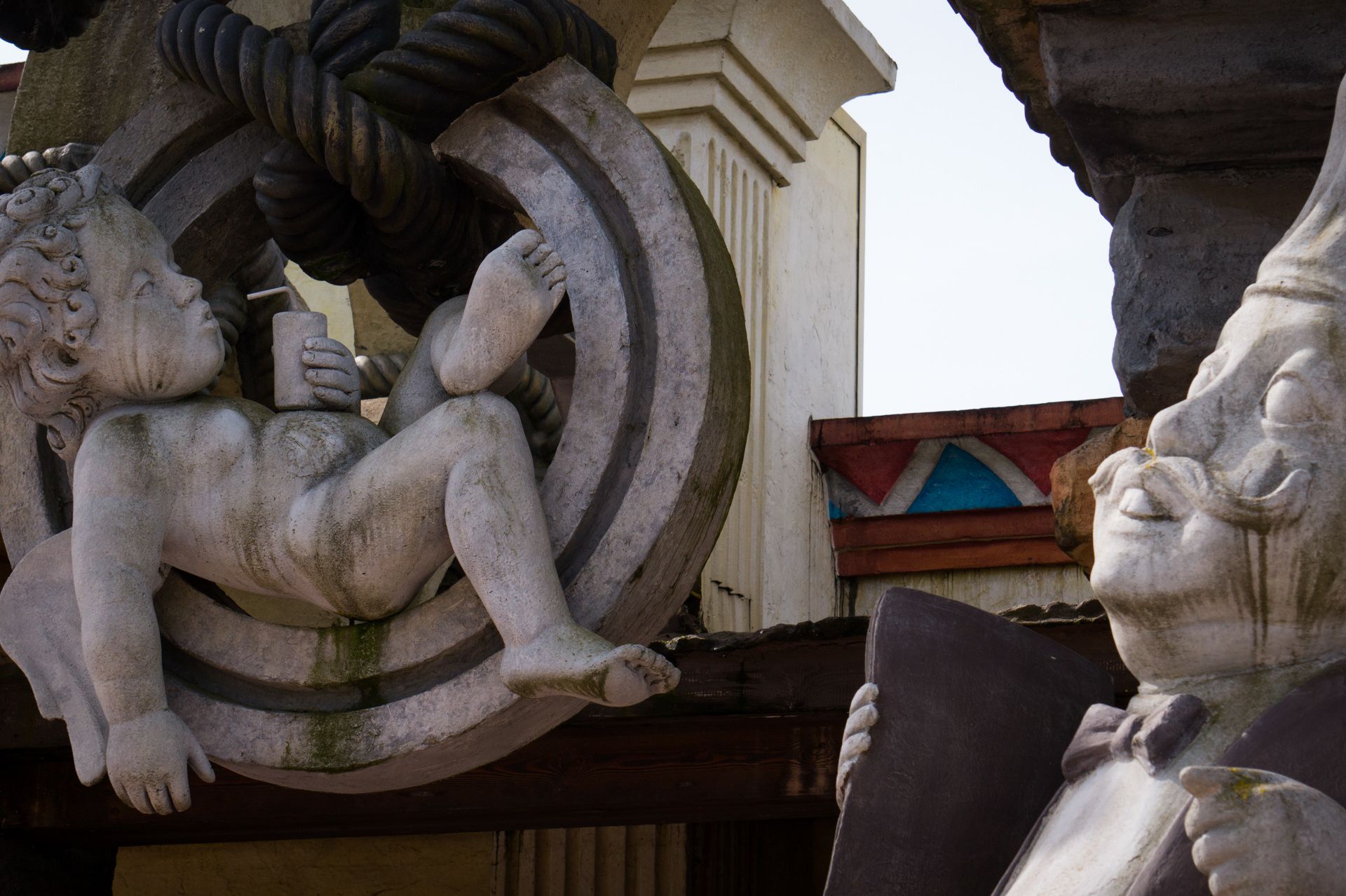
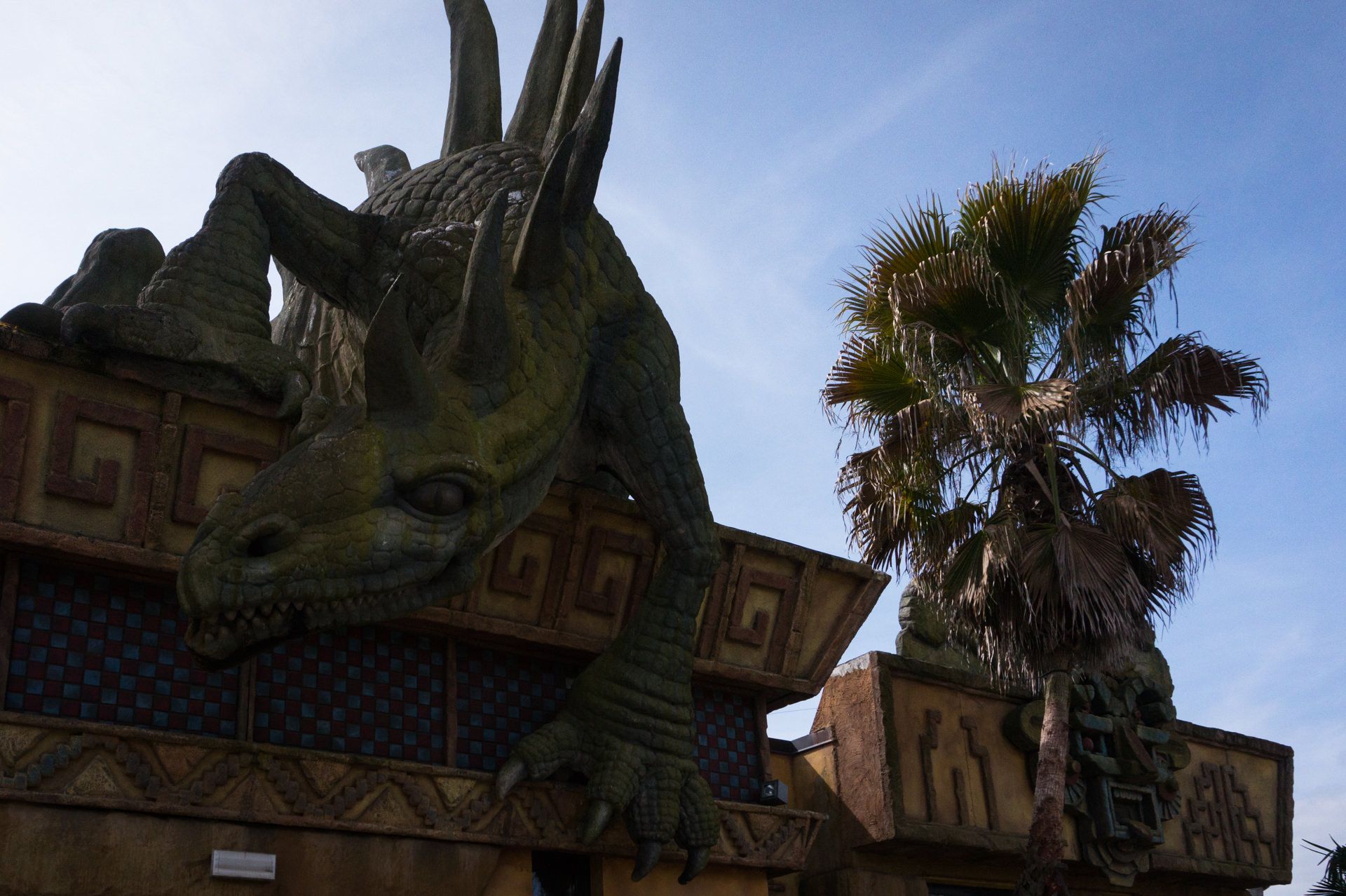
Busy times for Looney Tunes

Preface

Four years have passed to the day when I last walked through the gate of the Parque Warner Madrid theme park. At that time as part of a comprehensive tour of Spain with the, admittedly quite creative, name Coastern con Carne, now as the main reason to finally take a closer look at the Spanish capital Madrid. Decisive for this was the airline Norwegian Air Shuttle, which offers really low prices to Spain from Hamburg, as well as a meeting with Daniel (@Danieldikay), who is a student of the Spanish language and currently completing his compulsory stay in Zaragoza just 300 km away. The stay was booked through Travel Parks, the travel agency of Parques Reunidos, so we paid about 176€ for two nights in a Holiday Inn Express including breakfast and two entrances each for the Parque de Atracciones de Madrid and Parque Warner Madrid (each for up to 2 persons per ticket, as well as the possibility to go back to Parque Warner Madrid on the next day of the visit). A price that could hardly be lower without an annual ticket to one of the Parques Reunidos parks.

We stayed overnight in Alcorcón with good connections to the Cercanias Renfe, the suburban railway system of Spain, and the metro of Madrid. The journey to the Parque Warner Madrid turned out to be quite easy, only the departure from the park after midnight worried us. Via the central train station, and junction of all Cercanias Renfe, Atocha Cercanias, you can get to Pinto station quite quickly where you can take bus 413, which will take you directly to the park in a quarter of an hour. In the evening the bus takes you back to Pinto, where the last Cercanias Renfe back to Madrid leaves at 23:48. Another alternative had to be found, so we took the bus 412 to Villaverde Bajo-Cruce and got into the metro, which is still running until shortly after 2 o’clock.

Parque Warner Madrid

Theatro Chino 3D

After passing through the entrance gate you will find yourself on Hollywood Boulevard, the main street of the park. Here you will find some shops, some restaurants and the Theatro Chino 3D, a replica of the famous TCL Chinese Theatre on Hollywood Boulevard in Los Angeles. Besides the film Coyote y Correcaminos (a compilation of the last Road Runner and Wile E. Coyote cartoons), the film Marvin el Marciano en 3D (Marvin the Martian in the third dimension) is also shown here; especially the second film should not be unknown to visitors of the former Warner Bros. Movie World Germany near Bottrop Kirchhellen. It is about Daffy Duck and Marvin the Martian, and is of a surprisingly good quality for its age, especially with regard to the effects used. The film always looks like an old Looney Tunes cartoon and the story of it can entertain you very well.

 Oso Yogui and Cine Tour
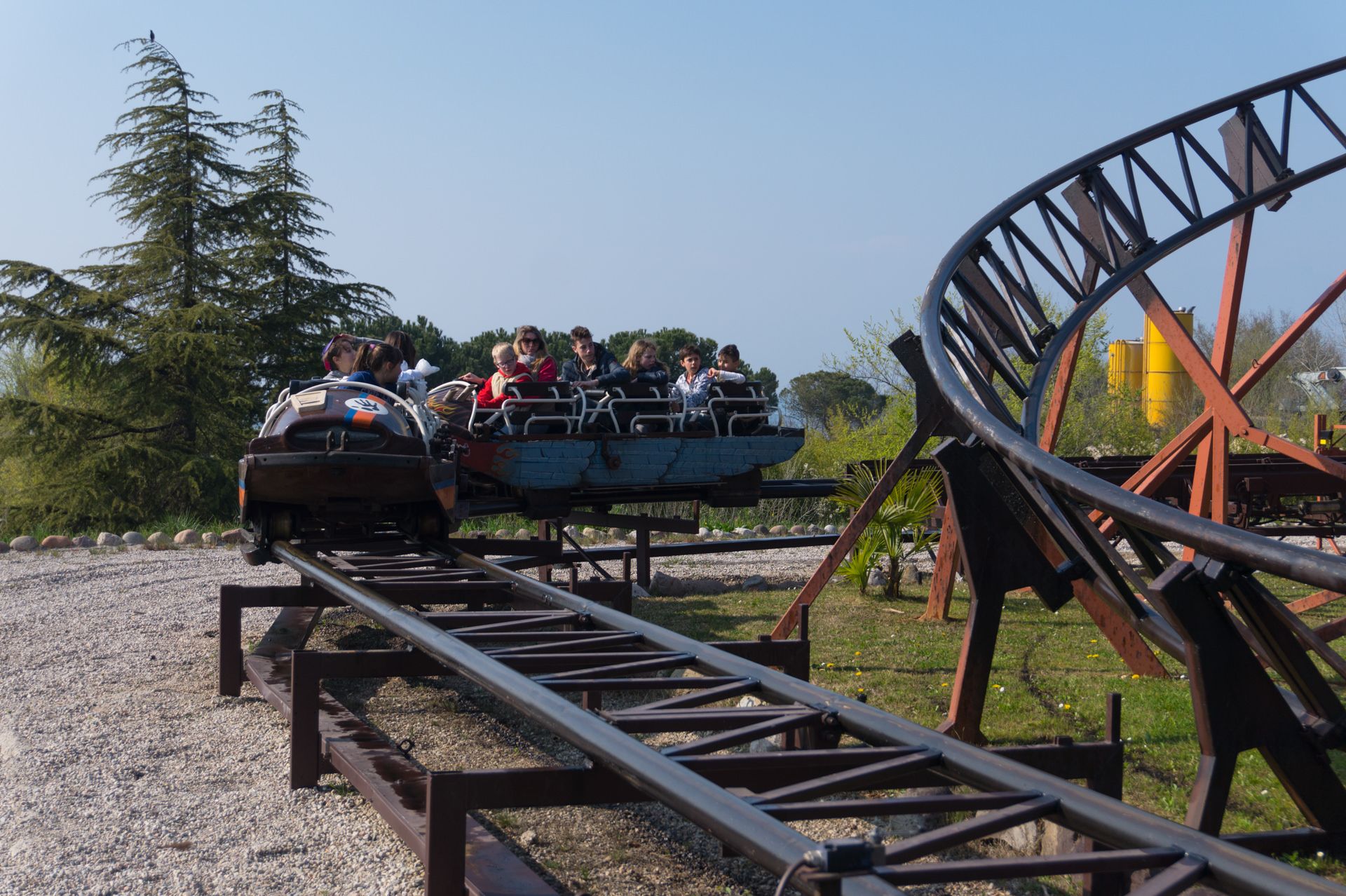
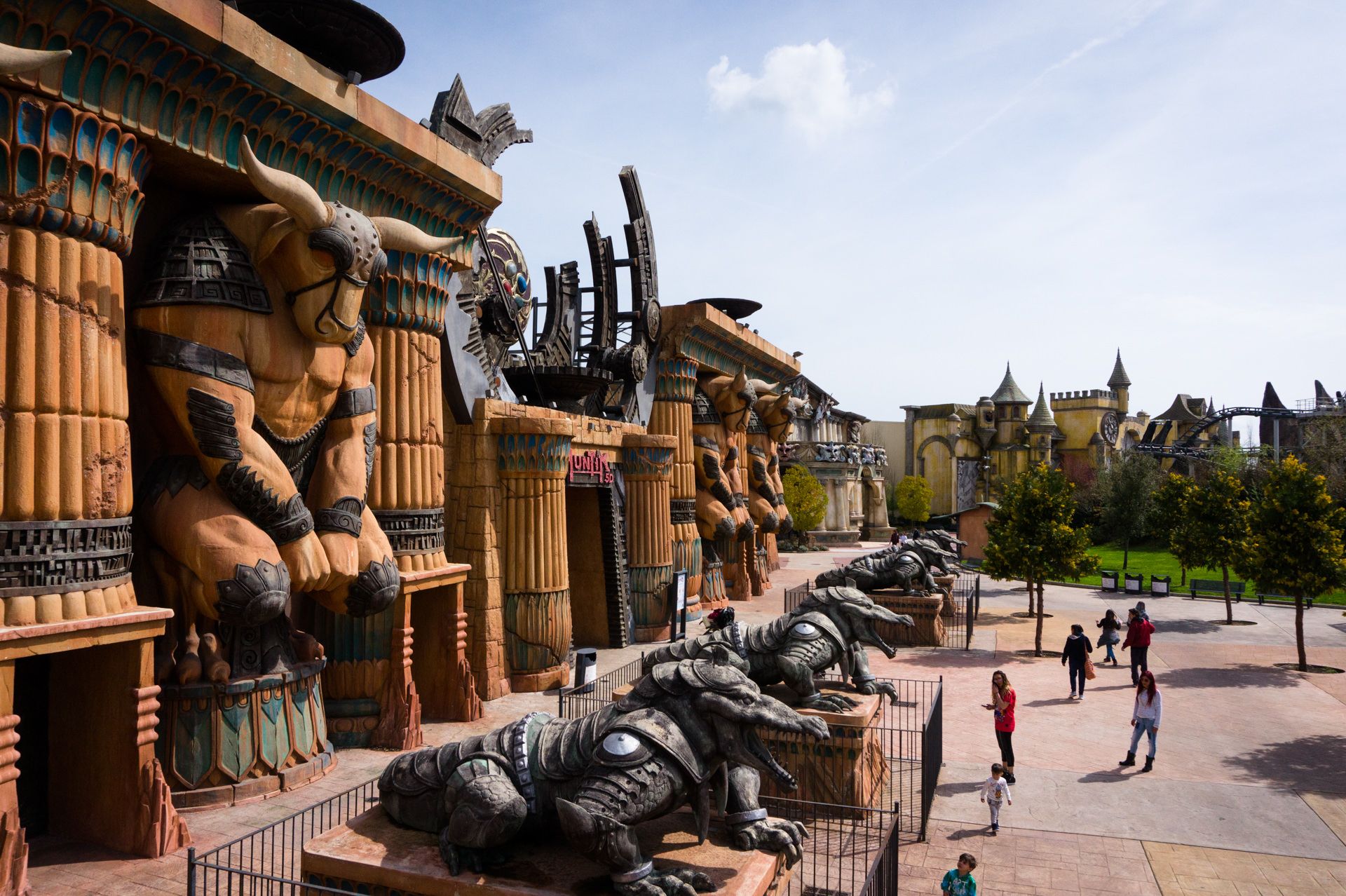
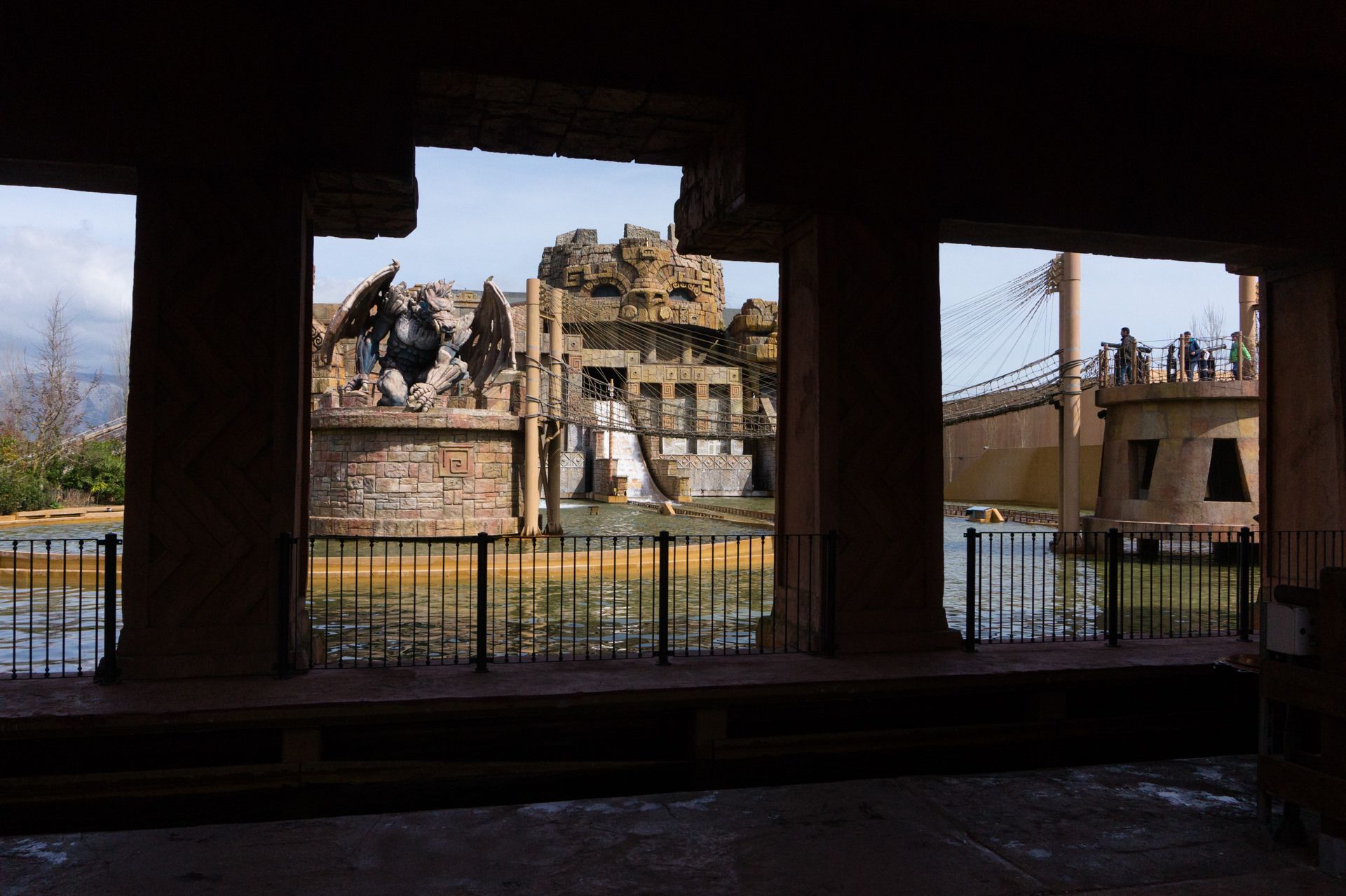
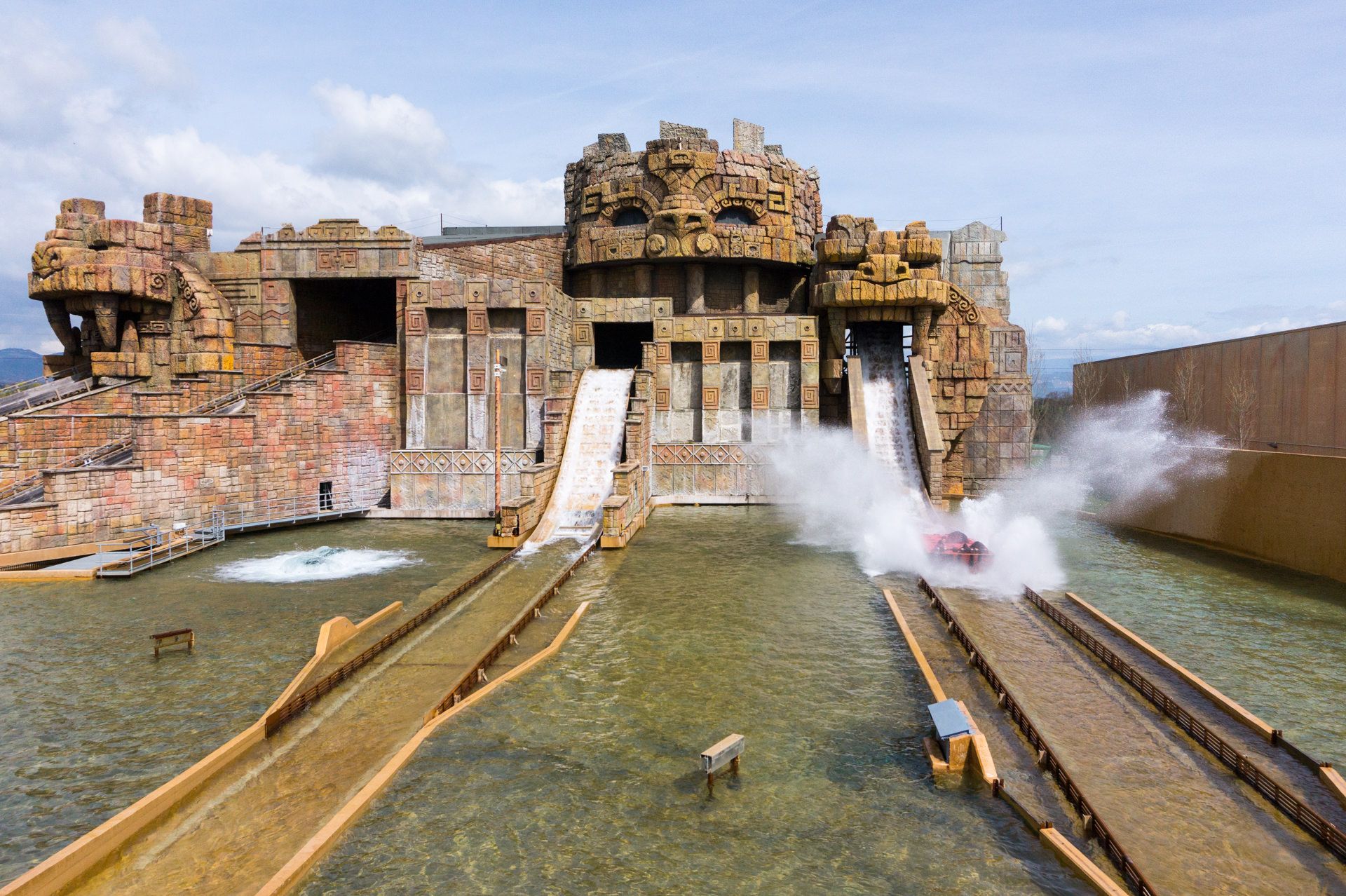
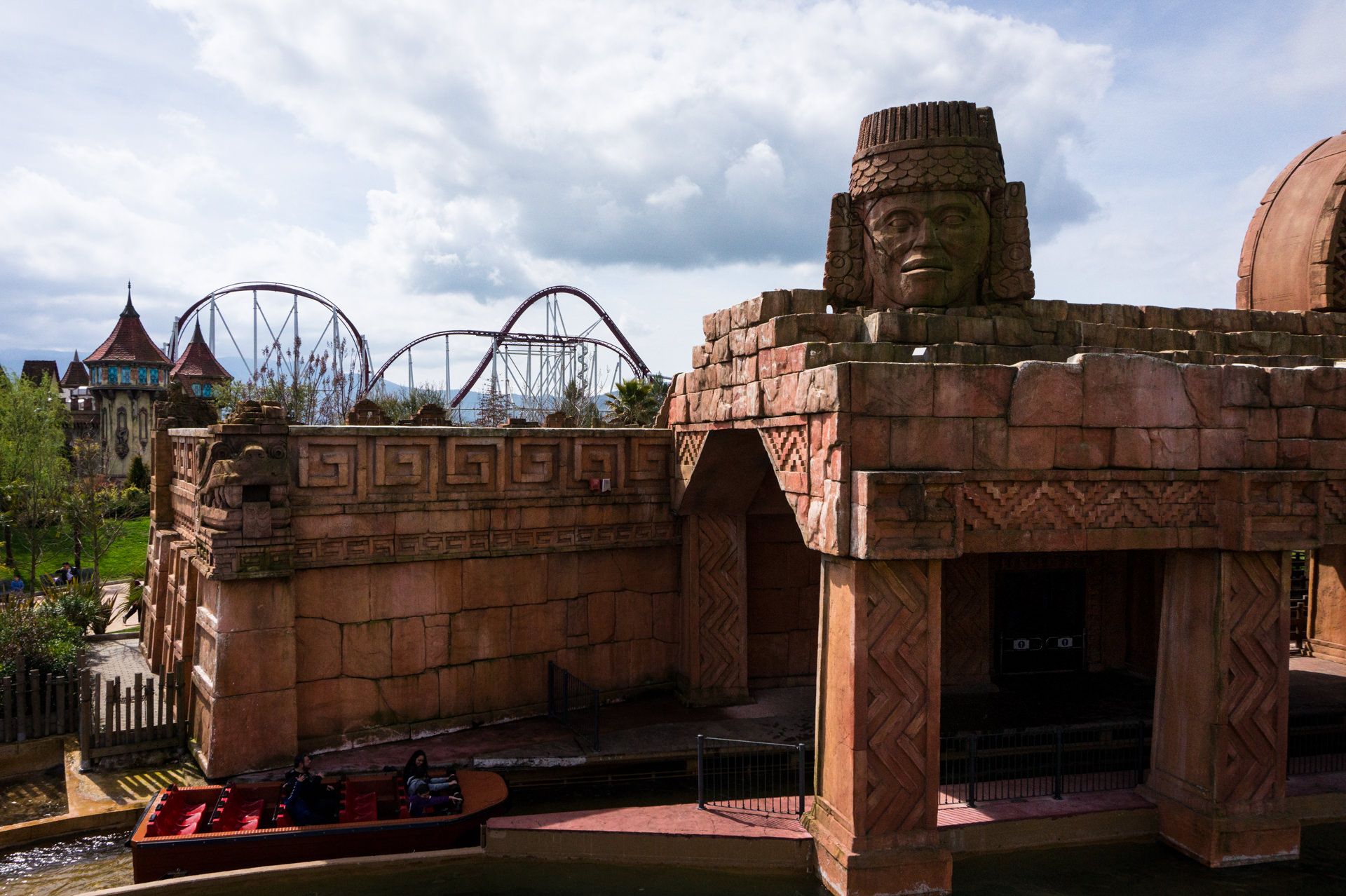
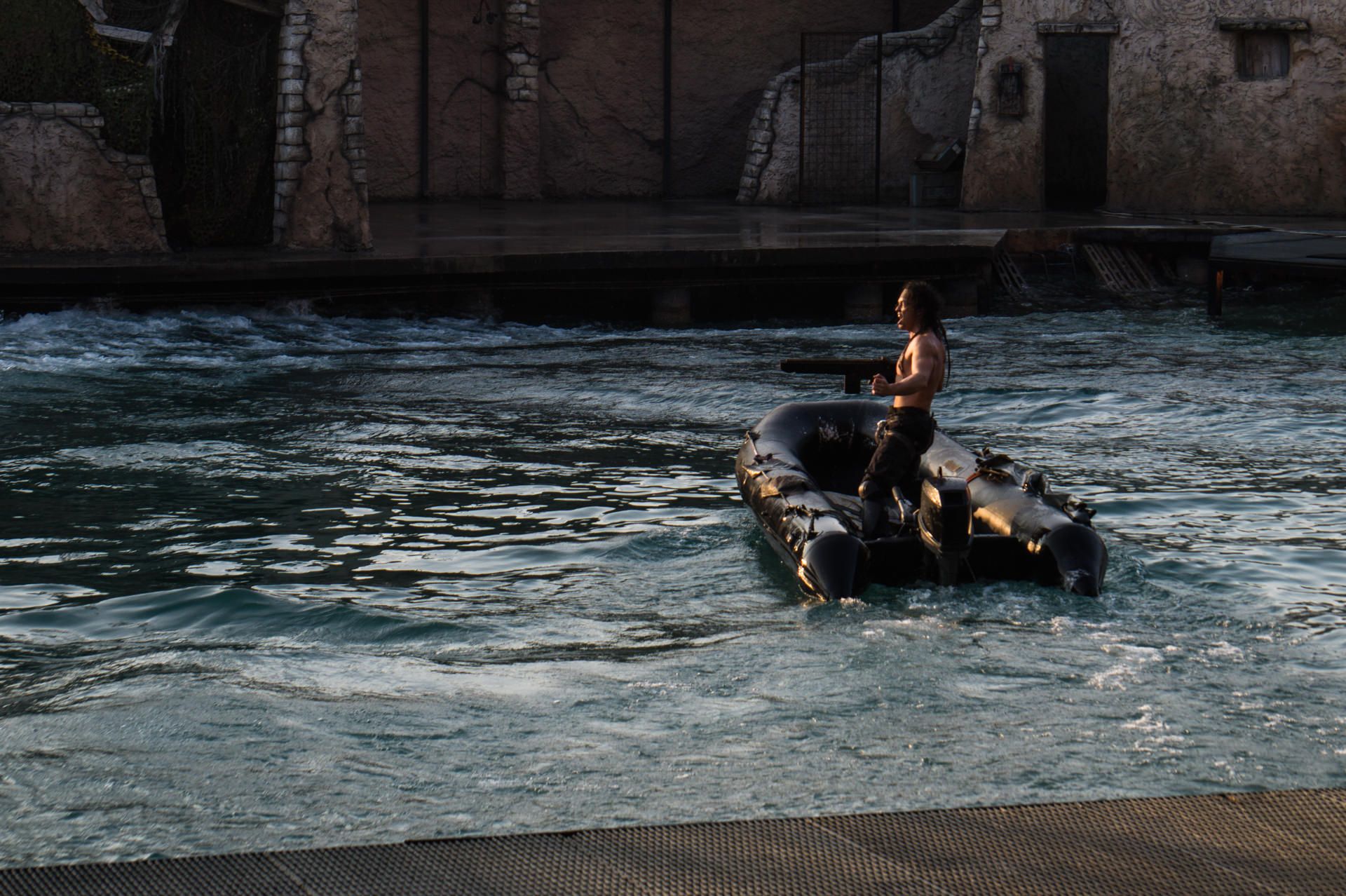
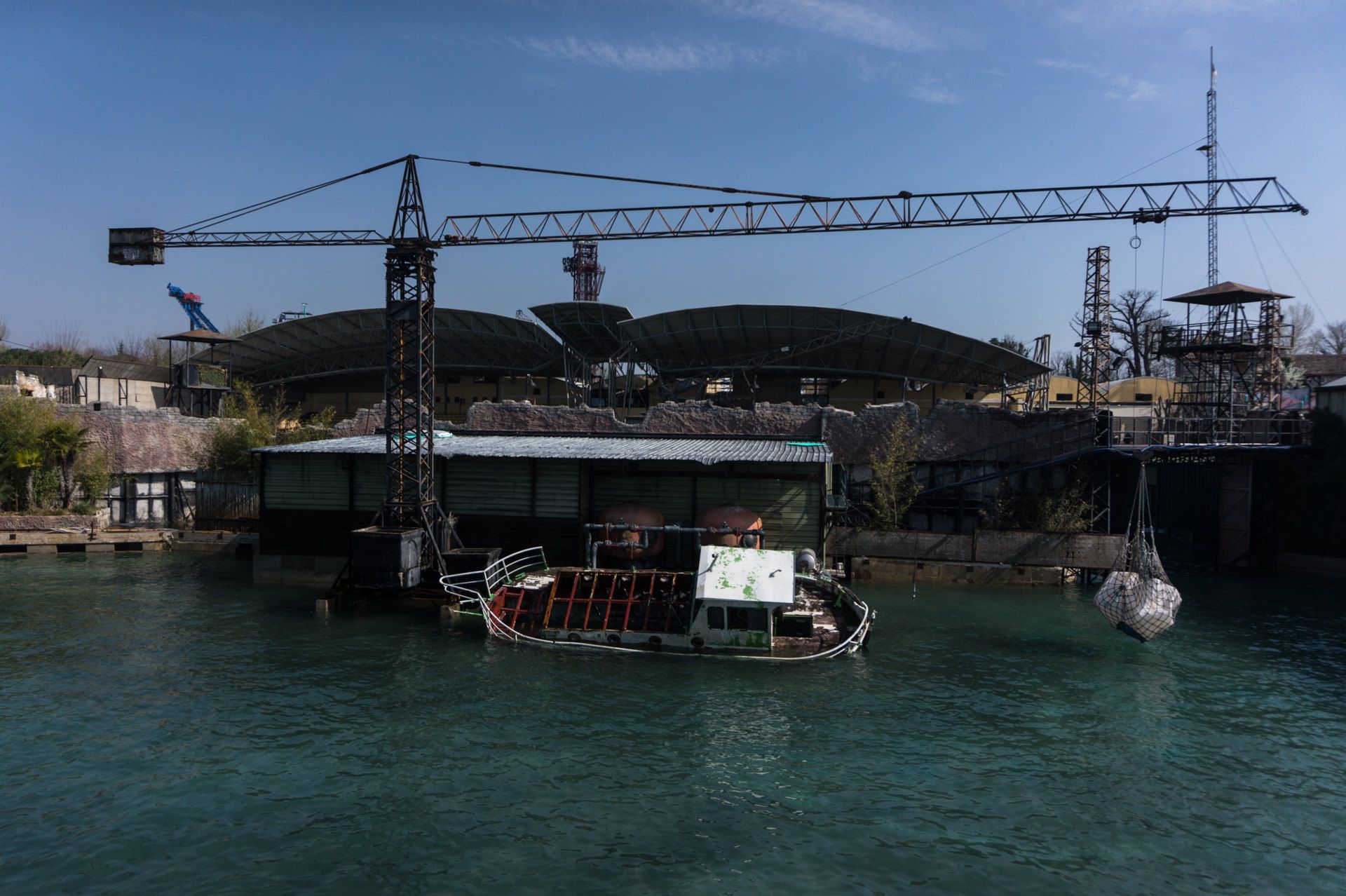
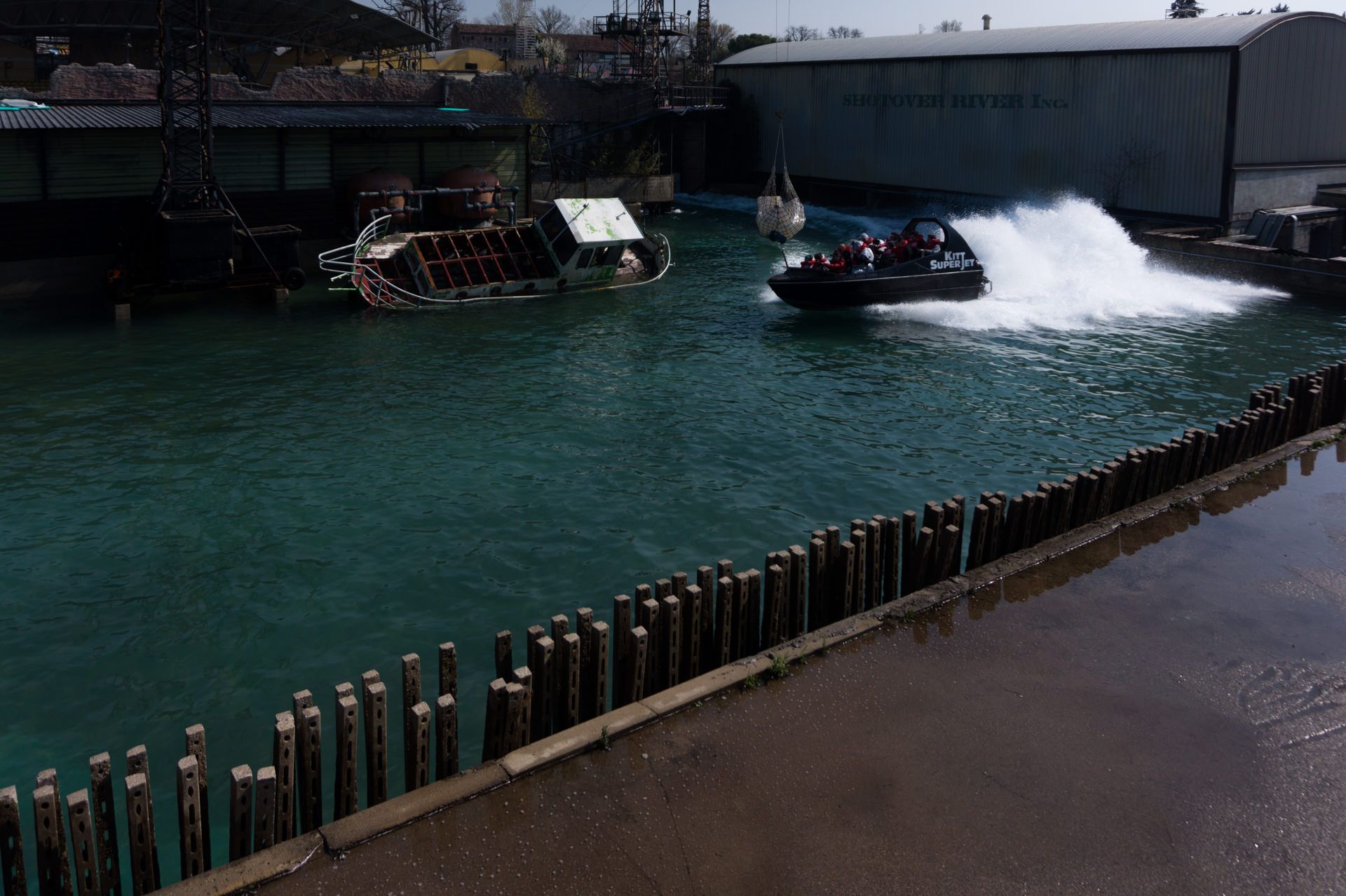
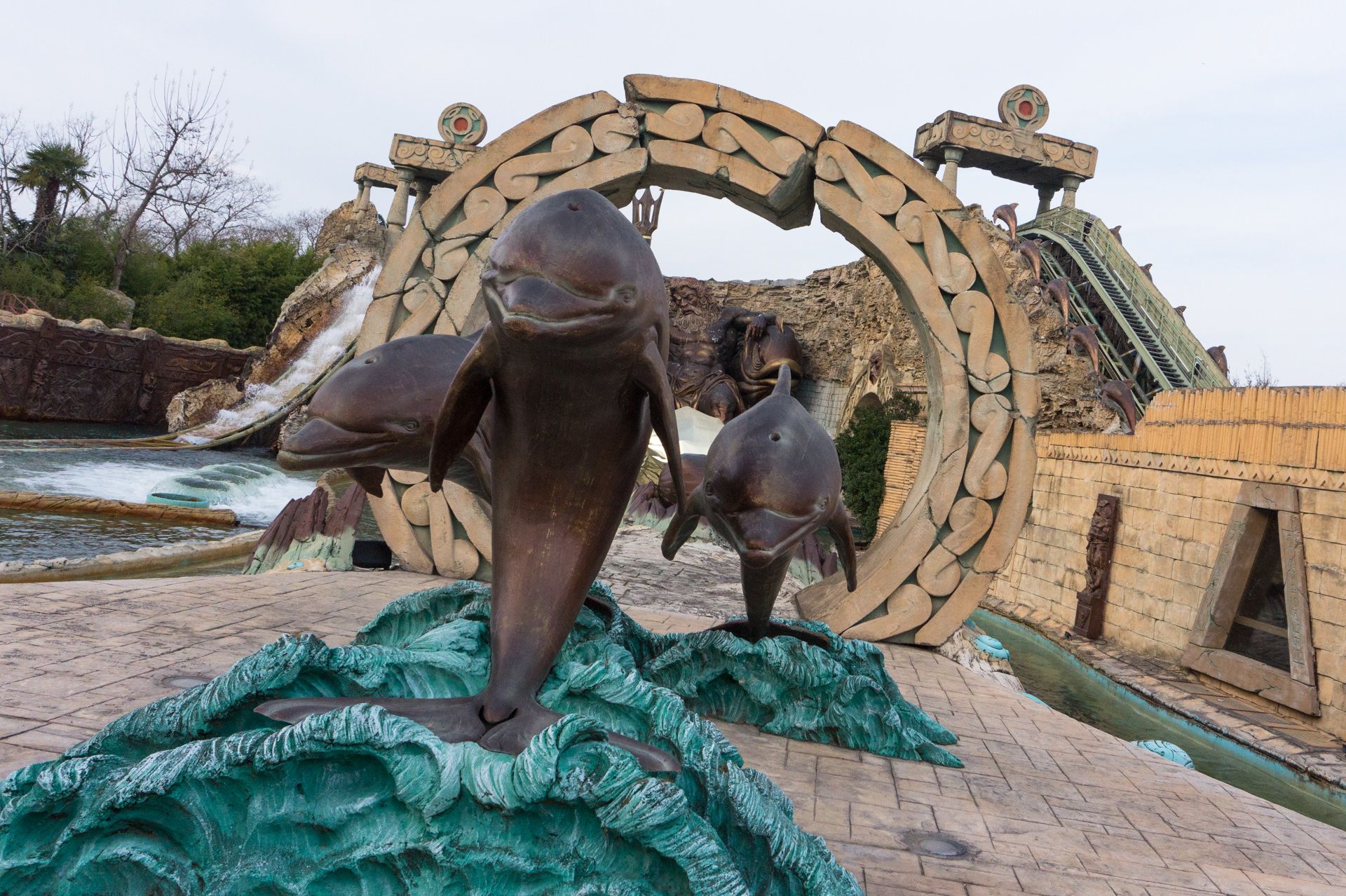
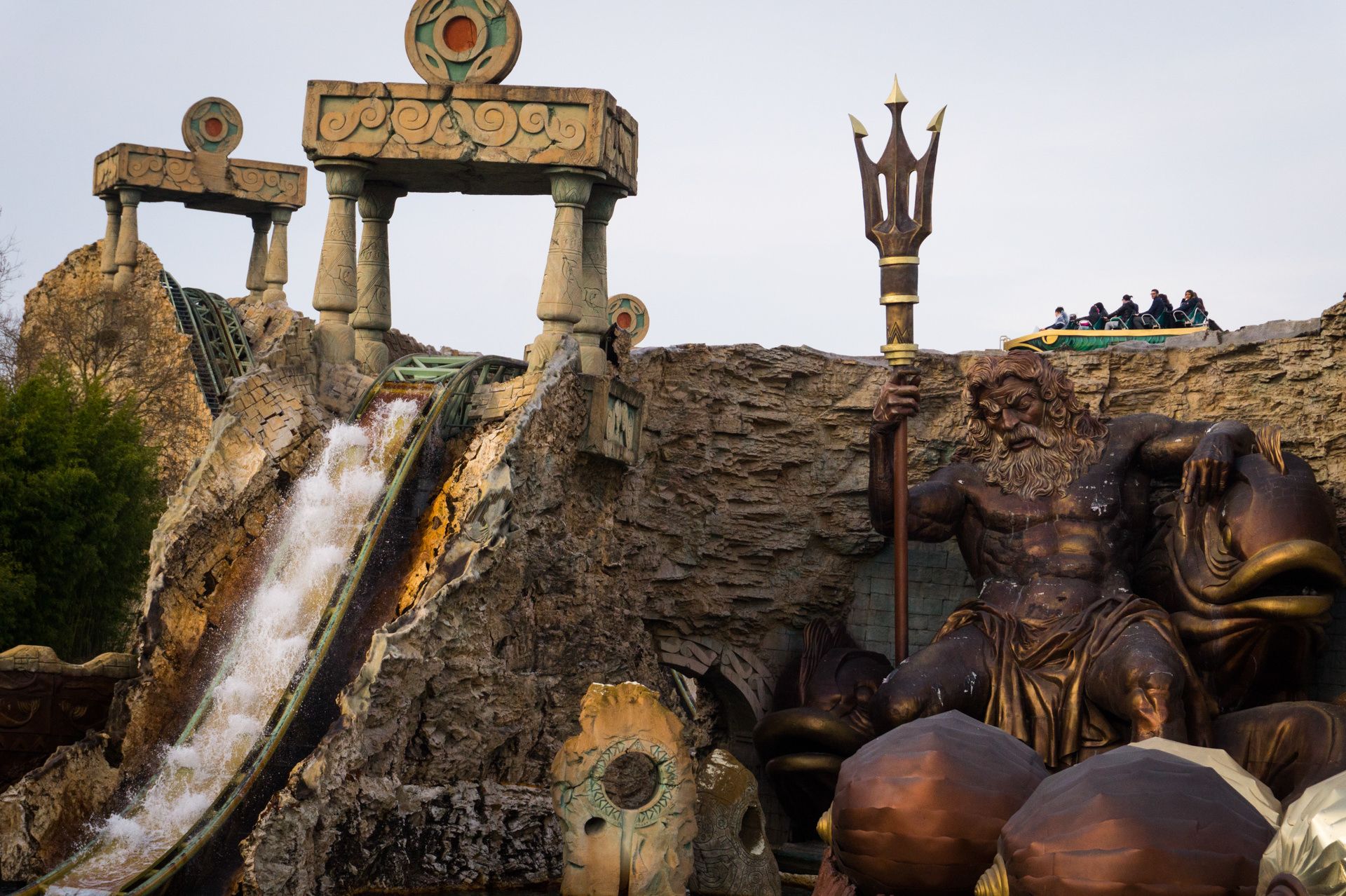
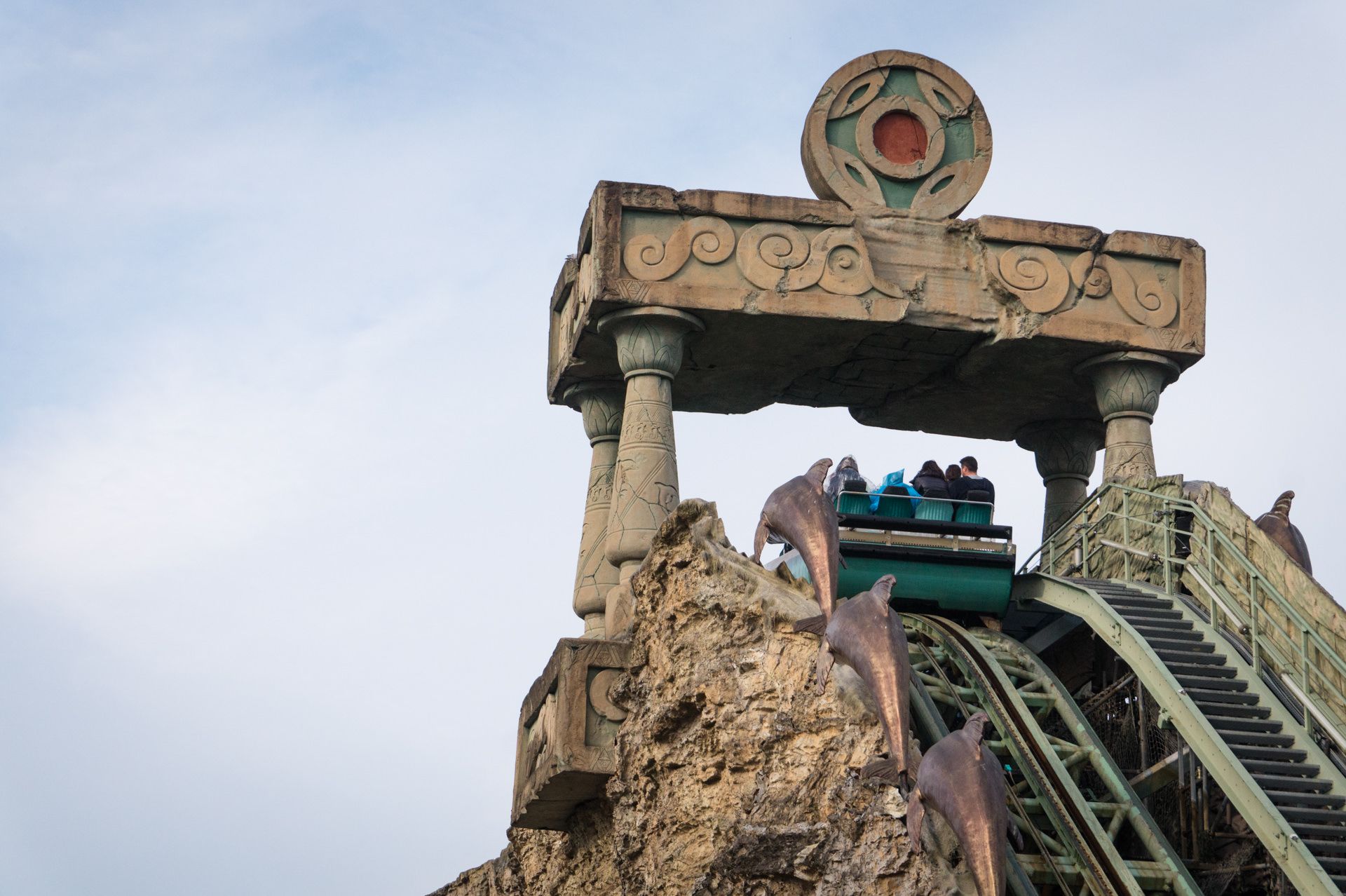
If you enter the park at the beginning of the opening hours, it is advisable to start your tour counter-clockwise and visit the Cartoon Village with all its attractions first. However, if you enter the park slightly later, you can expect longer waiting times, so a clockwise tour is the more sensible choice. The Movie World Studios are a wonderful themed area, where the theme of film, as in the entire park, now plays a much less important role than in 2011. While the Splash Battle Oso Yogui in its full splendour is still wetting the passengers down to their pants, the vintage car ride Cine Tour lacks all the figures from the Looney Tunes universe, so that in the end only a modest capacity remains on a somewhat longer ride. Here you also learn for the first time to hate the owners of Pase Correcamino’s Platinium wristbands, as they constantly pass before you.
Stuntfall

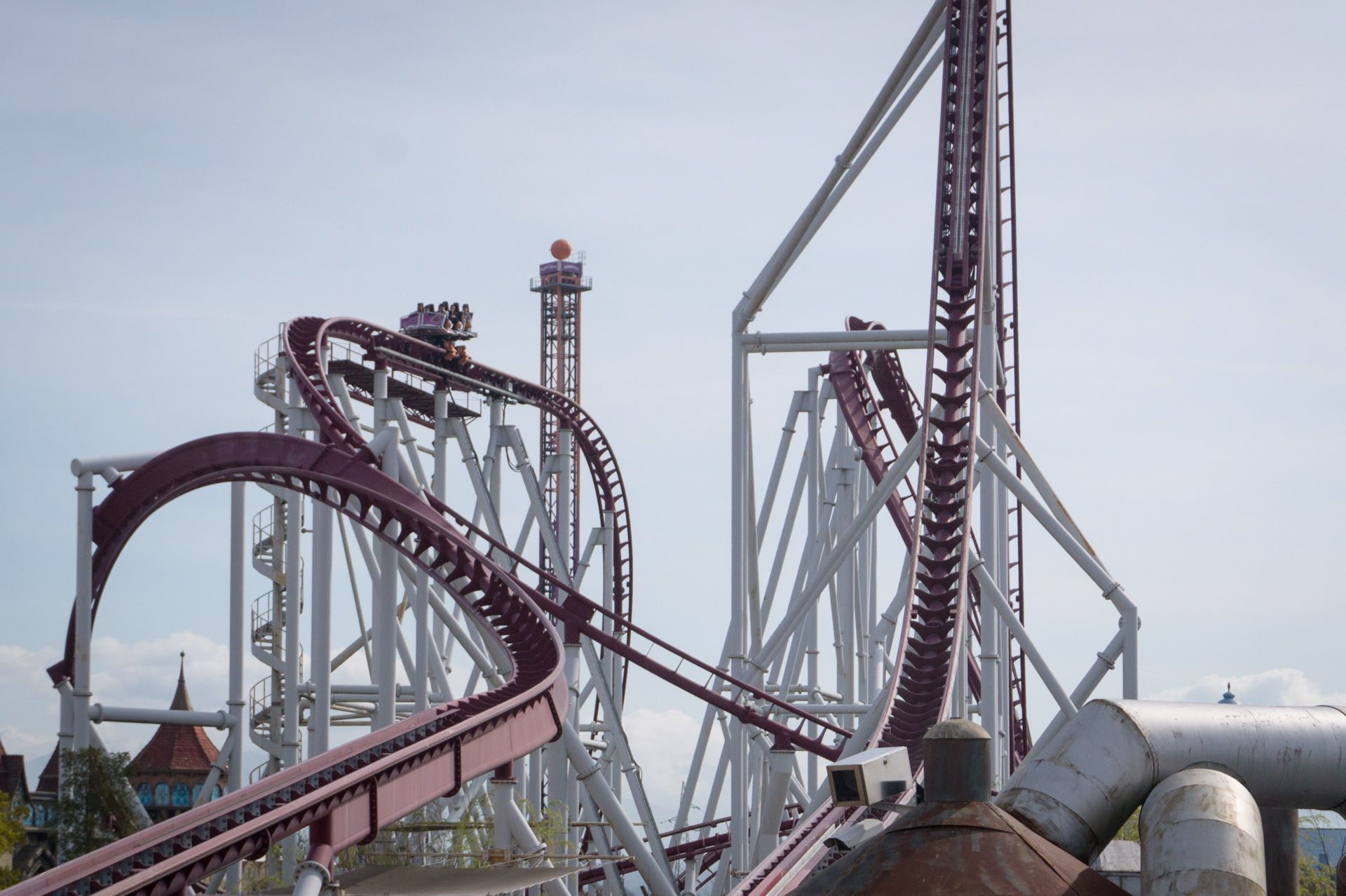
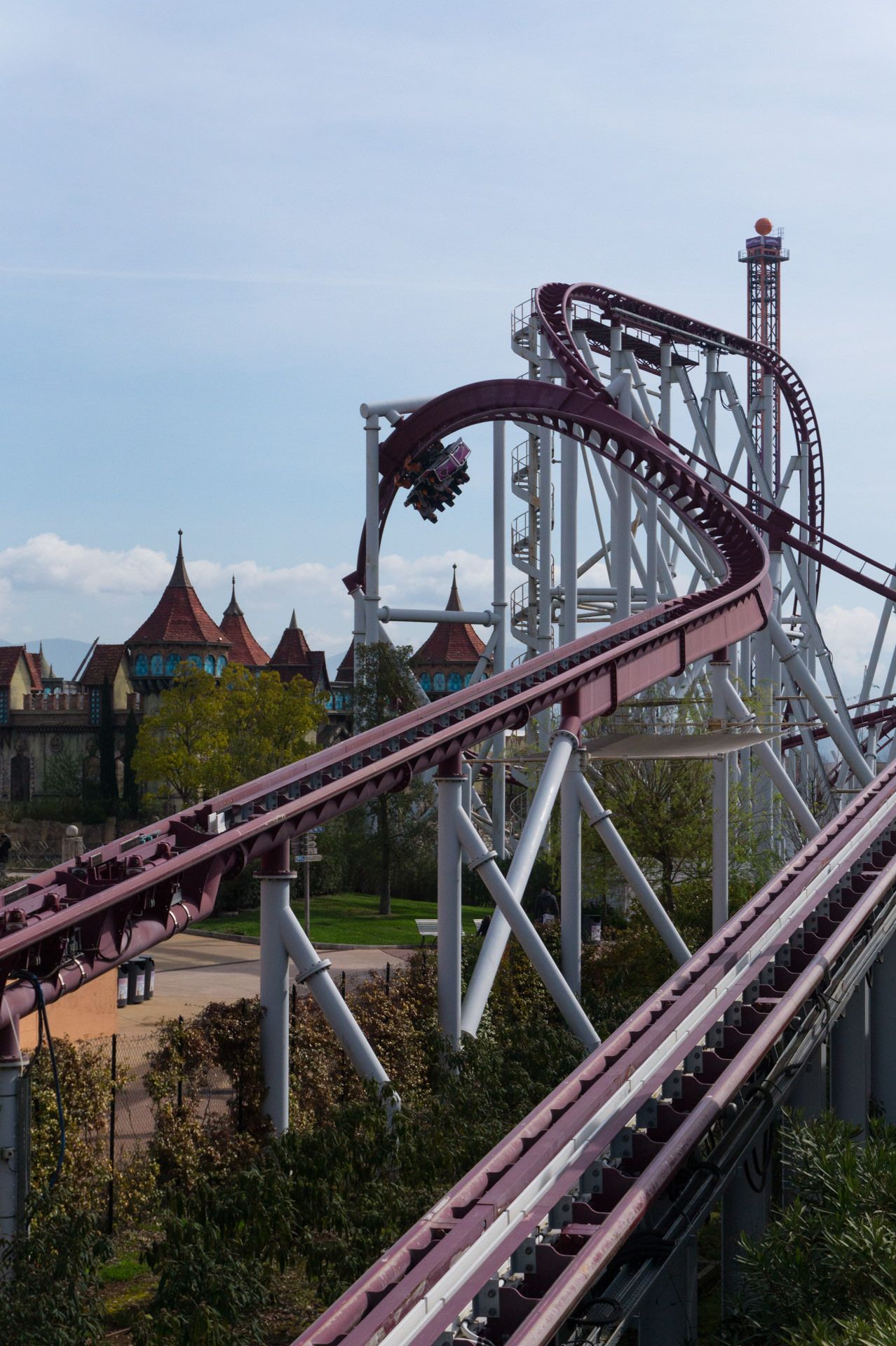
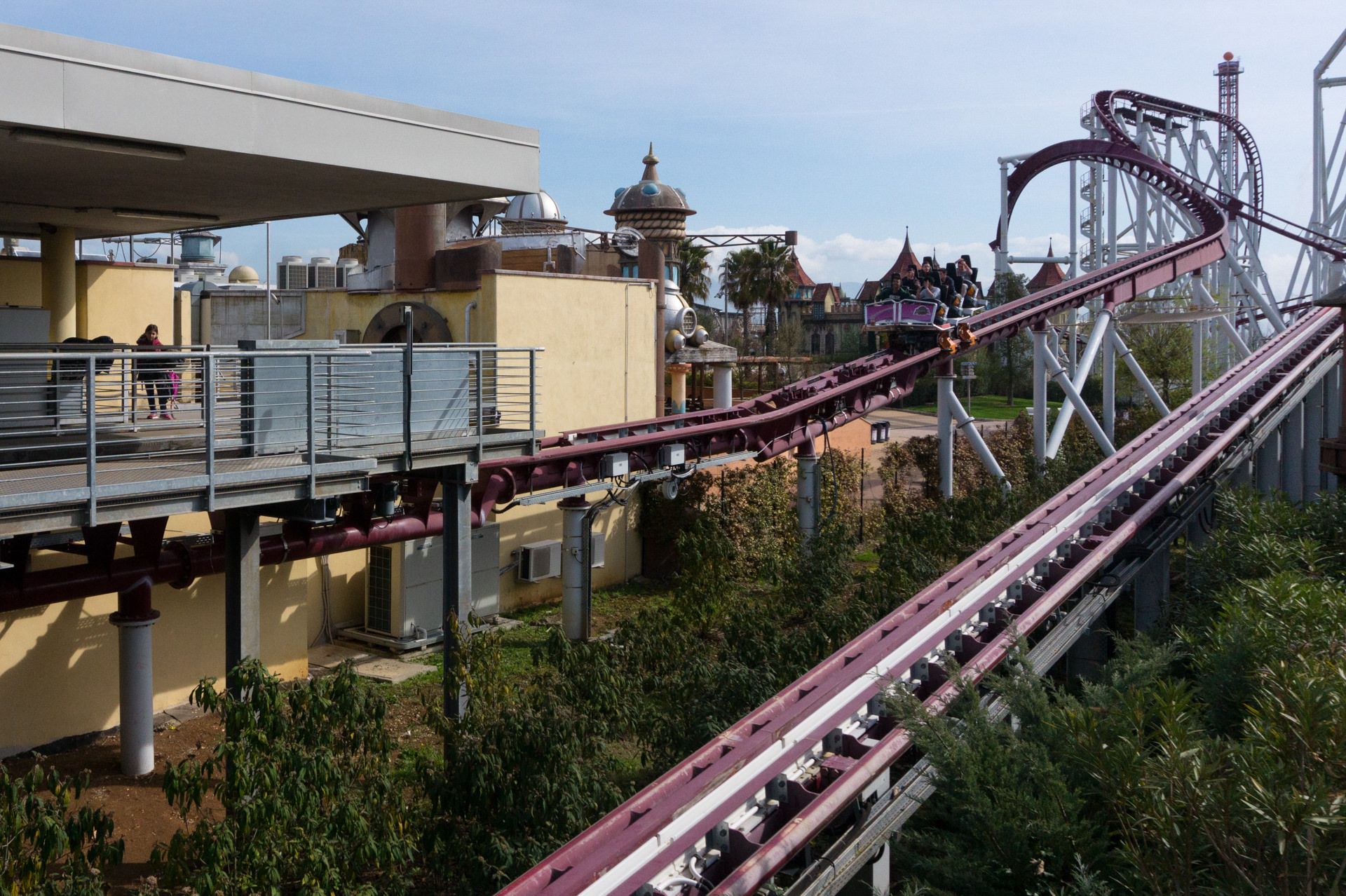
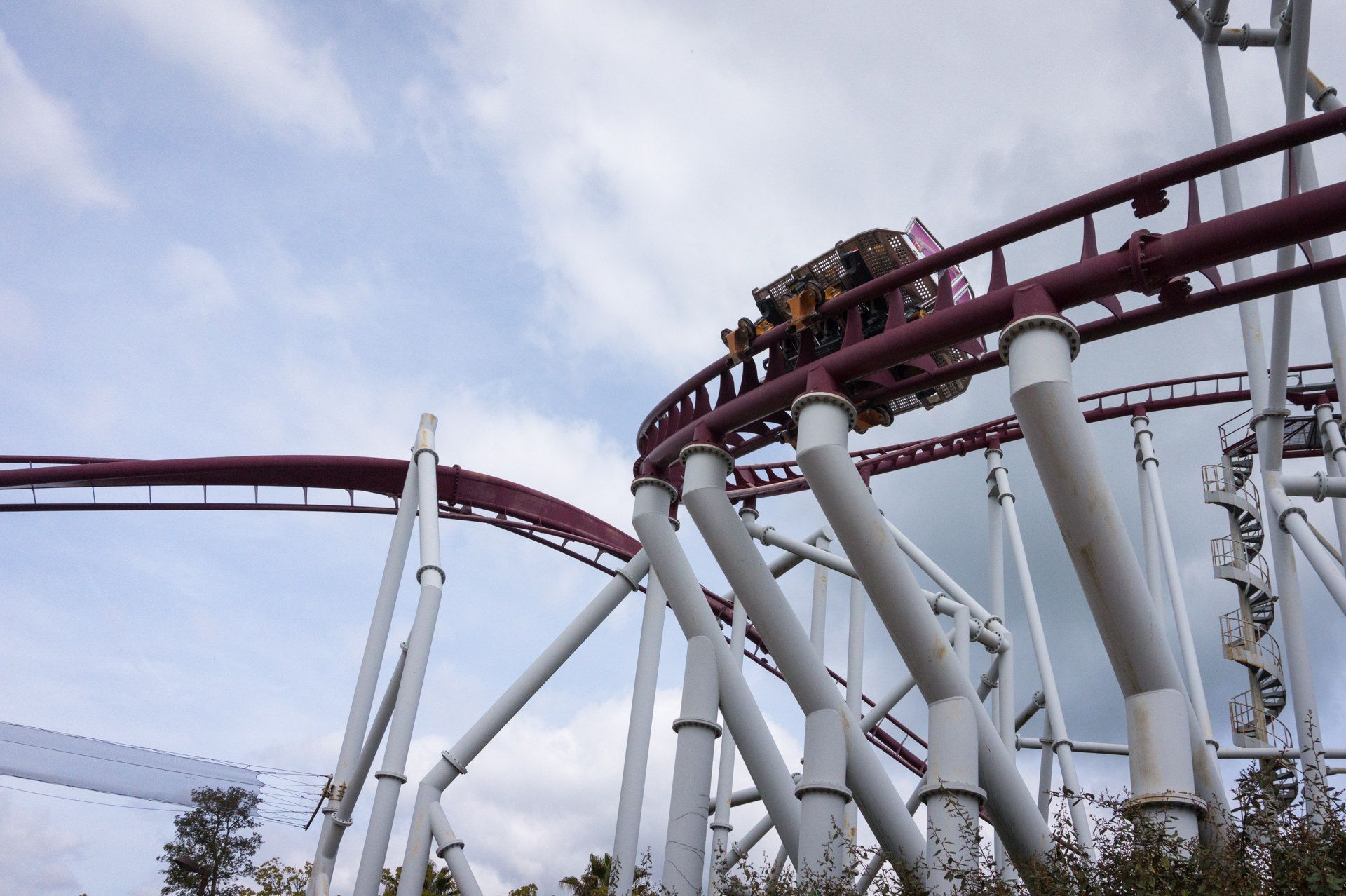
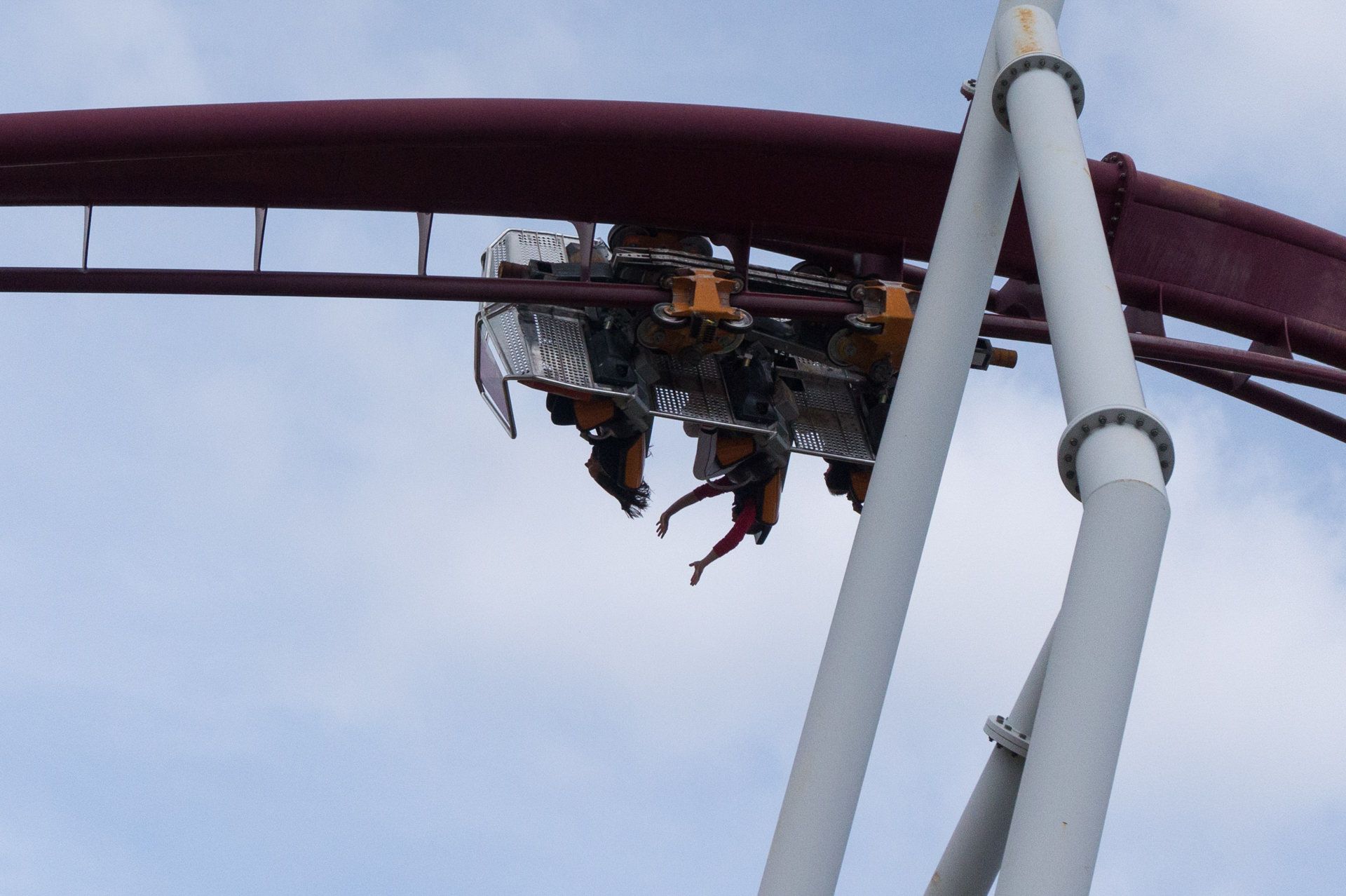
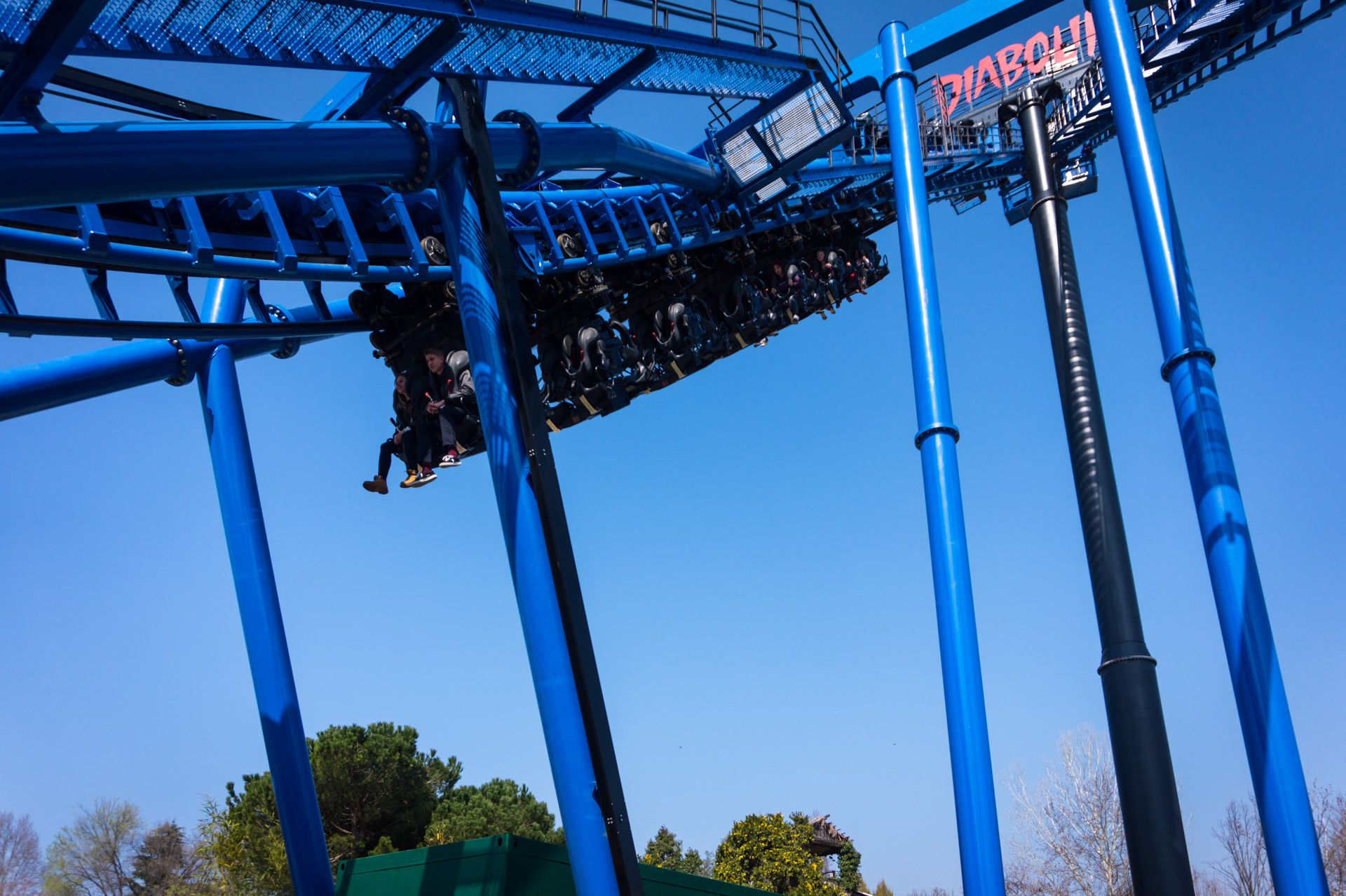
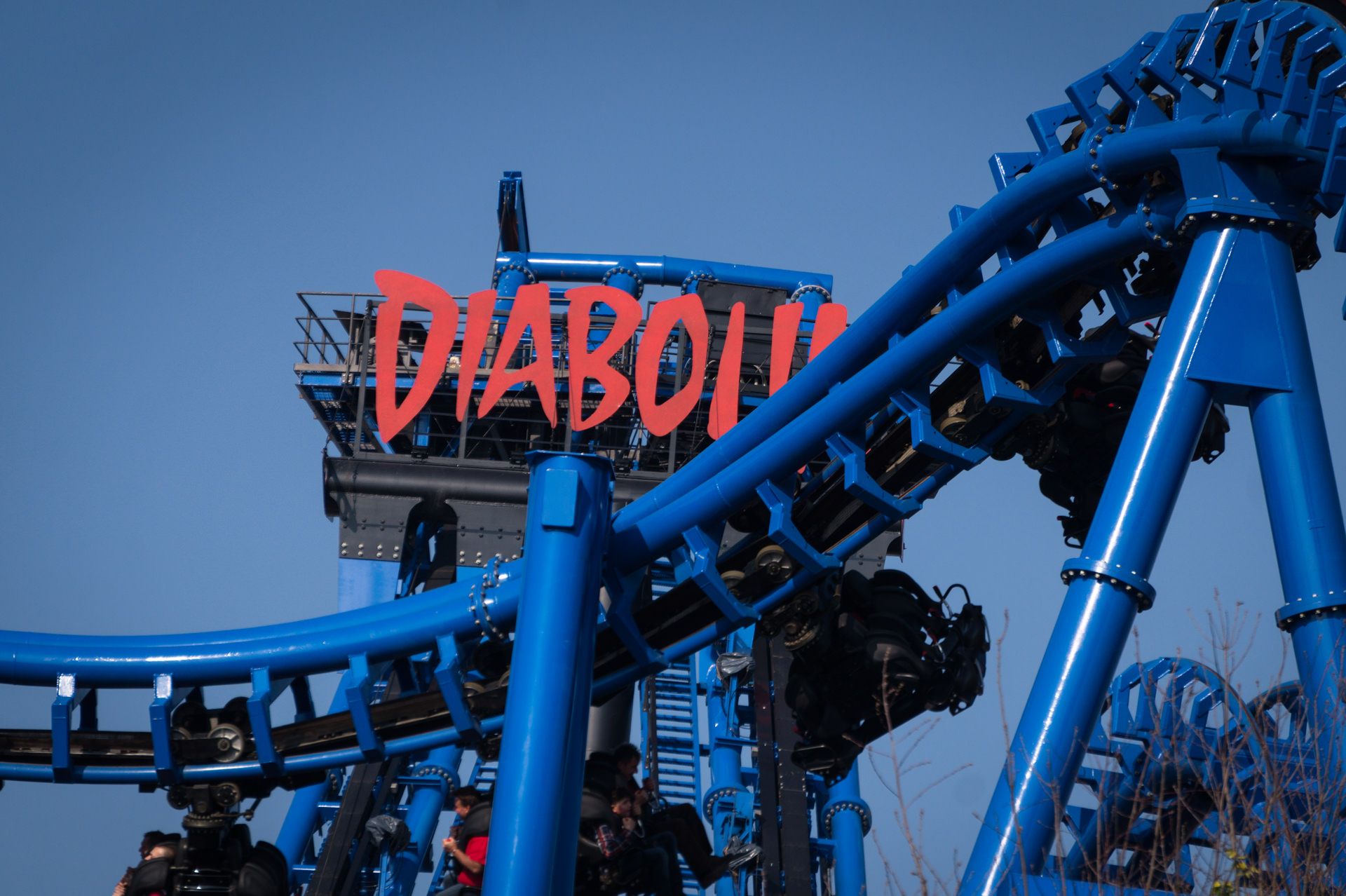
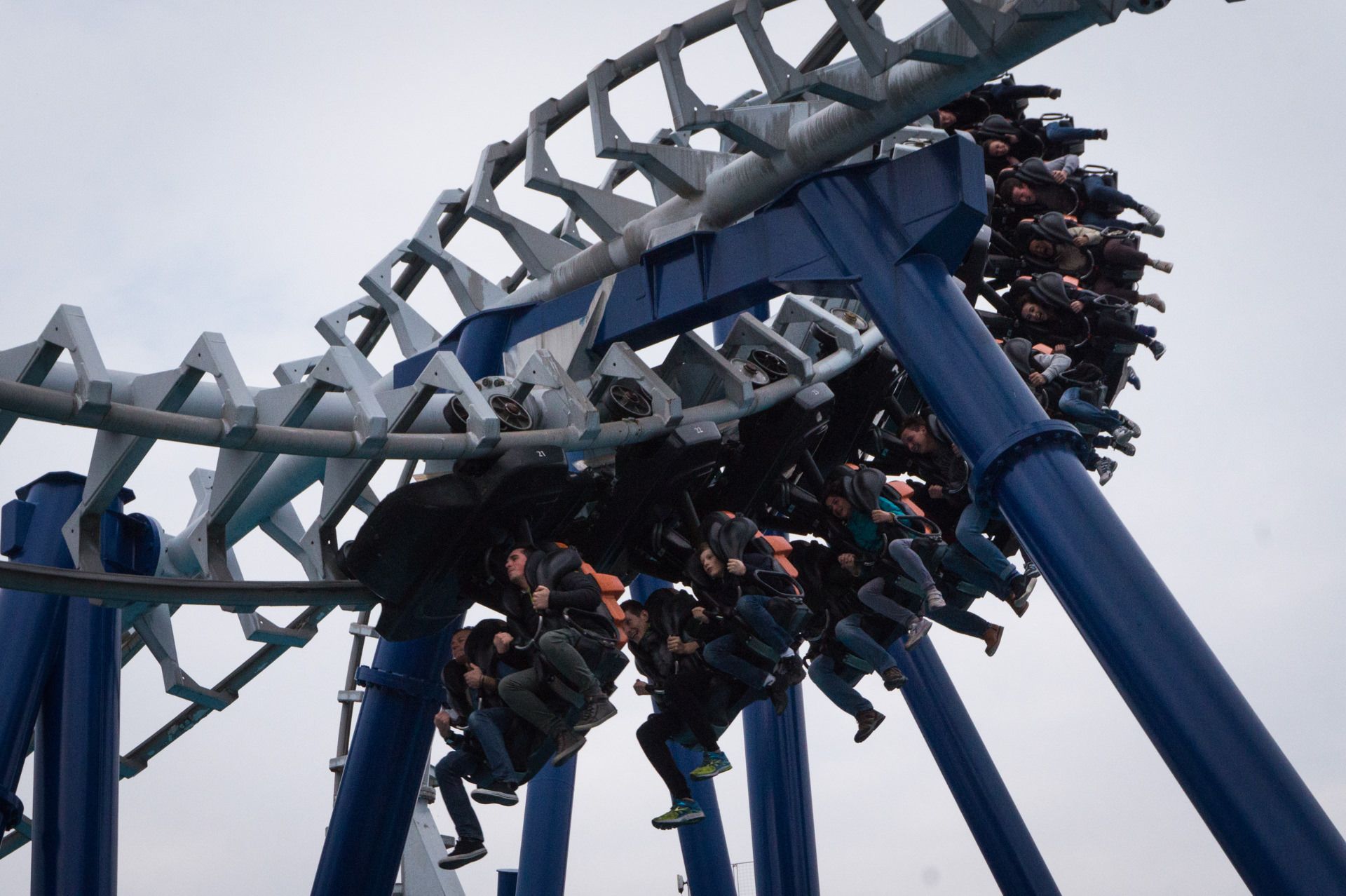
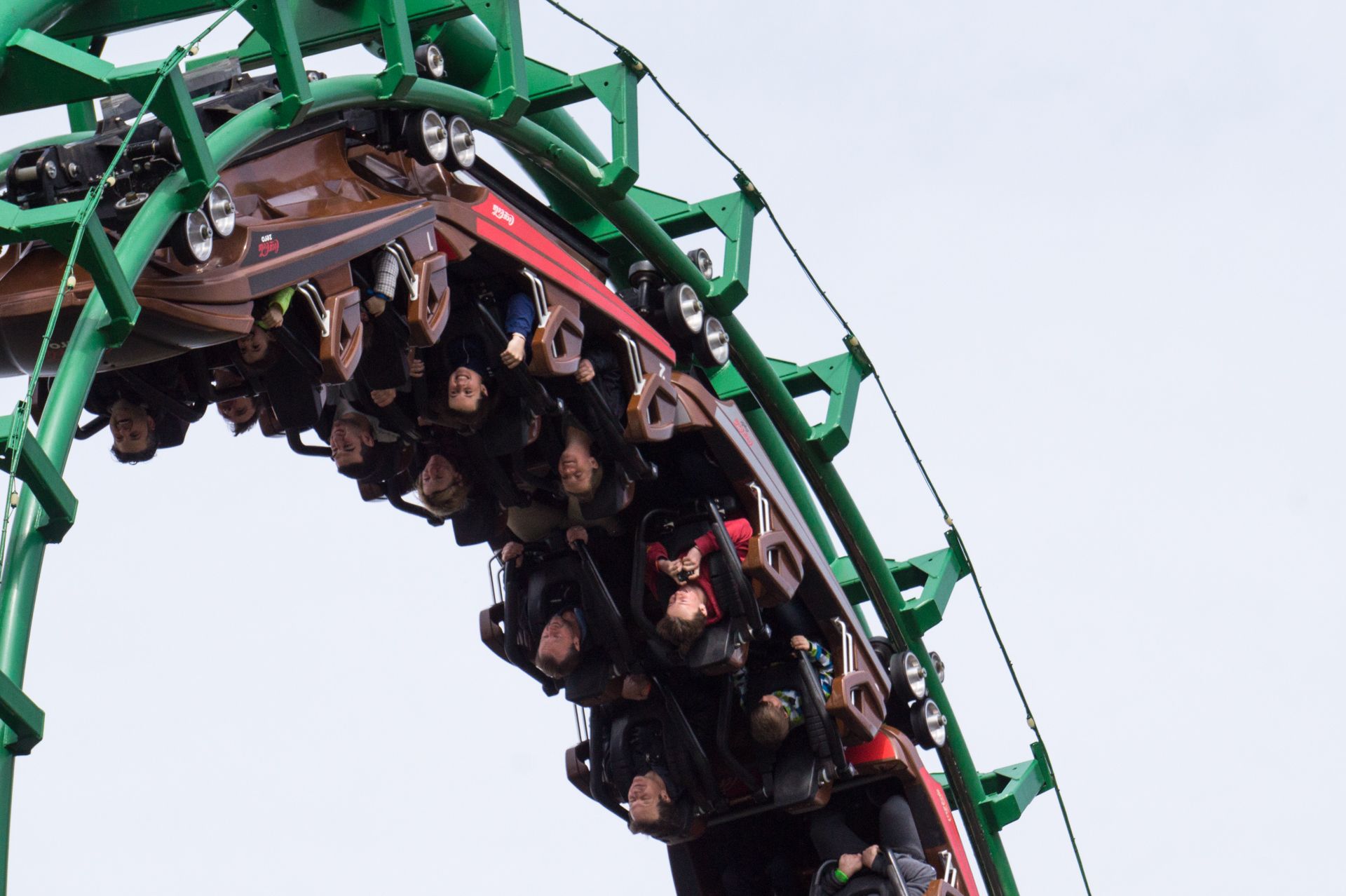
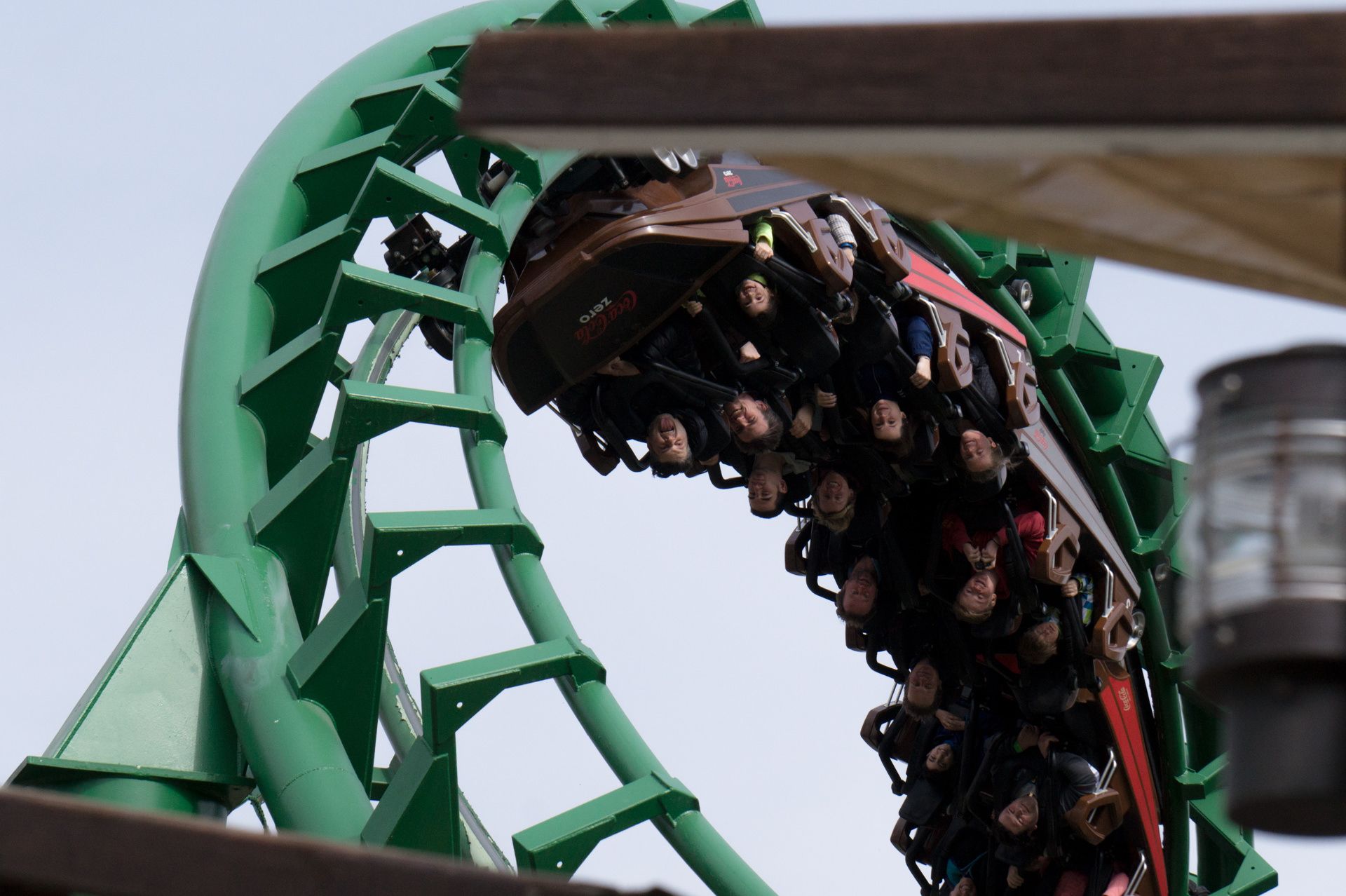
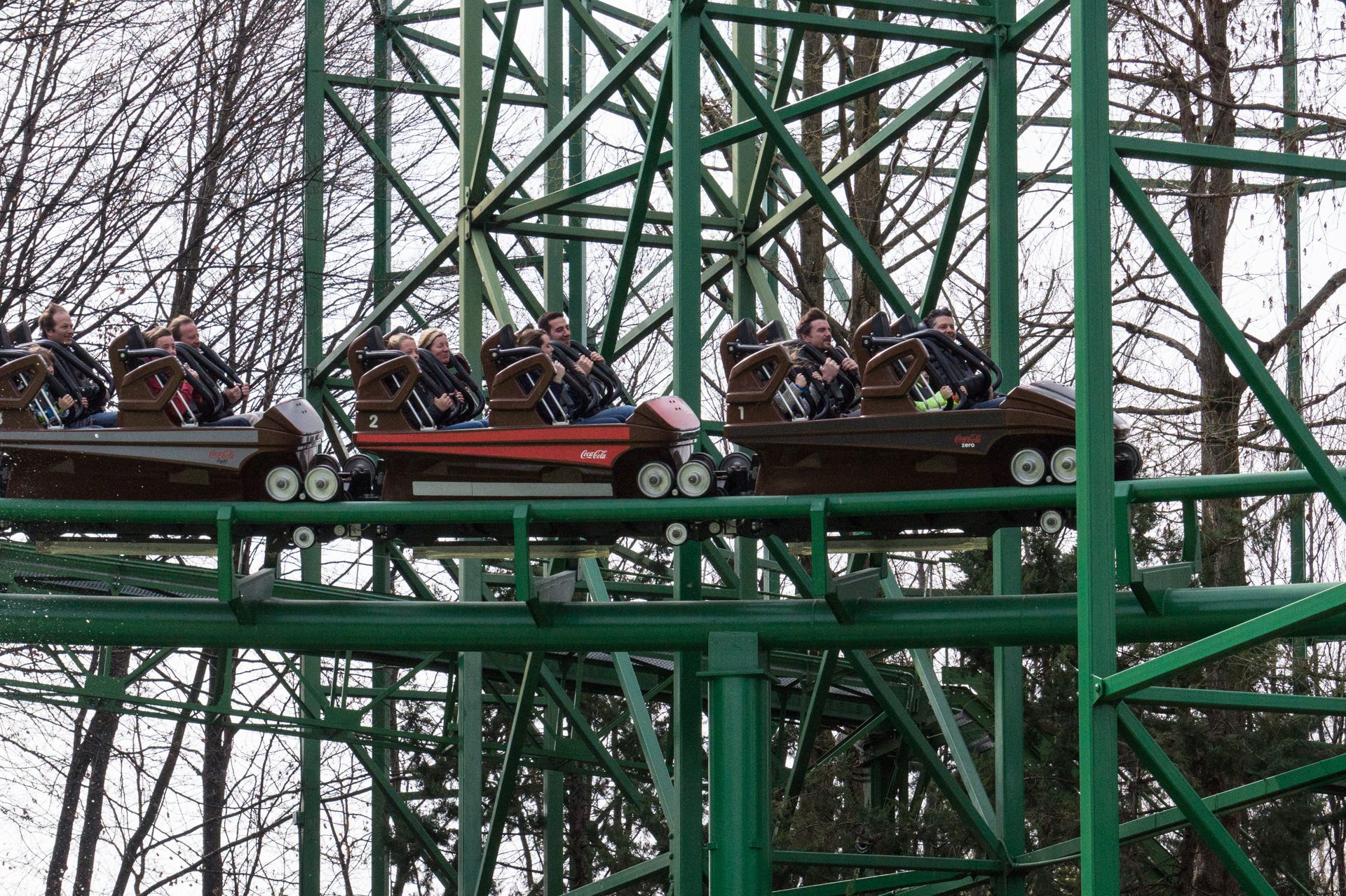
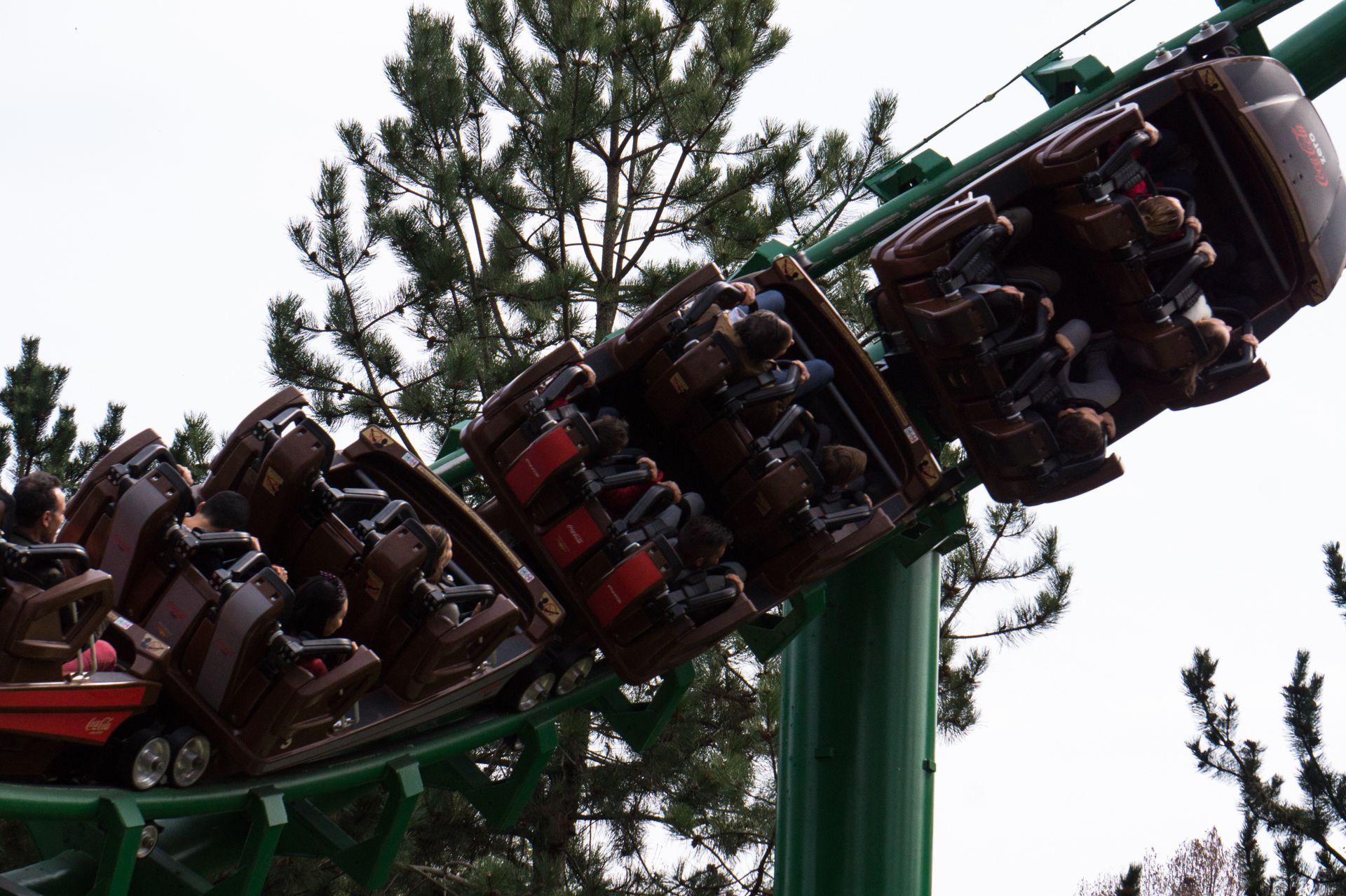
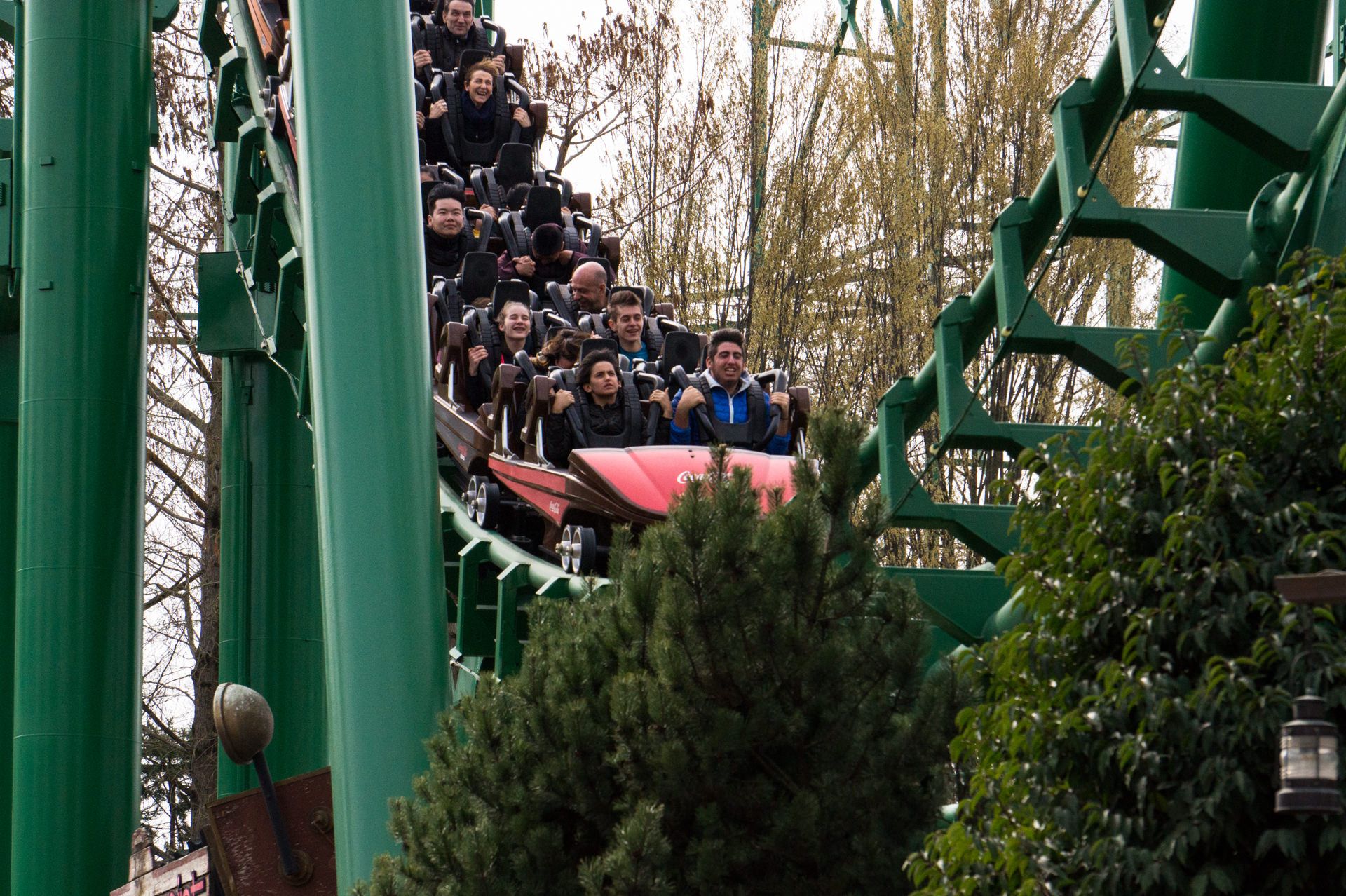
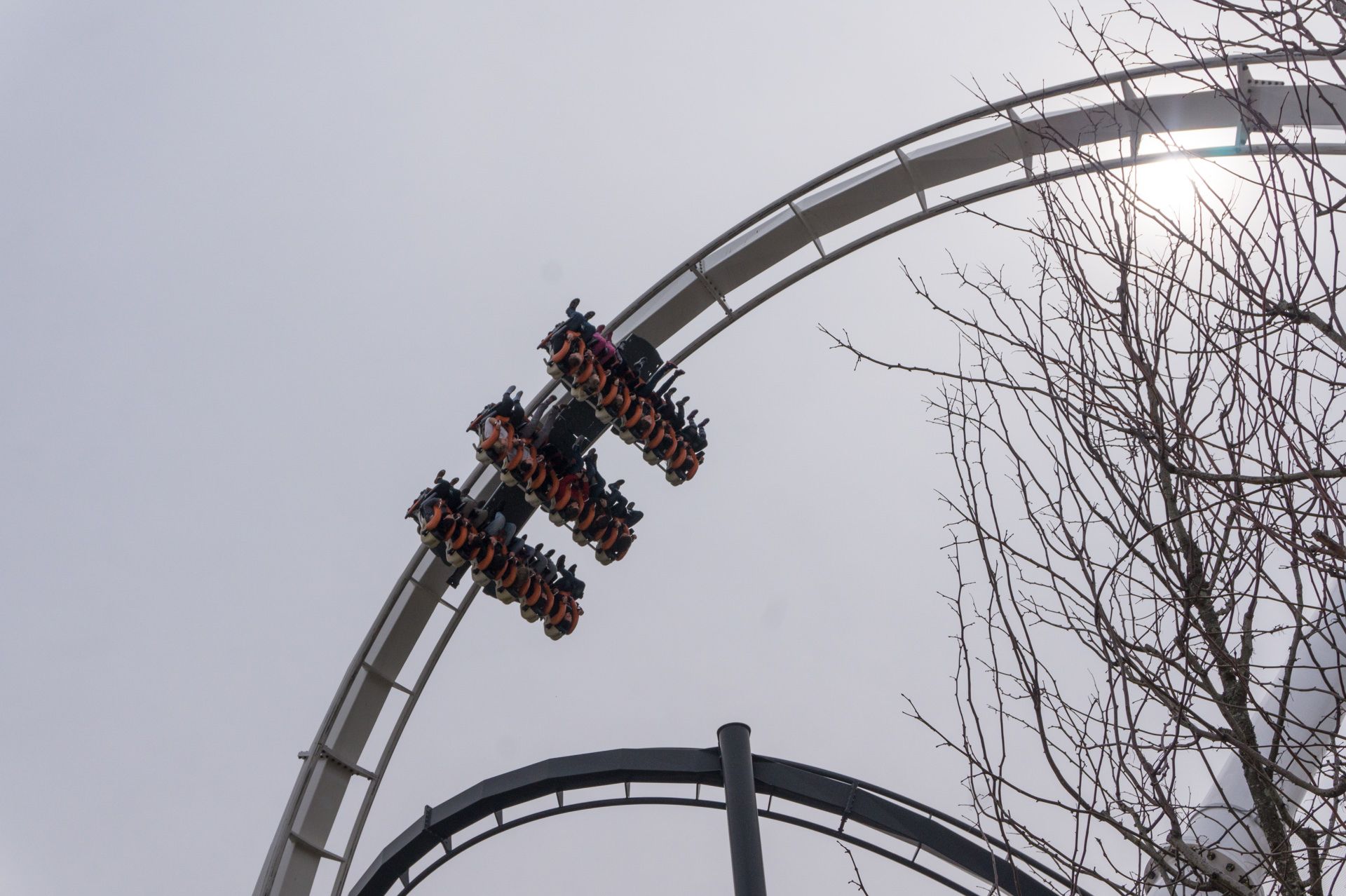
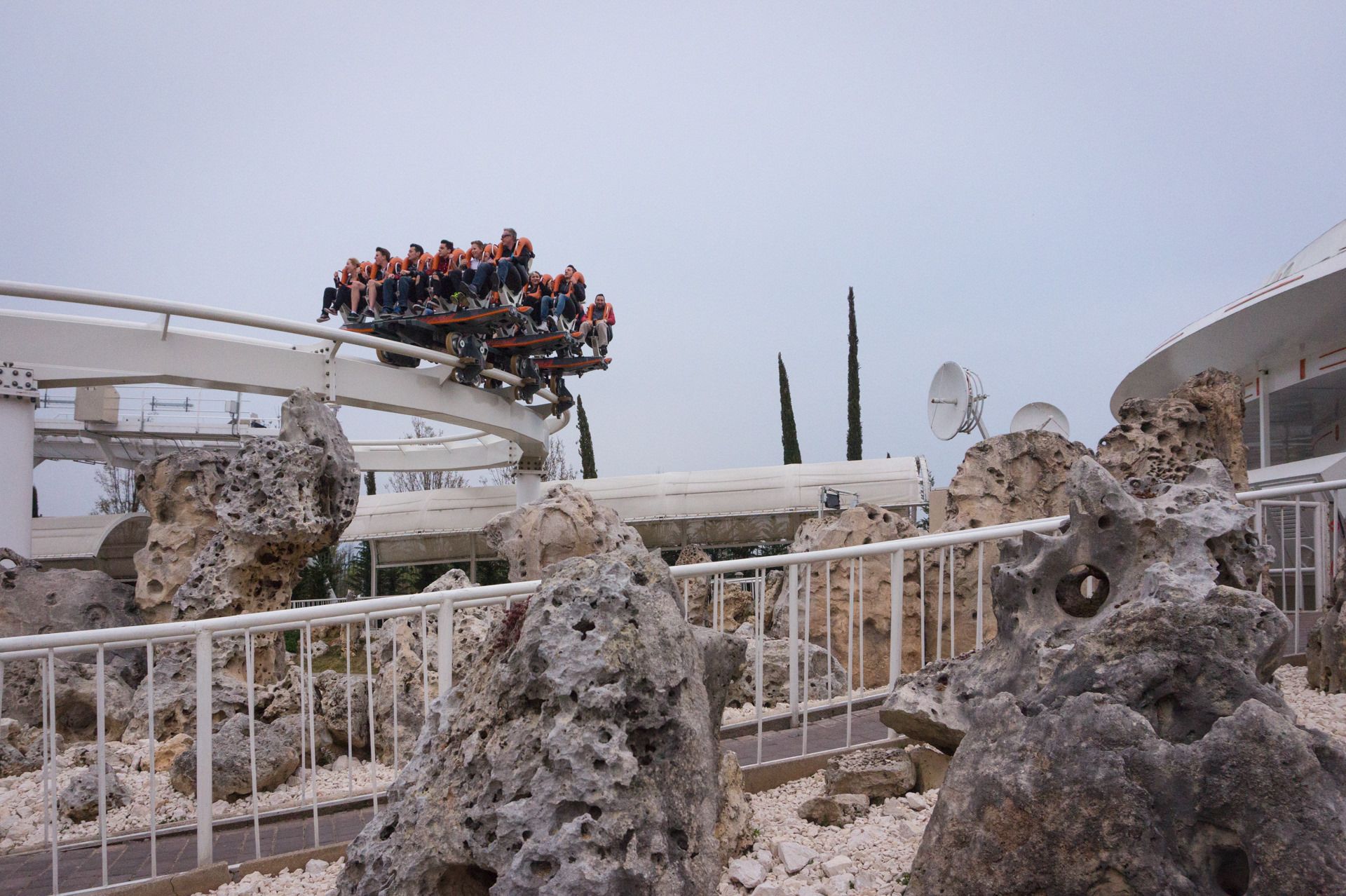
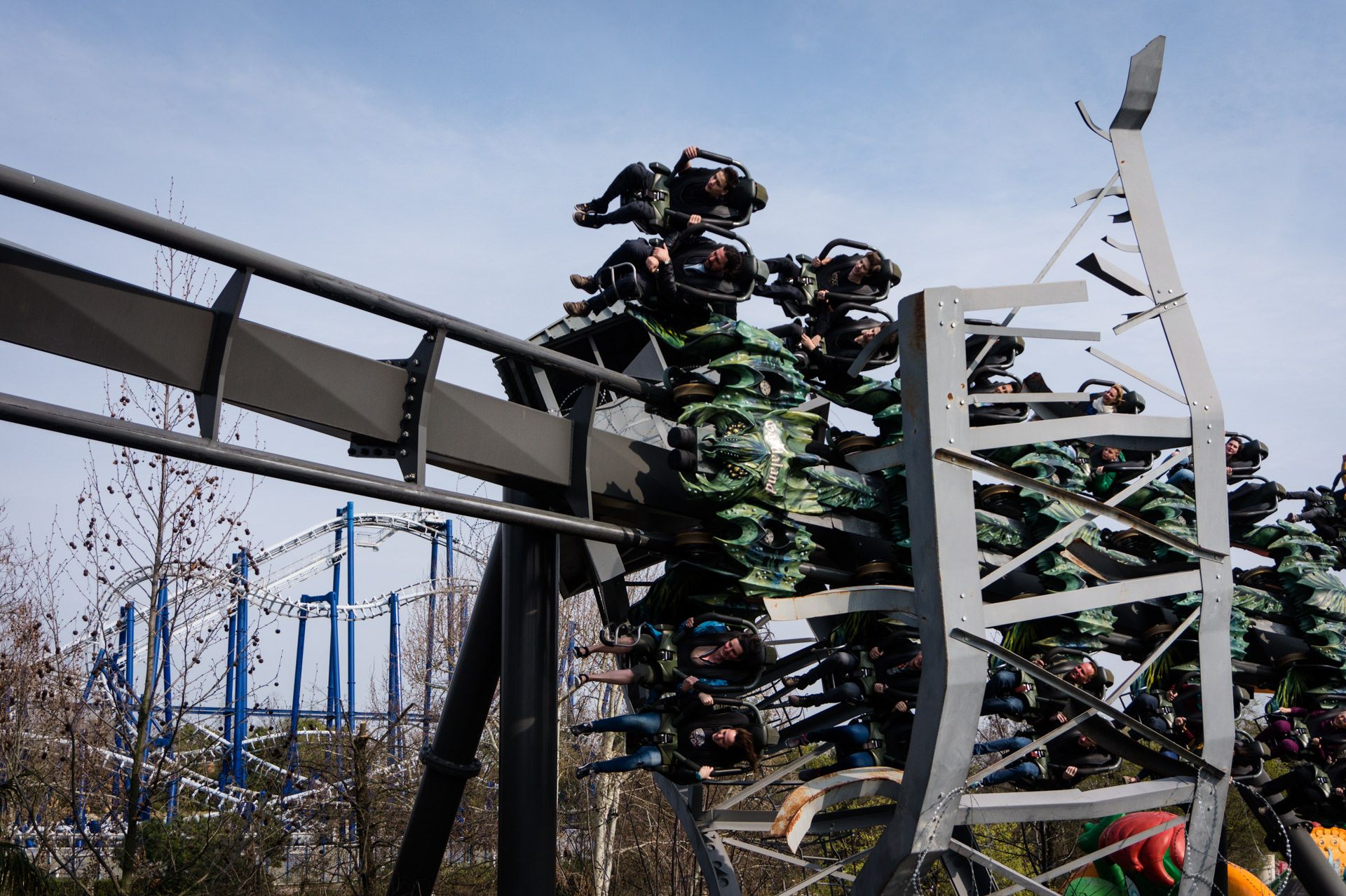
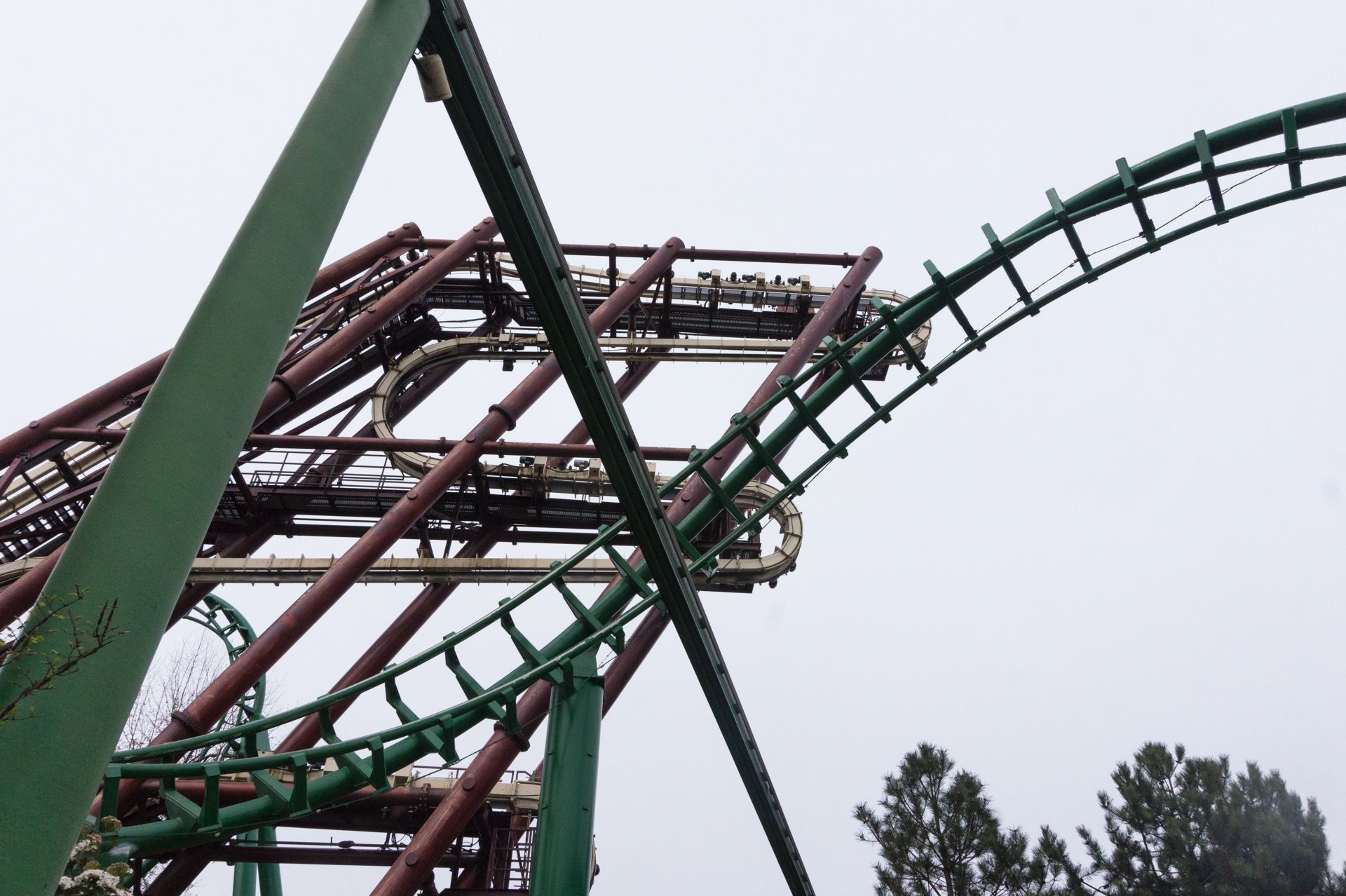
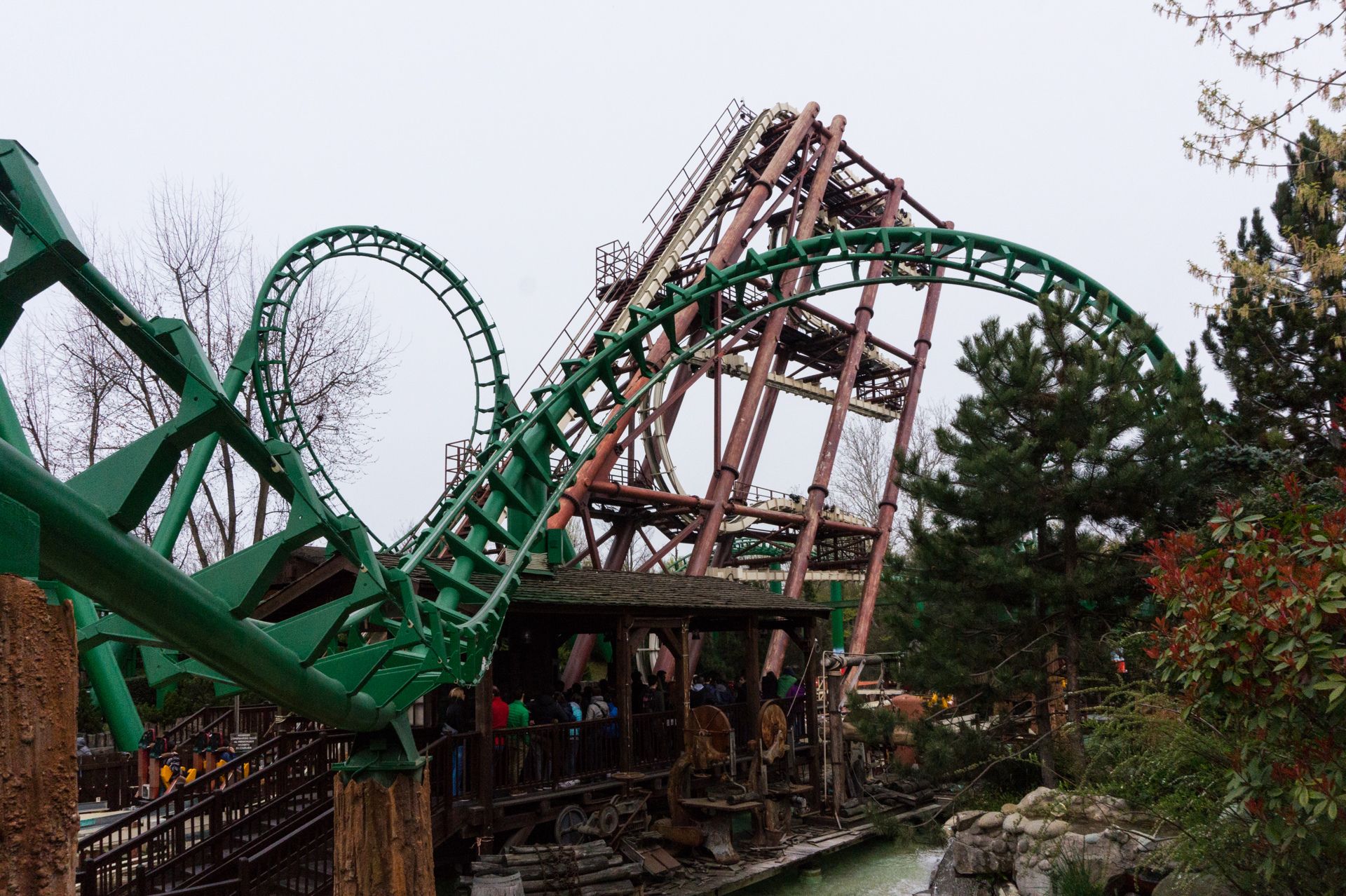
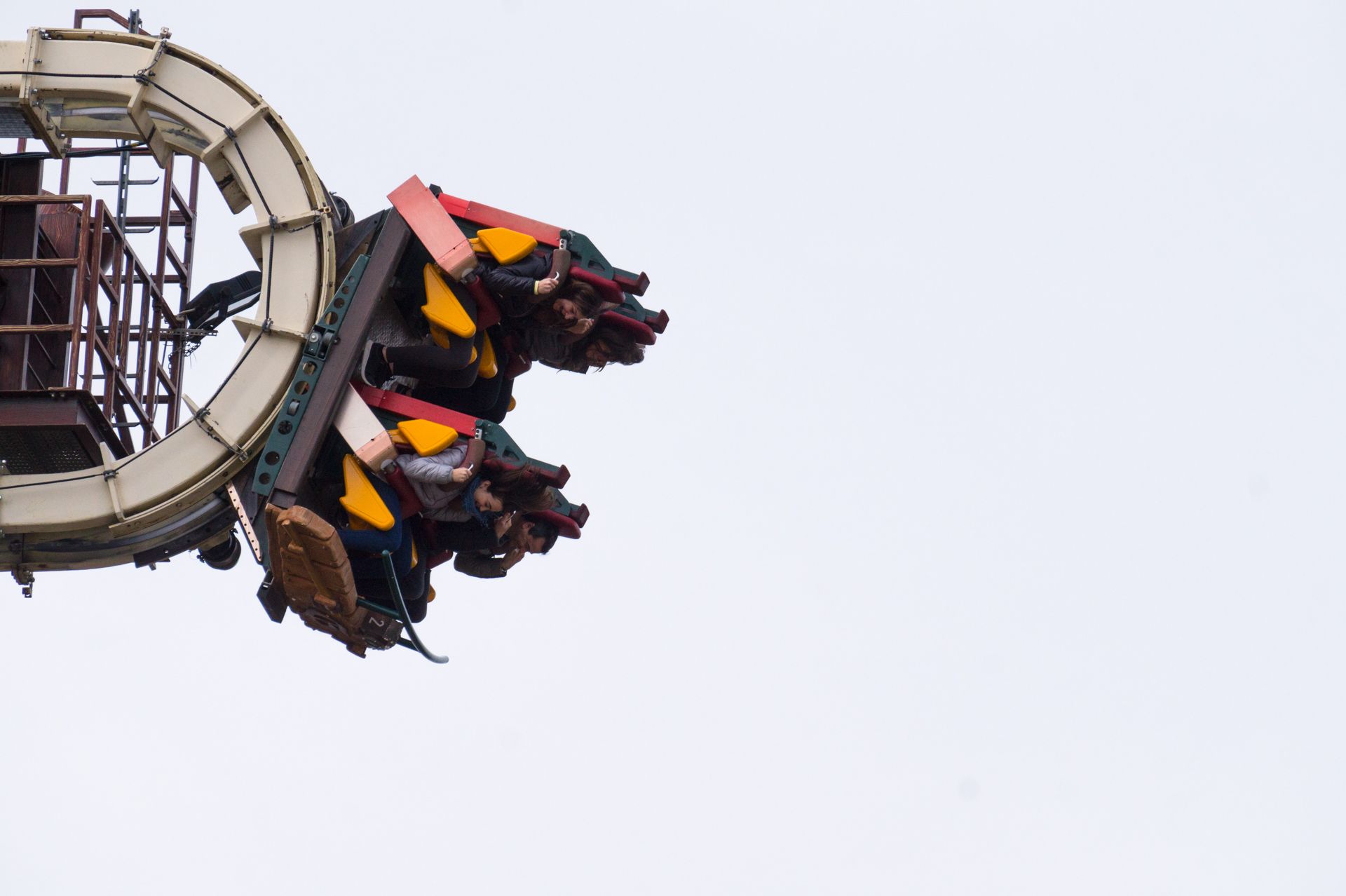
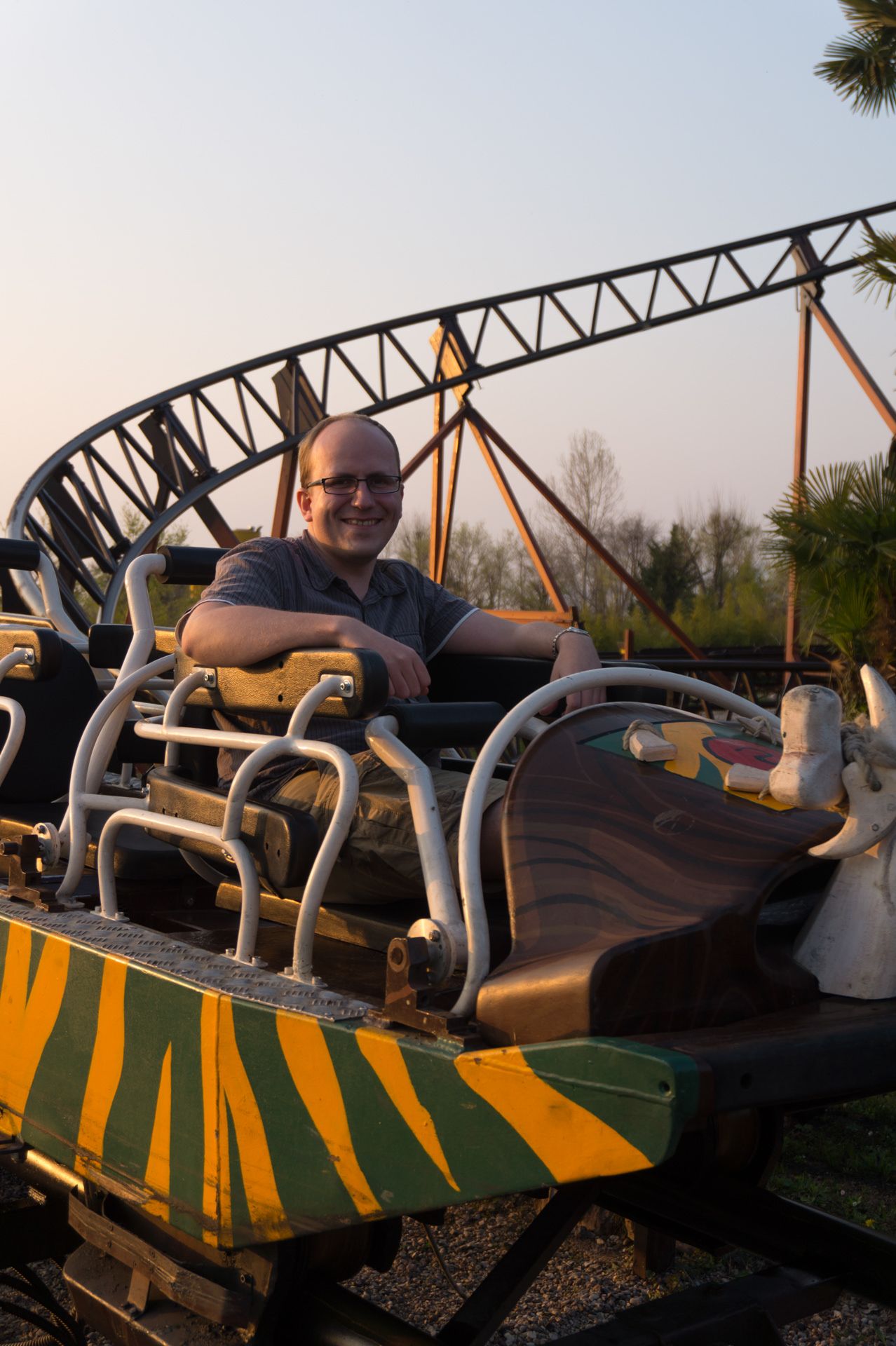
It’s only good that during the roller coaster Stunfall, due to an incident in which the train swung out in the first inversion figure and some rows, despite the existing platform, could not be evacuated easily, always runs with some blocked rows in the front and rear part of the train and therefore has a reduced capacity. Like at Shambhala in the Spanish Port Aventura, the train is almost exclusively filled with Pase Correcaminos owners, so that there is always a longer queue at this roller coaster. Stuntfall is a special kind of treat that you don’t want to ride only once.

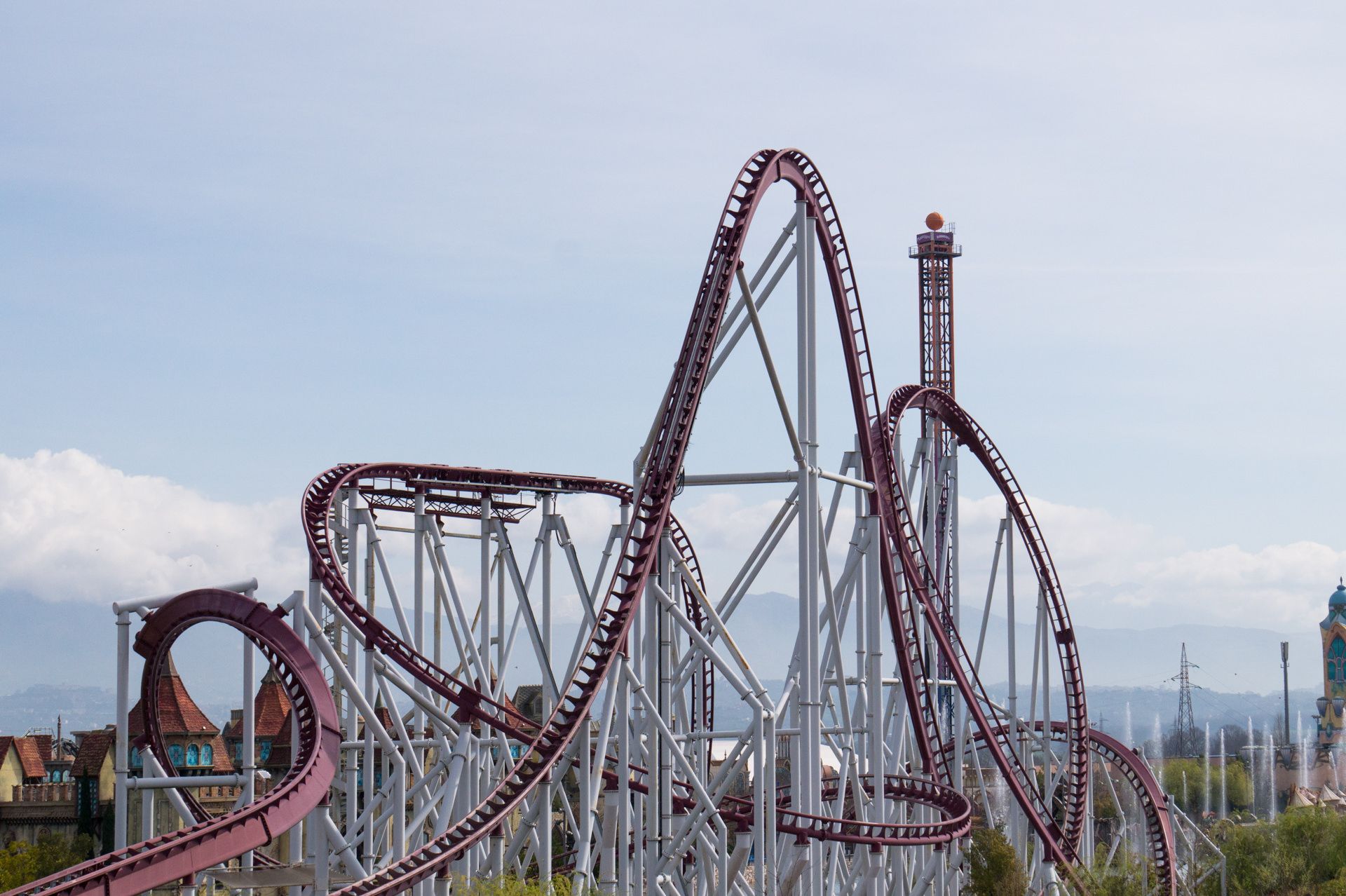
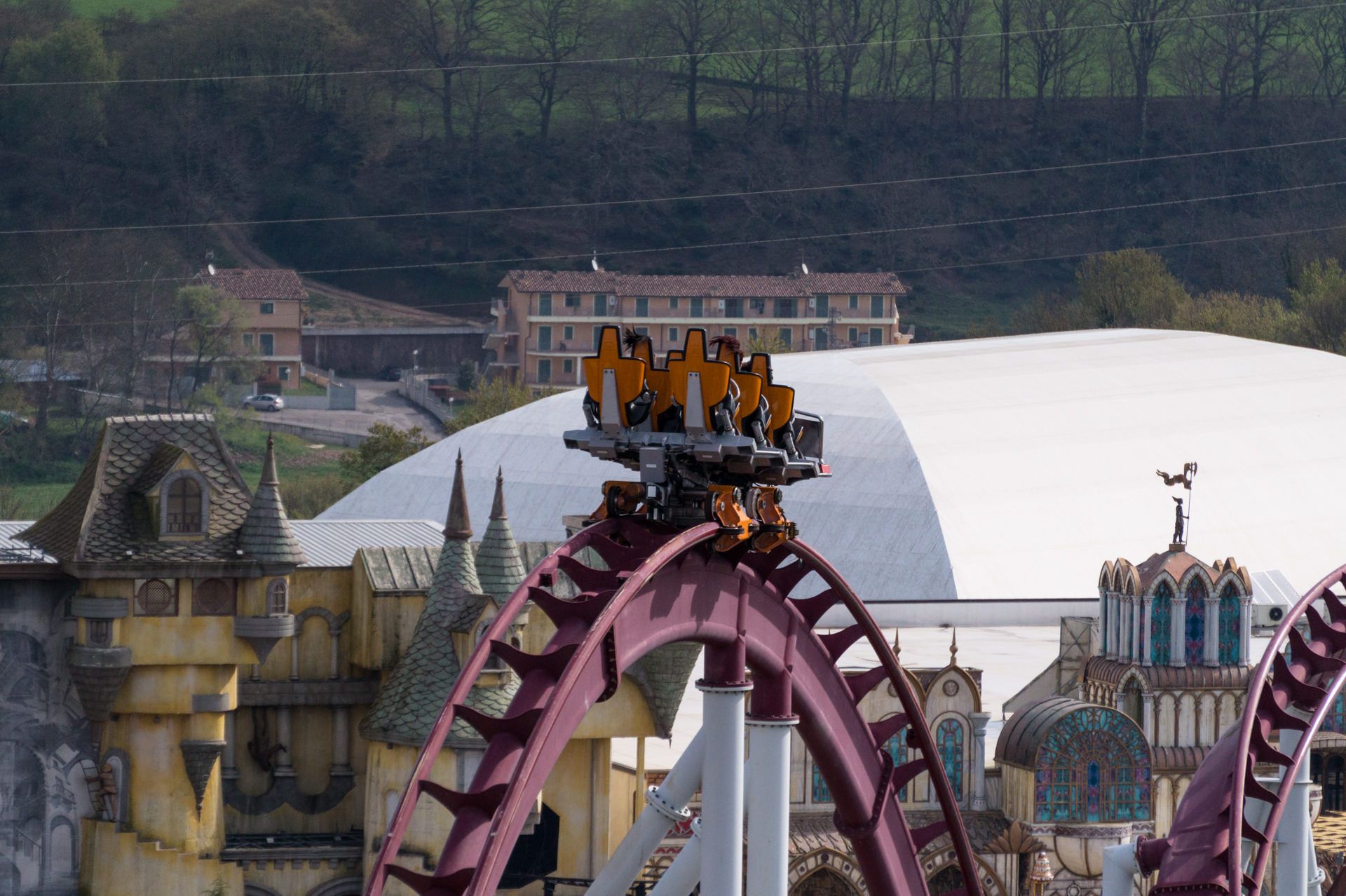
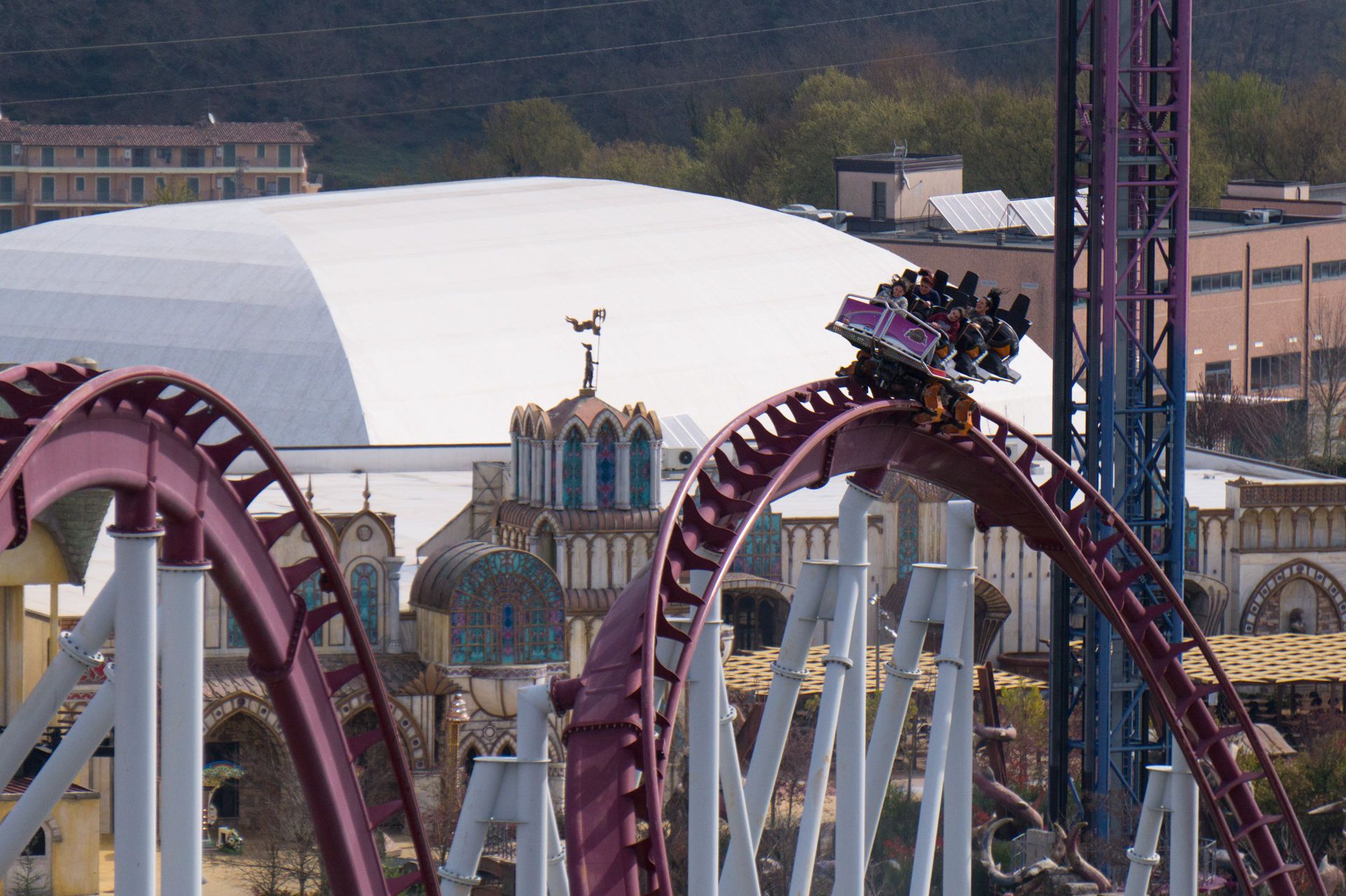
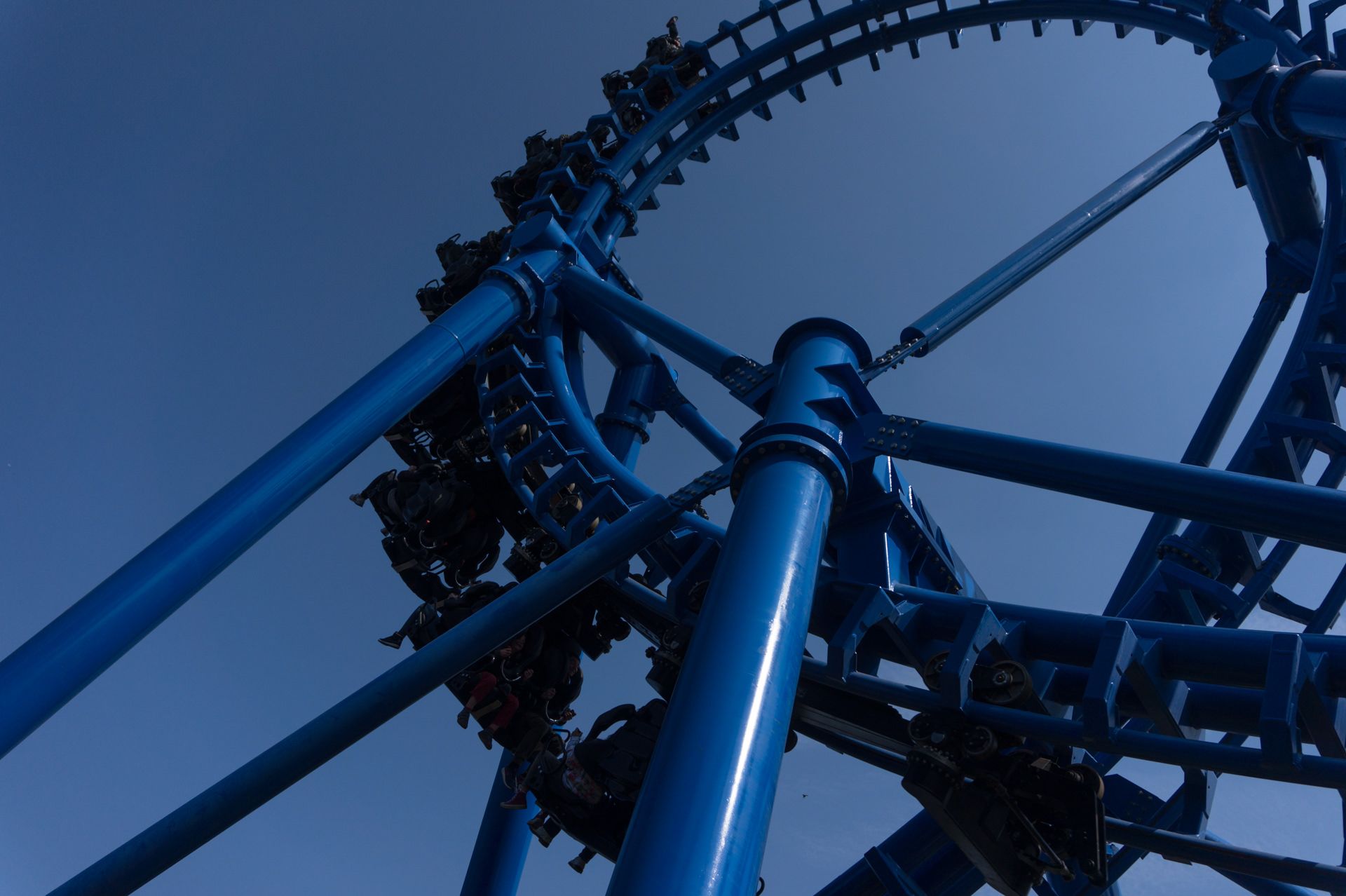
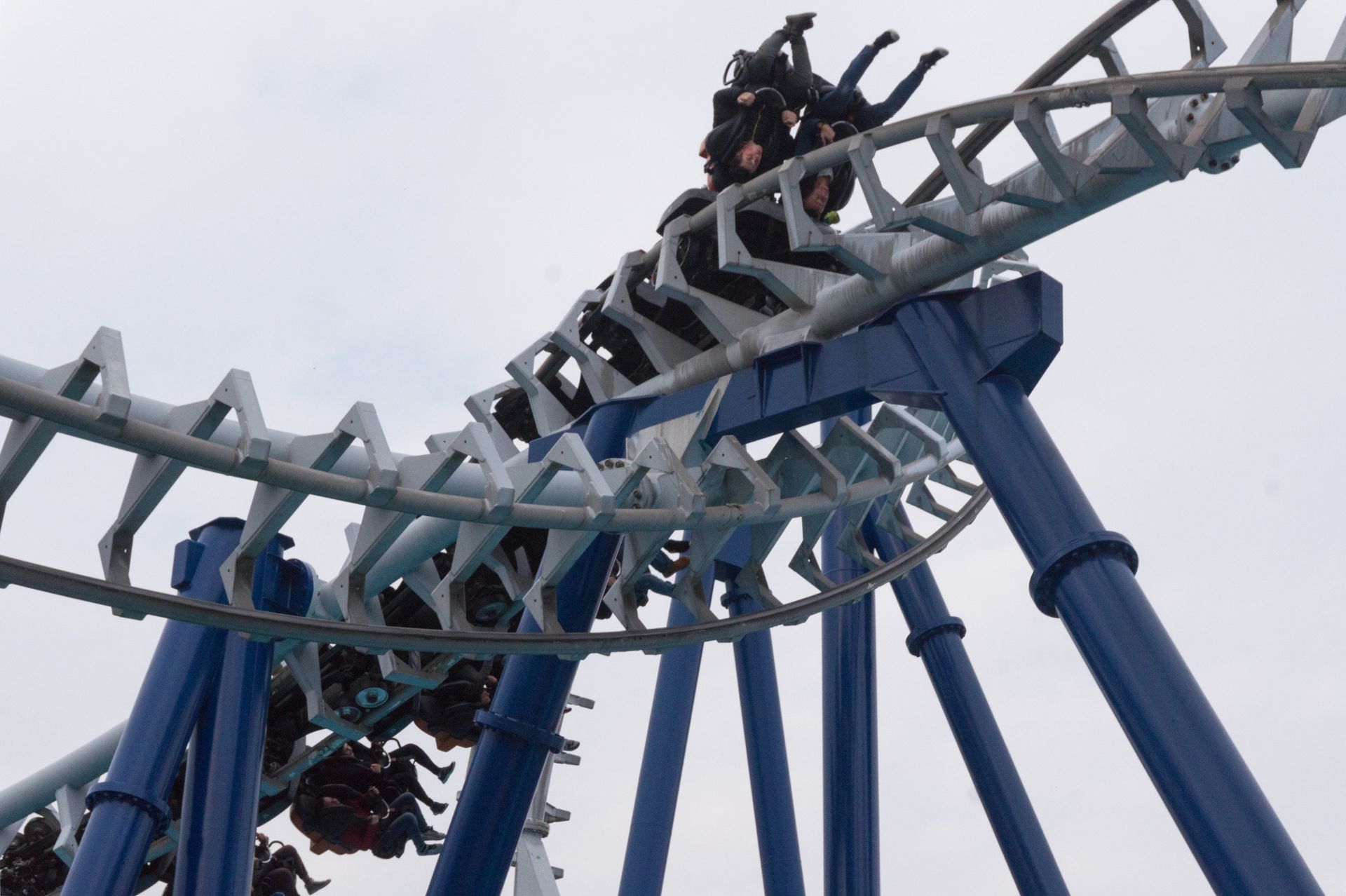
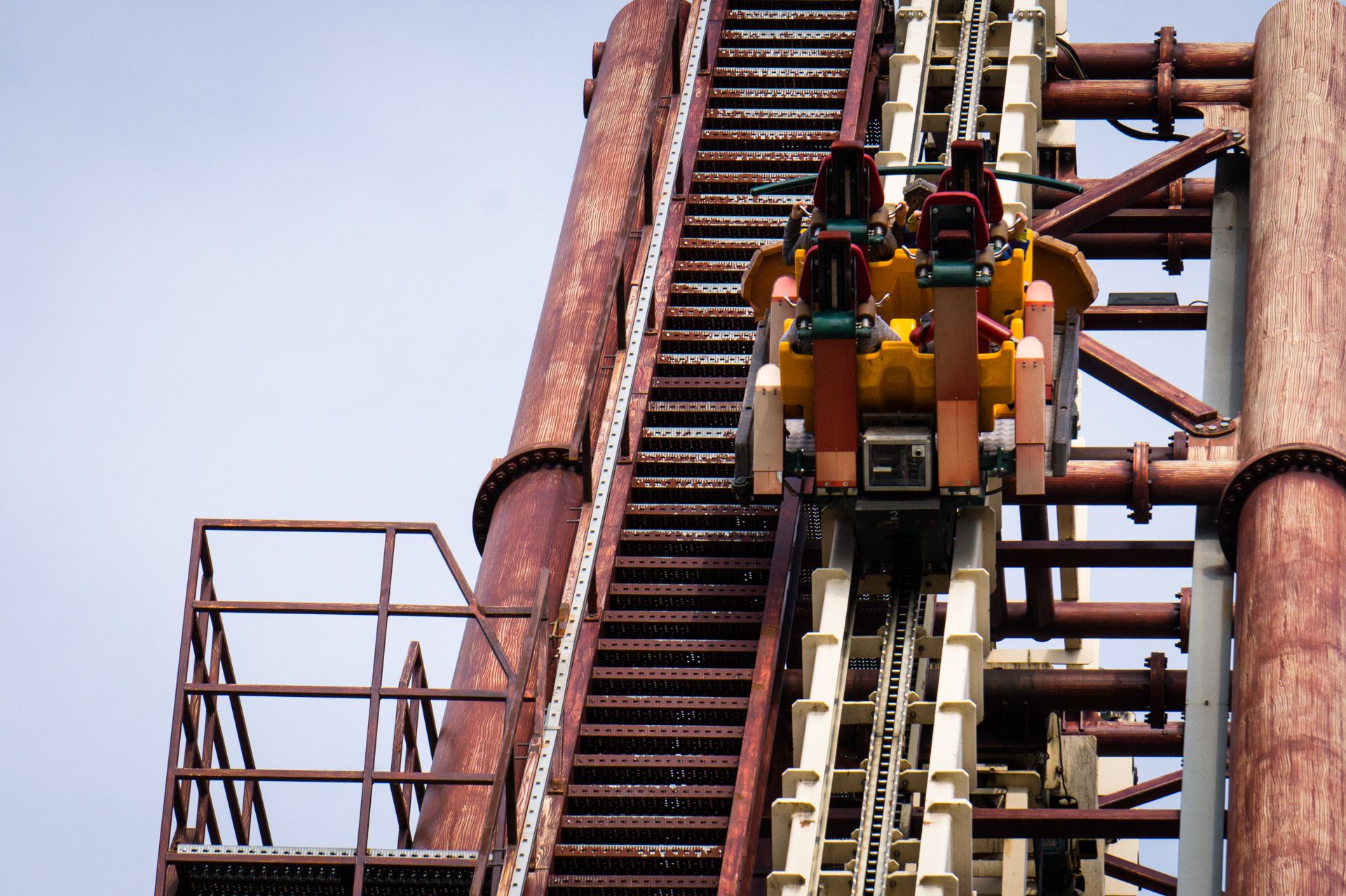
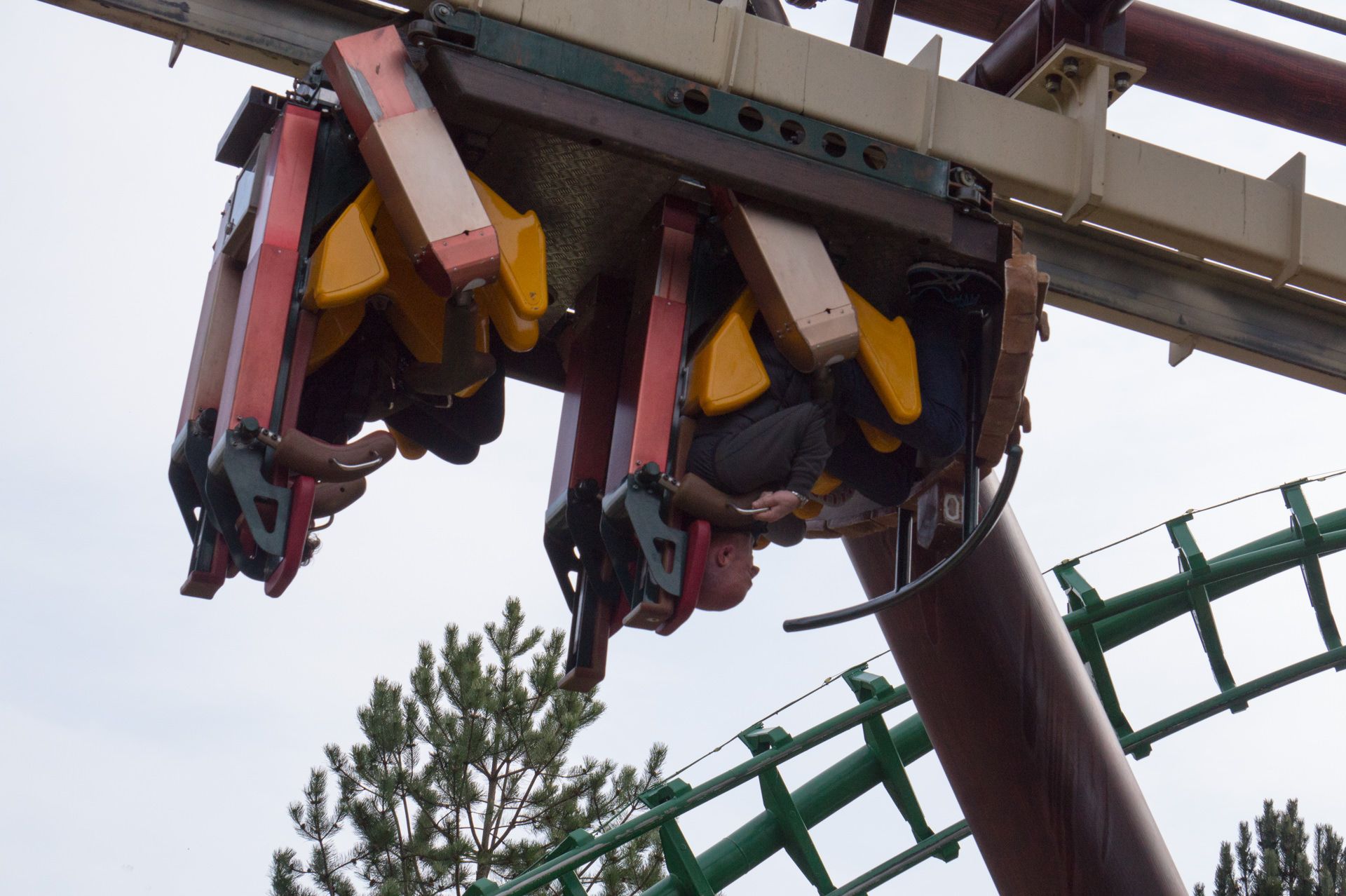
After the corridor has been lowered, the wagon group is pulled backwards up a vertical tower. As soon as the tower reaches a height of less than 60m, it is released and thus puts its passengers in free fall before the train goes with full force towards the horizontal station passage. With rapid pace you approach the Cobra Roll, the first inversion figure of the track, and do two headstands. After you have left the element, a truly huge loop follows immediately, in which there is hardly any lack of pressure in the forward direction. Without any brakes you race up the second vertical tower, as well as the now synchronously running catch-car, which catches you and carries you up. By engaging the sled, the body is now at the upper end of the shoulder restraint and thus without any contact to the actual seat. The part that inevitably follows could have been the inspiration for the Schwur des Kärnan from the North German amusement park Hansa Park, but it is much more extreme, because on the one hand the incipient free fall is of longer duration and on the other hand it is only ended by the body in the middle of the looping by renewed contact with the seat shell. The loop is now traversed with pronounced pressure, whereas the Cobra Roll is traversed much more slowly. On the way back, you are caught in the tower by a catch-car, which is now also running synchronously, so you inevitably get to know the restraint and hang in it for some time. Shortly afterwards you will be driven back to the station.

The Giant Inverted Boomerangs are a really great invention. During the development process, the responsible engineers of the Dutch manufacturer Vekoma certainly took their breaks in the coffee shops in the area. The synchronously running sleds alone make the ride interesting, at least in terms of control technology. It is also quite complex, which is why it is already a miracle that Stuntfall makes its rounds without any major problems compared to the very error-prone rides of the same series. The ride on the Stuntfall is relatively smooth, but thoroughly intense and peppered with a great pinch of airtime without straining the body too much. All in all a great ride, where the crew has done everything possible to get the ride moving.

Hotel Embrujado

In a side street is the entrance to the Hotel Embrujado, a run-down hotel that seems to be cursed. Here the story of Isabella, henceforth referred to only as the bride, and Rikardo, her groom, is told. During a fire the night before the wedding, Rikardo died in the house’s secret library, access to which was at first not found; the bride, on the other hand, waited and waited and waited. Years later, an access to the library was discovered, whereupon the tragedy of the past days seems to repeat itself. A passageway leads from the library to the richly covered banqueting hall, but it is only a projection of days gone by. It gets dark and the bride awakes from the dead. Her mood sets the room in motion, varying from grief to despair and anger over the fact that Rikardo has left her. In the end she realises her mistake and chases the visitors away.

The Hotel Embrujado is a good Mad House with a well implemented storyline, but also a lot of Spanish visitors, so the atmosphere suffers from the general and quite loud chatter among each other. In addition, the queue inside the building moves very slowly, which is why a visit in the evening with much less crowd creates a much more atmospheric overall picture.

Parque Warner Beach

If you follow the main path, you are in an escape with the lift hill of the supposed main attraction of the park, at least the steel track would be according to our definition. But now we turn left shortly before and stand in front of the entrance of the water park Parque Warner Beach. It was opened in 2014 and offers new perspectives on the two roller coasters Stuntfall and Superman: La Atracción de Acero. Inside it offers a Lazy River and a larger wave pool. Fans of impressive water slides will not always get their money’s worth at Parque Warner Beach, as there are only smaller slide complexes or play structures with integrated slides from the manufacturer Van Edgom, including an interesting body slide with a funnel. The general design of the water park has been consistently implemented in the style of the Looney Tunes and Hanna Barbara (The Flintstones, Scooby Doo, Yogi Bear) figures and is worth seeing, even if the figures from the Cine Tour had to give up their place for this. Due to lack of time we were unfortunately not able to visit the water park, so I cannot say if it is worth the additional entrance fee. At least it seemed to be accepted by the population despite the end of the season. An extension with bigger and more appealing attractions would at least be desirable, but then also with an entrance outside the amusement park.
Superman: La atracción de Acero

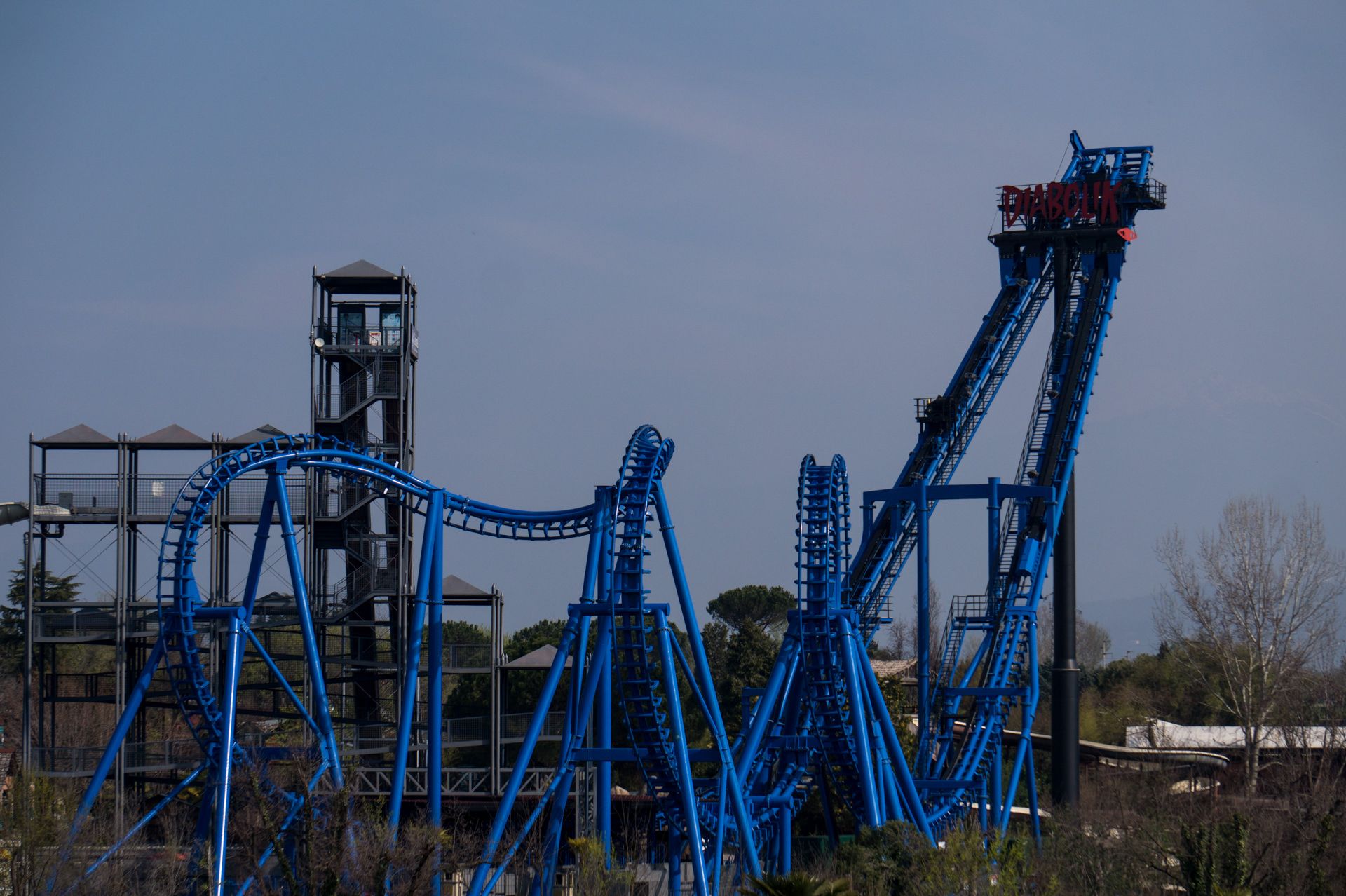
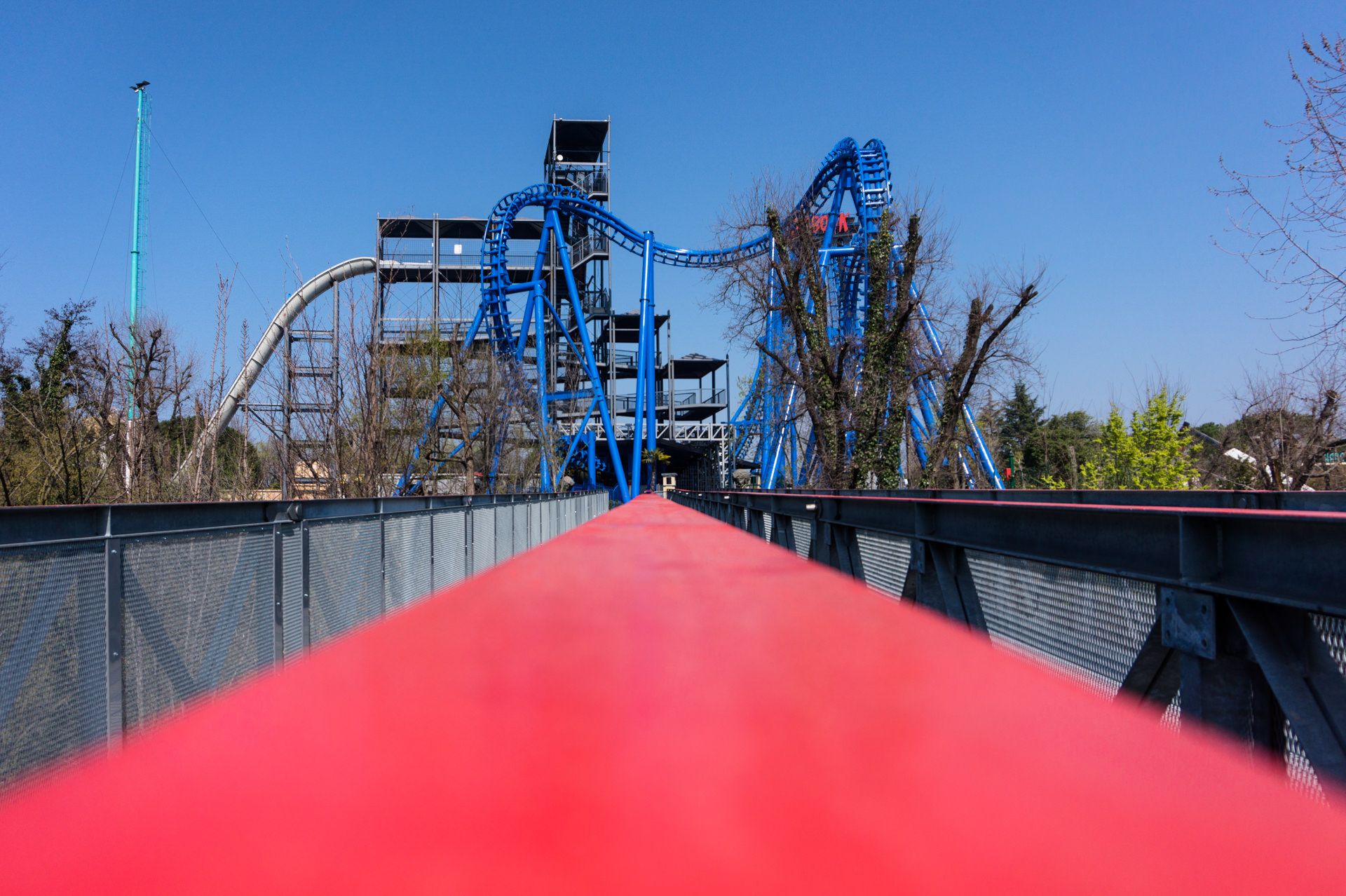
As already mentioned Superman: La atracción de Acero is the supposed main attraction of the park, at least it is one of the bigger roller coasters of the manufacturer Bolliger & Mabillard, so by definition it is already better than good. At Parque Warner Madrid, on the other hand, the steel coaster has an average waiting time of only about 15 minutes, thanks to halfway competent staff and two-train operation, no matter how crowded the park got later in the day. It’s quite funny that many visitors don’t see the roller coaster with all its supports and rails and often clog the entrance of the queue with their pushchairs.

After the floor in the station has tilted to the side, the wagon group leaves the station and immediately completes a small turn in a typical Bayernkurve. Now the lift hill leads to a height of 50m, whereupon a small intermediate slope is passed before the actual first drop. Shortly afterwards, the train disappears towards the ground and the body reacts sluggishly. Almost continuously without any contact to the seat shell you fall down the drop to find your original seat again shortly before entering the loop. This is passed relatively quickly and thus with clearly pronounced forces. The following valley is crossed with full force just before you climb the Immelmann. A Trim Brake in the next valley reduces the train noticeably, which makes the Zero-G Roll, an inversion figure in which one turns around one’s own axis without any acceleration, quite pleasant to ride. This is followed by a generously designed Cobra Roll in whose exit you pass a second reduction brake. This is necessary because on the following hill you are transported out of your seat with extraordinary force.  The first corkscrew is then entered in a straight line and after a short turn the exit of the first corkscrew is crossed by a second corkscrew, thus forming the element of the Interlocking Corkscrews. This is followed by a very intense curve close to the ground, whereupon the train takes another hill and carries the passengers up into the air again. An even more intensive upward helix follows, and shortly afterwards the brakes are reached.
Superman: La Atracción de Acero is simply brilliant. The ride offers everything a really good roller coaster needs, namely a great layout with its specific characteristics, in this case fast inversions and a balanced, although not lax, play of forces. The ride comfort is extremely good, although Superman: La Atracción de Acero is the ride with the most shoulder bar contact in the whole park and the condition of the trains in general is poor, as almost every headrest of this ride is now damaged.

Lex Luthor and Sillas Voladores de Mr. Freeze

Opposite the steel track, Lex Luthor, one of Superman’s opponents, bores his guests to death in a top spin with a lousy ride programme; interestingly, however, the ride is very popular with the park’s visitors. One of Batman’s opponents is much more fast-paced, however, as the Sillas Voladores de Mr. Freeze, a very nice wave swinger with an unusual design, offers a pretty good ride programme.

La Venganza del Enigma

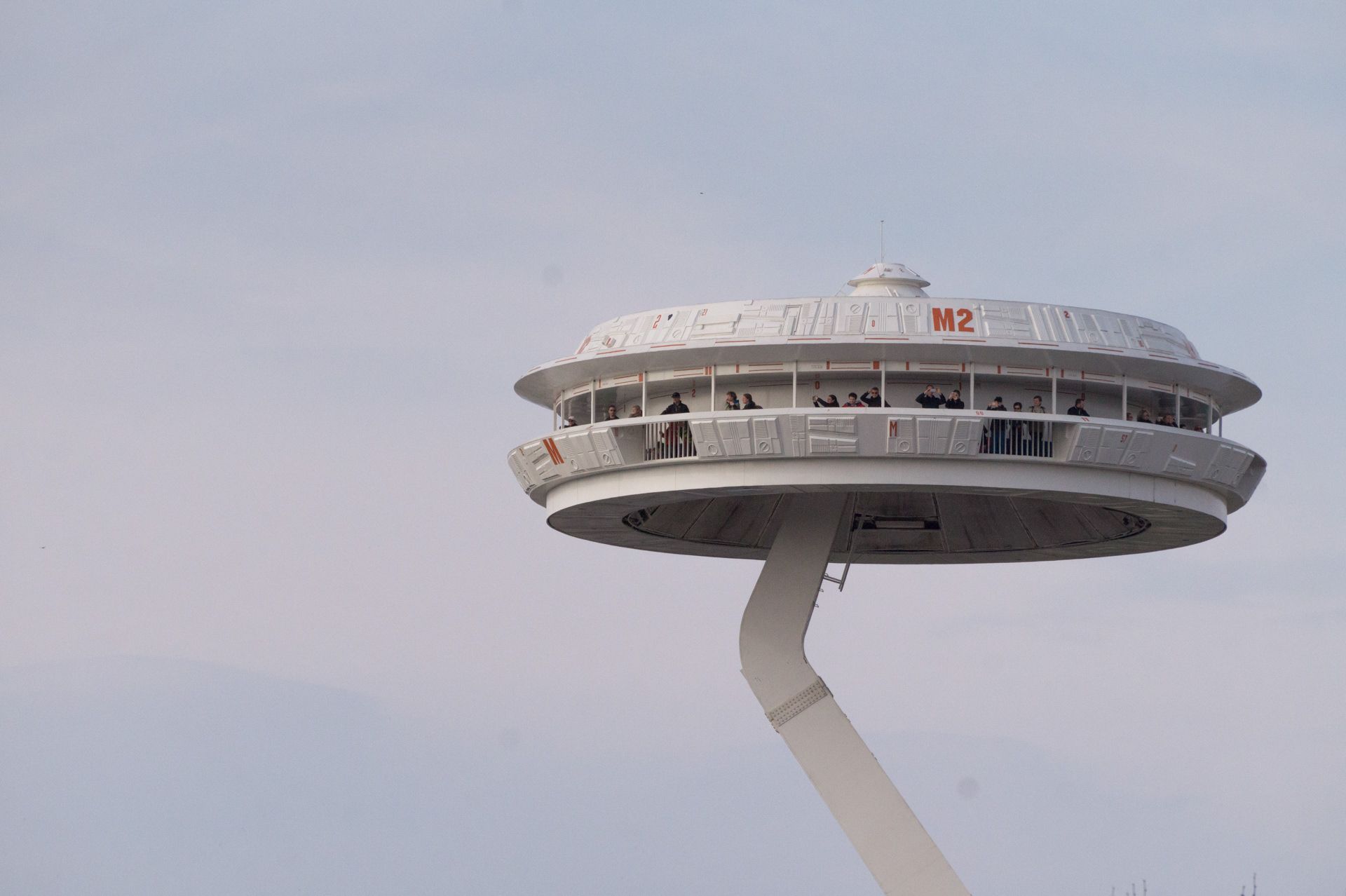
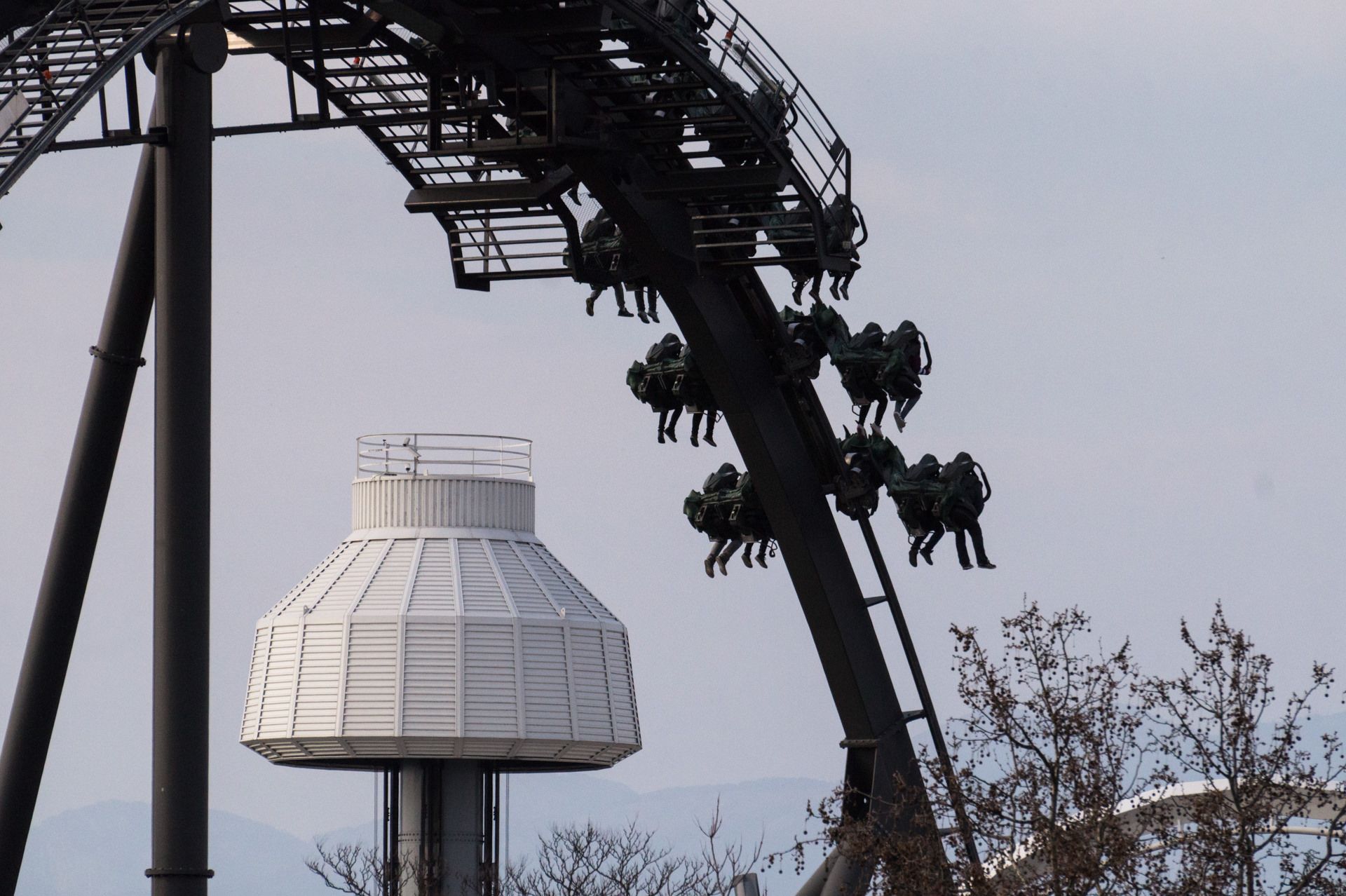
High above the ground is La Venganza del Enigma, where you are transported to a height of 100m due to the Riddler, also a villain from the Batman universe. The 120m high Combo Tower of the company S&S has in theory three different modes. On our visiting day two lanes were operated in Space Shot mode and the third lane, which only functions as a turbo drop, was closed although the waiting area was quite well filled towards the end of the day. While I described the ride in 2011 as a damn high observation tower at best, I have to revise my opinion now, because the ride, perfectly placed in the park, can do more than just look good. The launch in space shot mode pulls surprisingly strong and just as long before you reach the maximum height and are lifted out of your seat a little bit. Up here you have a wonderful view of the underlying Parque Warner Madrid and theoretically of the Spanish capital before commuting at a leisurely pace. At least it is no comparison to other Space Shot rides and so La Venganza del Enigma is quite high in my favour, especially since it is the only tower above 71m height that is still fun to ride.

Batman: La Fuga

On the other side of DC Super Heroes World is Arkham Asylum, Gotham City’s asylum, where a large number of the most famous and dazzling Batman opponents decided to escape at the same time. As Dark Knight, you’ll have to catch them again. On your way up to the station of the Inverted Coaster Batman: La Fuga, you can explore the asylum from the inside. This can, if the ride is operated in the move-in mode, due to the minimal number of employees and surreal-looking processes, sometimes take a little longer.

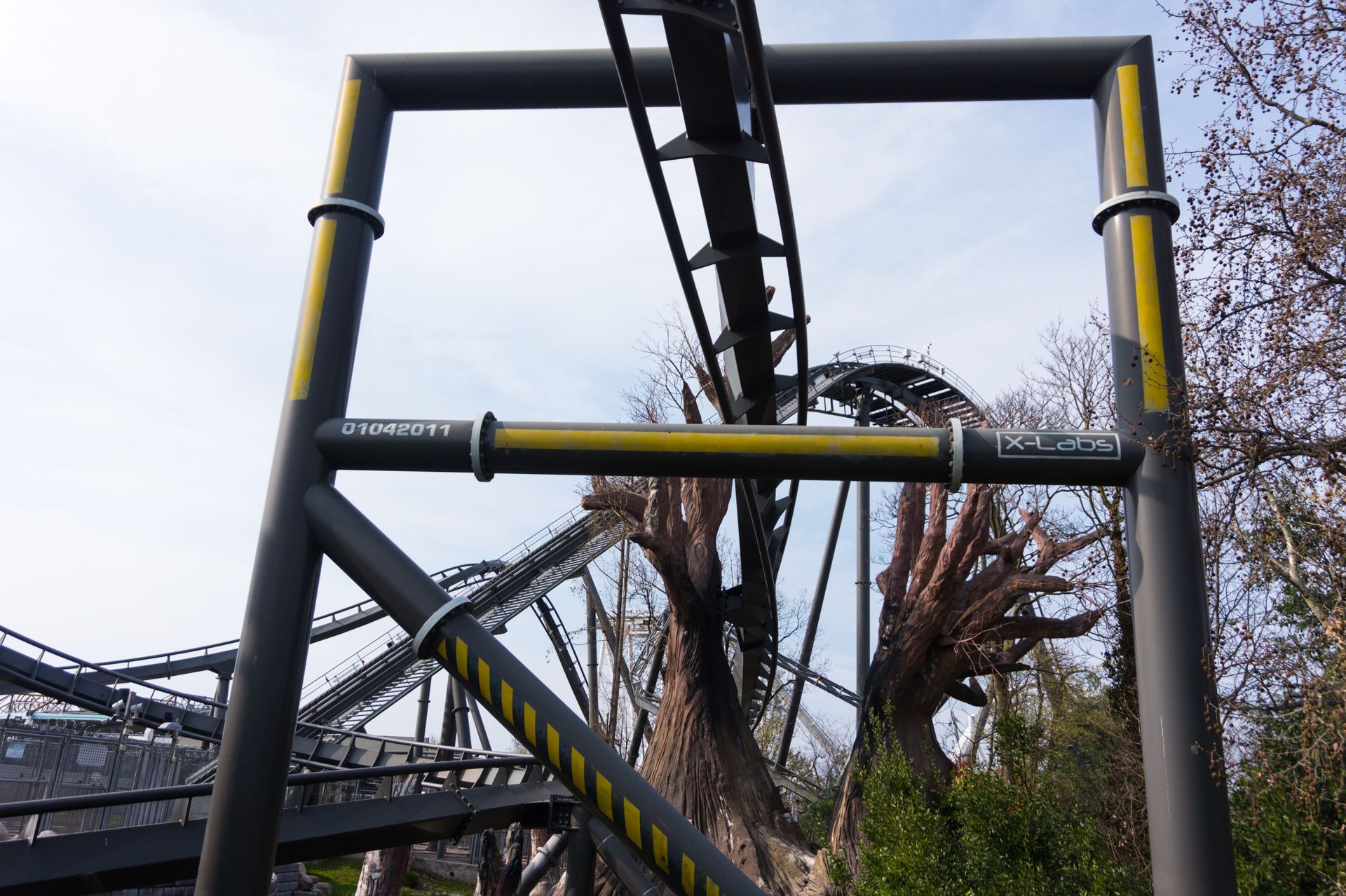
After you have boarded the train and it has finally been checked in, the journey can start immediately. You don’t spend much time on the lifthill before you make a small predrop and get pulled into a steep curve. With immense force you pass the first valley and are immediately pushed into the first loop. Before you know it, you’ll be upside down again in the following zero-g roll. Without mercy, you now perform another loop, whereupon a left-hand upward helix introduces the supposedly most harmless part of the layout. But as soon as you make the turn at a lofty height, you no longer feel your legs. A steep turn brings you back to ground level, whereupon the first corkscrew is introduced. Especially in the rear part of the turn you pull through the element with quite high acceleration. After a rather tight turn you are again standing upside down in a corkscrew, whereby the play of forces of the first corkscrew is presented here even more intensified. After an upward left turn you reach the brakes and shortly afterwards the station.

Batman: La Fuga is short, not very high, but distributes the G-Forces like no other coaster; at least in Europe. The 11 sister installations, 6 of which have a similar theme, on the other hand, are burdening the passengers in the most positive sense in the rest of the world, but mostly in North America and there from time to time also backwards. Batman: La Fuga is a great roller coaster through and through, even though it is a very intense roller coaster, which is why it wouldn’t be a pity if, besides the current renaissance of the Suspended Looping Coaster by the Dutch company Vekoma, other rides of this kind were built by Bolliger and Mabillard.

Passing through the beautifully designed Gotham area of DC Super Heroes World, the tour will take you past the bumper car Los Coches de Choque de el Joker and the former simulator Batman: la Sombra del Murciélago, which had its last season in 2014 and may be replaced by a Justice League style dark ride, into the Old West Territory. Here you will find the break dance Los Carros de la Mina, as well as the two water rides Cataratas Salvajes and Rio Bravo.

Cataratas Salvajes

The wild waterfalls, i.e. the Cataratas Salvajes, are a very efficient and in my opinion very beautifully staged spillwater from the company Intamin. The efficiency of the ride is simply based on the simplicity of the layout, which is an oval without unnecessary frills. So after the boat has been transported up the lift hill, it makes a turn at lofty heights and immediately plunges down the only shot of the ride. This creates a large wave, which is then showered down on the boat’s occupants or moistens the daring passers-by on the bridge over the lane. The degree of wetness of the ride is relatively high already, but on average it is on a par with other rides of this type.

Coaster Express

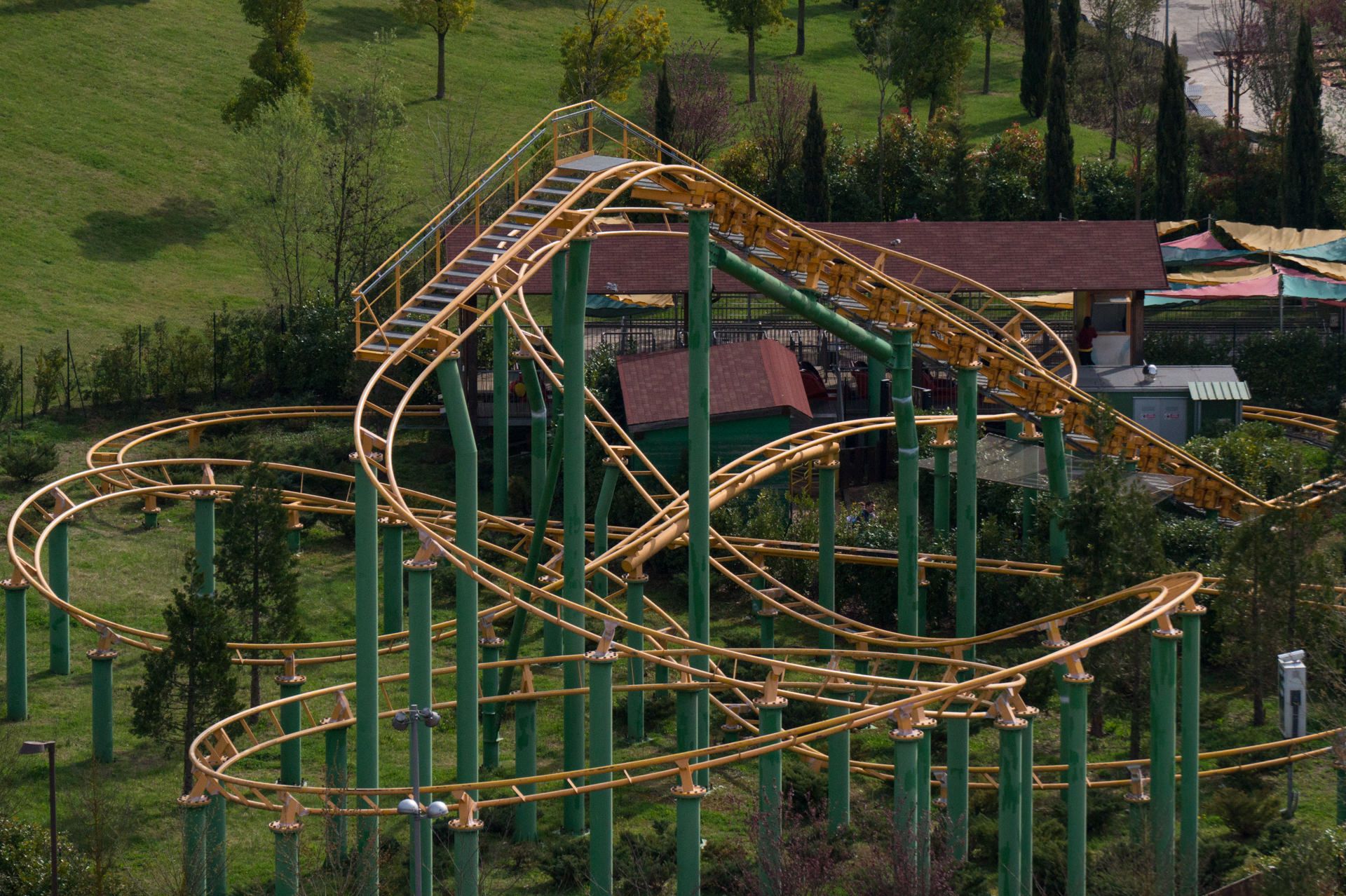
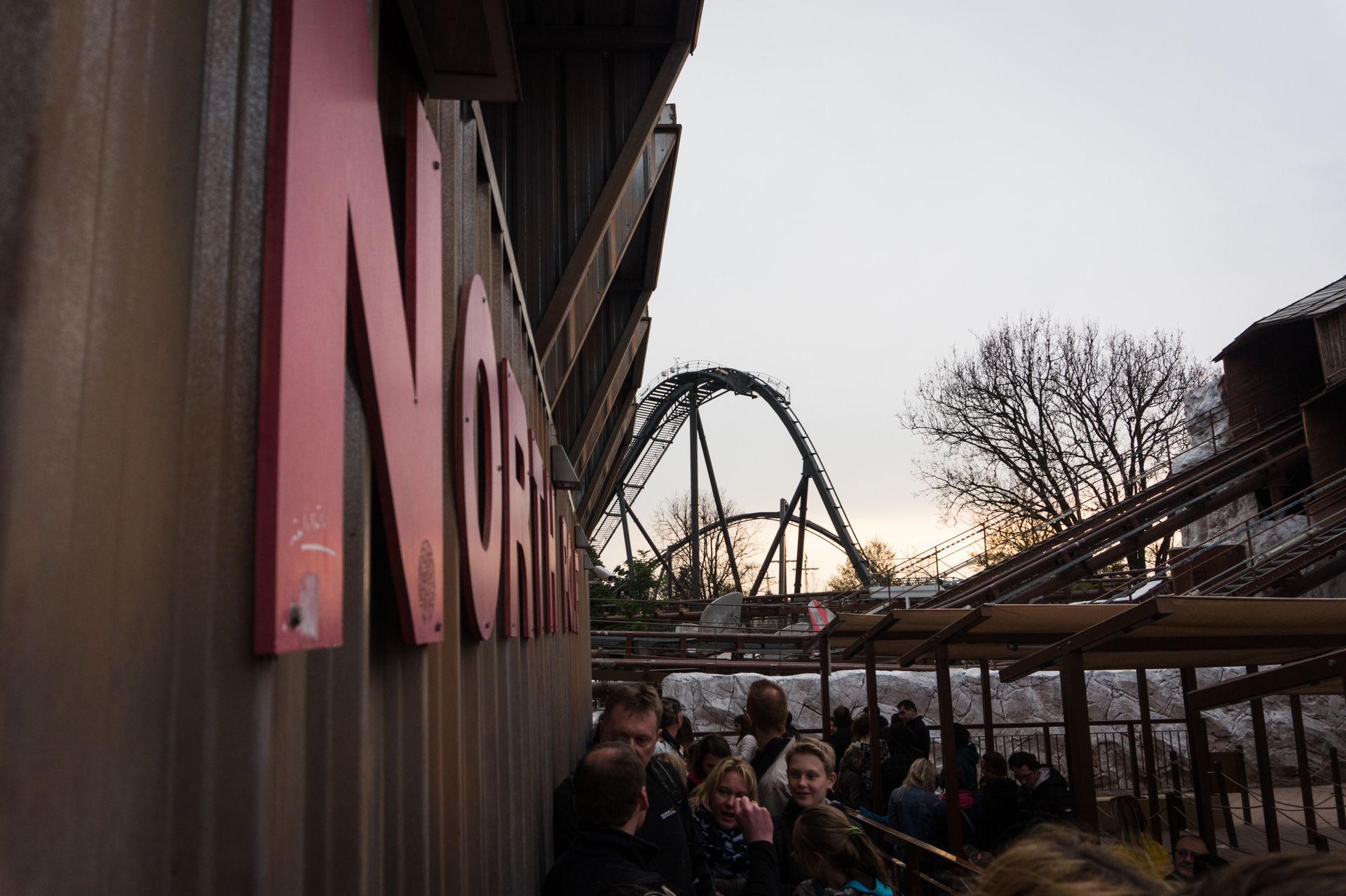
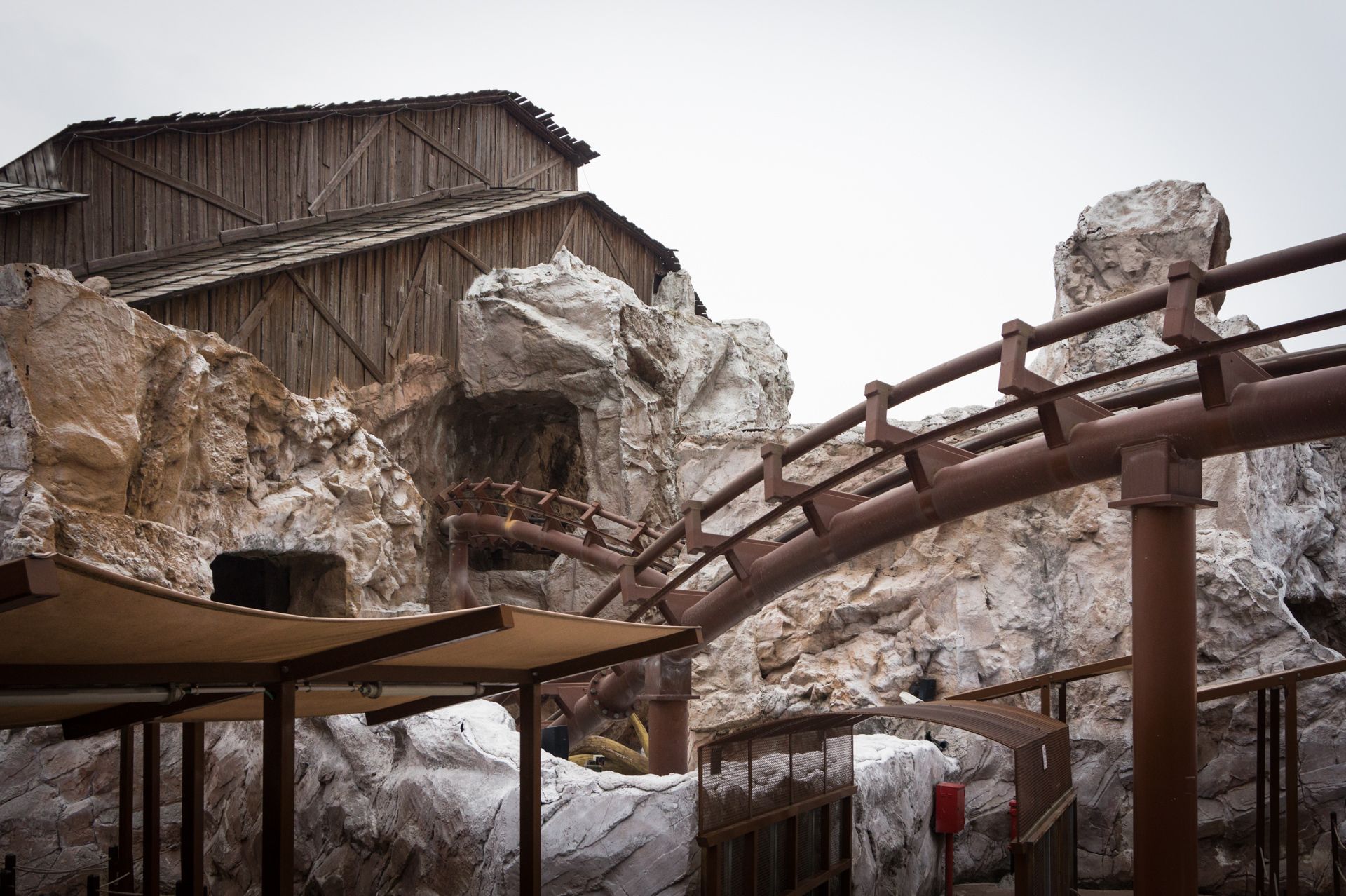
The roller coaster Coaster Express is the only roller coaster of the park which can show an eventful history after the American Six Flags group as the operator of the park was discontinued. Like Bandit at Movie Park Germany, the ride started as Wild Wild West, designed to match the movie of the same name from 1999. As this movie was a flop without equal and meanwhile, partly unjustified, is considered as one of the worst movies, it was decided not to use the licence for the roller coaster and the theme area of the same name any longer when the park changed its operator to Parques Reunidos in 2005. The oversized queue underneath the station was shortened to the outside area and the space is now used for other purposes, but you can still have a look at the train with the ejection seat from inside the station.

After leaving the station, you cross the transfer track for a short time, whereupon a left turn follows. The train then hooks into the chain and is transported up the lift hill. Arriving at a height of about 36m the train immediately turns into a wide right turn, which turns out to be a 590° helix. The speed in the valley is about 80 km/h before it starts to rise again. At a higher level, you now wrap around the First Drop until you reach the ground again. A longer straight section is followed by a small right bend at a lofty height, after which a wide straight drop joins. Now you make a higher right turn, which at the same time changes into another drop. Here you make the second and last change of direction of the layout, because shortly after that you cross another transversely inclined helix, but this time leading left and only 520° wide. This is followed by a hill relatively close to the ground, whereupon another left turn follows. This is joined by another hill across the support structure, on whose descent there is a reduction brake. This brake is noticeably effective, which is even useful in the following and quite funny curve; it was exactly this curve which set the maximum size of the passengers to a comparably low 1m85 until a few years ago. Shortly afterwards the brakes engage and the train returns to the station.

While on my last visit in 2011 I had warned against getting on the ride at all and described the ride as a torture, I have to say that the Coaster Express is a pretty funny roller coaster and not to be missed. Although this wooden roller coaster offers absolutely no noticeable negative forces, the feeling of speed in the curves is very strong; at least the ride made me laugh almost all the time. The ride characteristics on Europe’s longest wooden roller coaster are generally good and the ride looks good from the outside.

Rio Bravo

The Reversing Boat Ride Rio Bravo from Intamin is a copy of the Hopkins ride Wild West Falls from the original Warner Bros. Movie World on the Australian Gold Coast, but is based on the original design idea after the movie Rio Bravo. So you can enjoy the ride all the more, because it has been thematised down to the last detail.

After crossing the long queue you can take a seat in one of the boats, at least in the evening. To my astonishment the seat belts have been abolished in the meantime, which at least adds to the capacity of this quite popular attraction. Shortly afterwards the boat bobs past the maintenance hall of the ride towards the first lift hill. At the top you enter the huge mountain range, where the first turntable is waiting for you. The turntable then releases the boat into the first shot, which is done backwards. So far so good and often experienced, but Rio Bravo wouldn’t be an extraordinary log flume if there wasn’t a special feature following it. For many people, it is often very unexpected to see a camelback coming up, which will take you 10-20cm into the air on its crest. Shortly afterwards the descent into the cool water follows, whereby the degree of wetness is still very manageable. After a bend, you reach another turning point, whereupon the boat is on its way forward again. The river now leads you through a canyon, an Indian village and the western town of Dogde City, before you enter the mine again. Arriving at the highest point of the ride, you are brought back into position by a turntable, whereupon the second and final shot ride is initiated with a fantastic view of the wooden roller coaster Coaster Express. Once you arrive at the bottom you will be pleasantly moistened. This is followed by the return trip to the station.

The Rio Bravo log flume is a great ride with a bigger element of surprise at the beginning of the ride. The general design is terrific, but it lacks a bit of effects after leaving the second turning point. Although I don’t ask for buckets of water to be thrown in my face like on the magnificent log flume Valhalla from the English Blackpool Pleasure Beach, a little more would have been possible here, especially since the other water rides of Parque Warner Madrid are all wetter.

Tom y Jerry

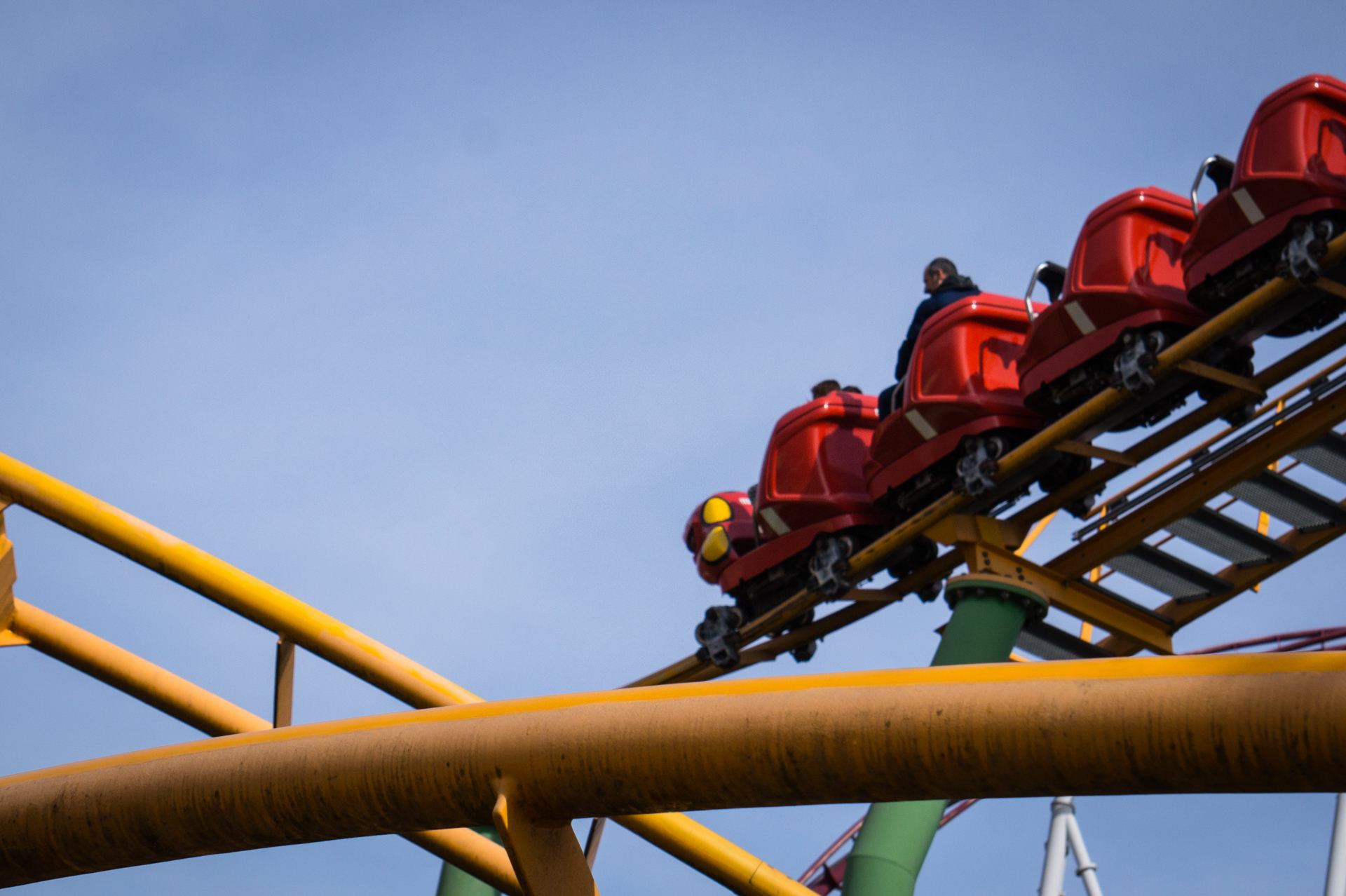
You can hear the Tom y Jerry children’s rollercoaster at Parque Warner Madrid from far away, as the ride sounds like a jet plane flying over the park. This is one of the last Zierer Tivoli large coasters produced, which was commissioned by Six Flags at the turn of the millennium and therefore has supports that meet the clearance gauge in comparison to the rides from the 1970s, which are often to be found in Germany. The layout can be described relatively simply as two adjacent eights, in which the rather wide curves are negotiated by a train that is all the longer. Mostly the course will be ridden through several times, but not at Parque Warner Madrid. Otherwise the waiting time at this very solid roller coaster would be hard to control, because Tom & Jerry is one of the most popular rides at Parque Warner Madrid.

Cartoon Village

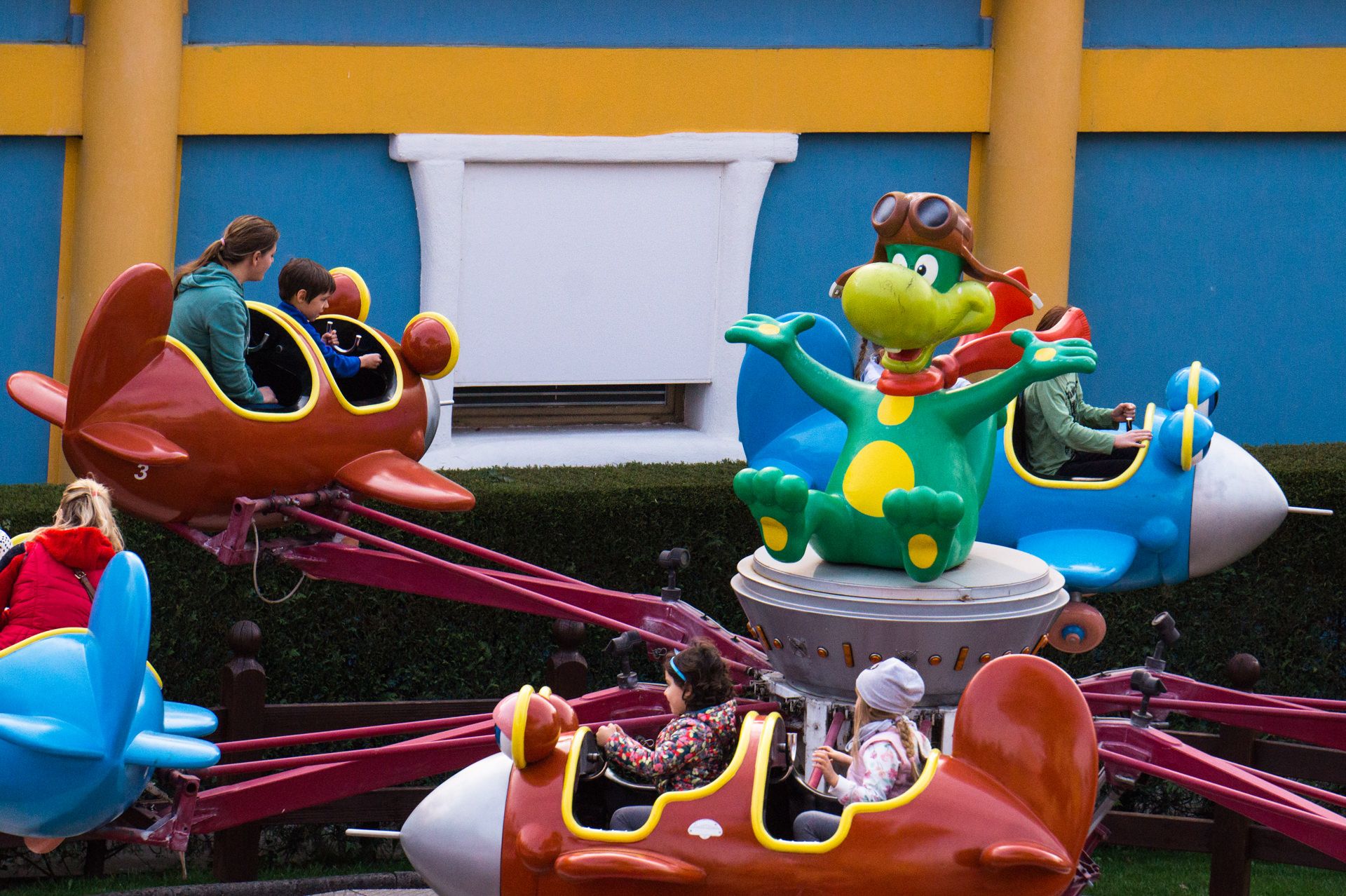
However, this generally applies to the Cartoon Village theme area with its two children’s lands and the Rápidos Acme rafting. It is true that the situation in Spain is not quite as extreme as in England, where basically only well-known, or for us sometimes completely unknown, children’s series bring the masses into amusement parks. Paultons Park has shot the bird with the Peppa Pig World, so that it is only known to the public as Peppa Pig World and various advertising brochures can already be found in Scotland. In Spain, on the other hand, although the children’s areas are more important, other visitors also come to the park and are spread over the other theme areas of it, although this proportion has increased significantly in recent years.

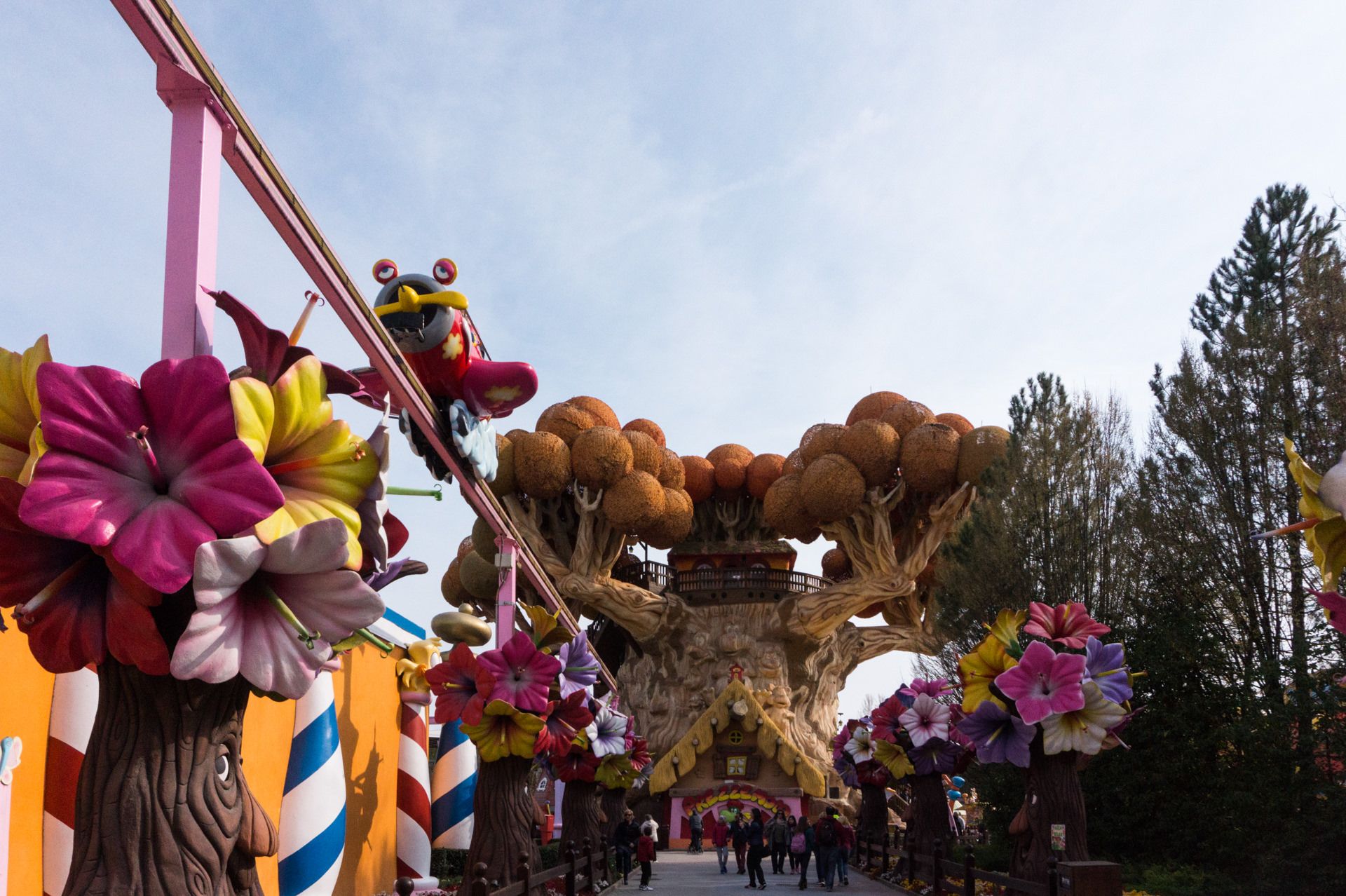
What is interesting about the Parque Warner Madrid children’s areas, however, is the way they are designed. One area was completed for the opening in 2002 and the other in 2011, with the roller coaster Correcaminos Bip, Bip from 2009 being halfway integrated. While the old children’s area has countless rides in a narrower area, always in the shade of countless trees, the new area has few rides in a larger concrete area without any shade. Although these are all neatly arranged, there is no atmosphere whatsoever in this addition. What is interesting here is that almost every new plan park has these patterns, which in my opinion is a no-go. The Academia de Pilotos, a children’s monorail from SBF Visa from 2013, has at least tried to break up this situation.

Correcaminos Bip, Bip

The roller coaster with the supposedly strange-sounding name Correcaminos Bip, Bip is a Youngstar Coaster by the company Mack, which has the same layout as the one year younger Götterblitz from the Austrian Familypark. Just like at Lake Neusiedl, the ride begins with the ascent of the lifthill. After reaching the top of the lifthill, a small gradient leads into the first curve, followed by the big drop. At full speed you pass the first valley and immediately a horseshoe, an element which is shaped like an elevated horseshoe. In a right-hand bend, you accumulate meters of altitude once again, whereupon these are reduced in a downward left helix with subsequent gradient. Now follows a curve combination of up and down helices, which resembles an eight when viewed from above.  Finally, another right turn leads the train up to the braking section and then back to the station.

Correcaminos Bip, Bip is a very elaborately designed ride, but also a very unlovingly staged roller coaster with a great layout and equally good ride characteristics. It’s a bit of a pity to see that the hunt for the Road Runner, i.e. Correcaminos, is hardly visible from the outside because of the high wooden fences with peepholes. It’s also a pity that the ride is a stand-alone attraction in a dead-end street. But all of this would not be so bad if Correcaminos would not get on the nerves of the waiting people at some point due to his pass for the queue, the Pase Correcaminos. Although the queue is manageable, it takes half an eternity until it is your turn. So somehow you can understand Wile E. Coyote. However, he only caught the Road Runner at Family Guy.

Rápidos Acme

An extraordinary ride for Europe can be found in the park with the Rápidos Acme. Even if you find it hard to believe, you will get wet on this ride. Now you could argue that River Quest from Phantasialand in Brühl often releases its passengers completely soaked from the ride, but not everyone is affected. The secret recipe of the Parque Warner Madrid is as simple as it gets, as the park does without unnecessary gadgets like waterfalls or wave pools and instead concentrates on creating as many rapids as possible on a very curvy route, which constantly splash into the boat, while always directing water jets into the boat from the outside. The whole action is nicely designed by the characters of the Looney Tunes, but to be honest, you can hardly concentrate on them during the ride. Unfortunately the effects had all been switched off towards the end of the ride, which is a pity, but it was probably a bit too cold for the Spanish.

La Aventura de Scooby-Doo

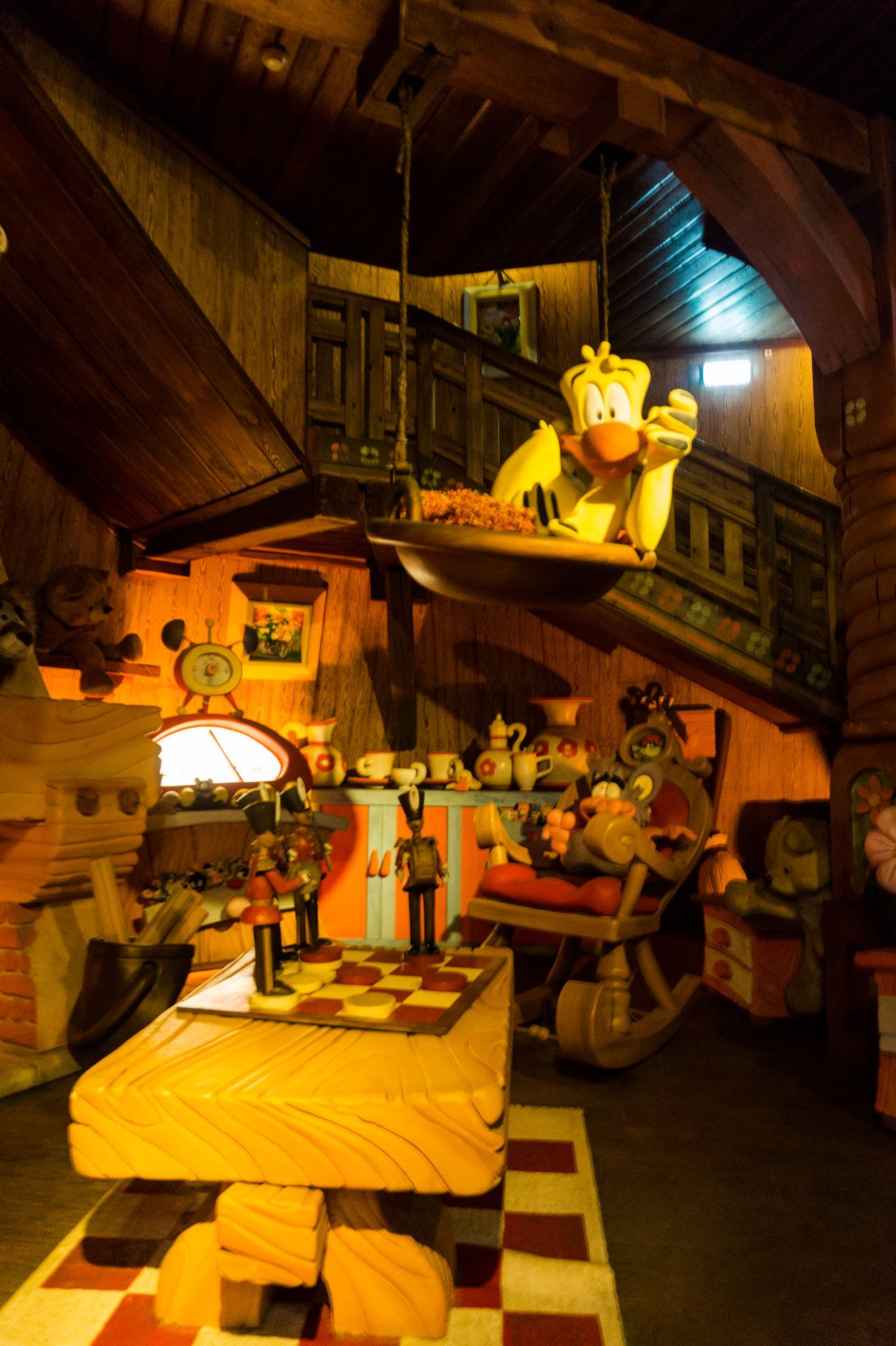
Right at the beginning of the Cartoon Village, coming from Main Street, is the interactive dark ride La Aventura de Scooby-Doo. This was designed in the comic style of the Hanna Barbara series Scooby-Doo Where are you! and features the typical elements of this series. This ride was produced by the Sally Corporation and can also be found in two Six Flags Parks and previously in each of the Paramount Parks, but now under the management of Cedar Fair as Boo Blasters on Boo Hill. The ride itself should be experienced directly after the opening of the ride or with a corresponding Pass Correcaminos, because the handling of this dark ride is more than just a bad joke. In addition, Scooby-Doo itself is very popular with the local children, which is why the crowds at the ride are always relatively high. The ride at least is nicely designed and can be fun, but it is one of the weaker rides made by the manufacturer.

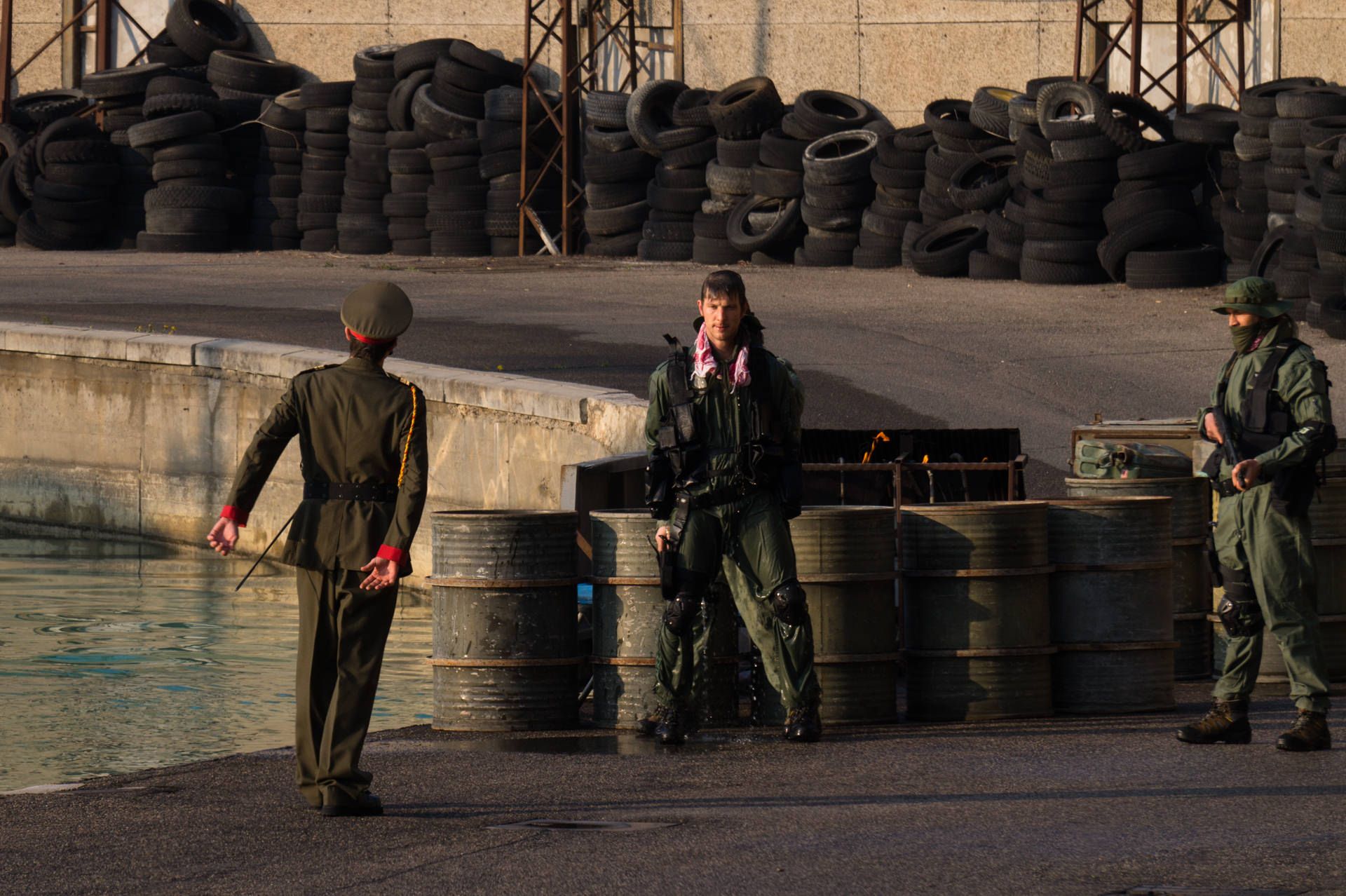
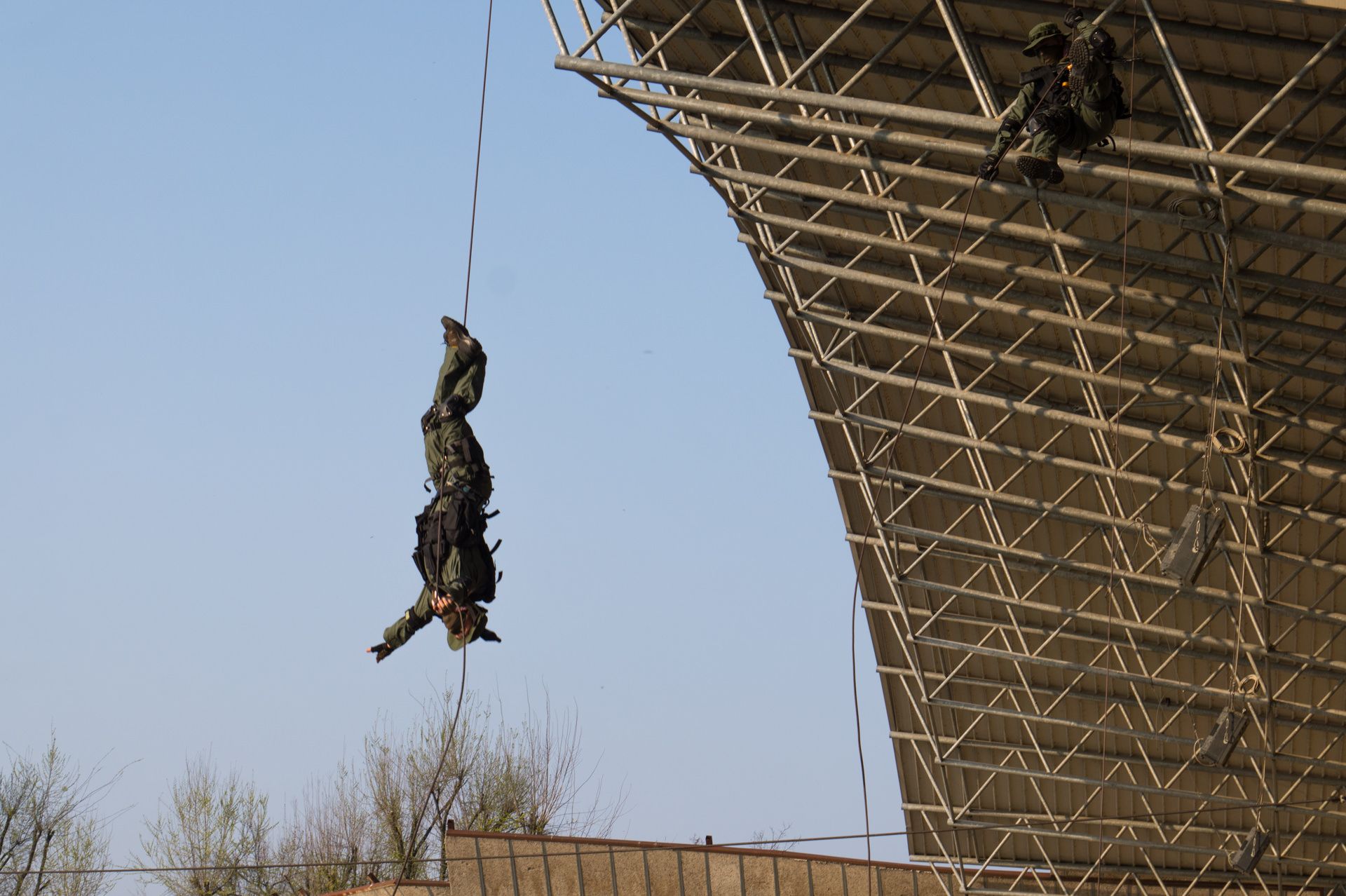
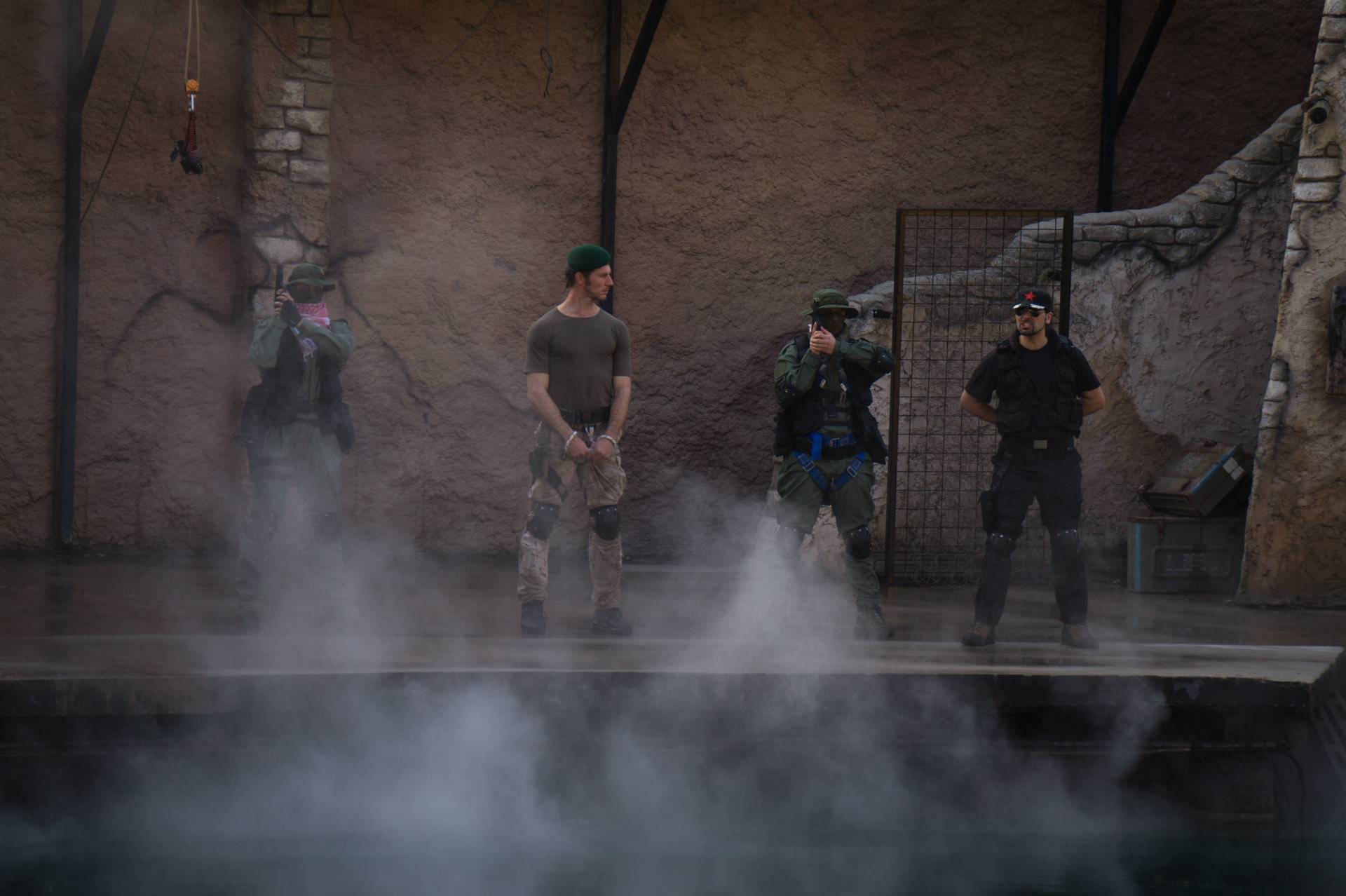
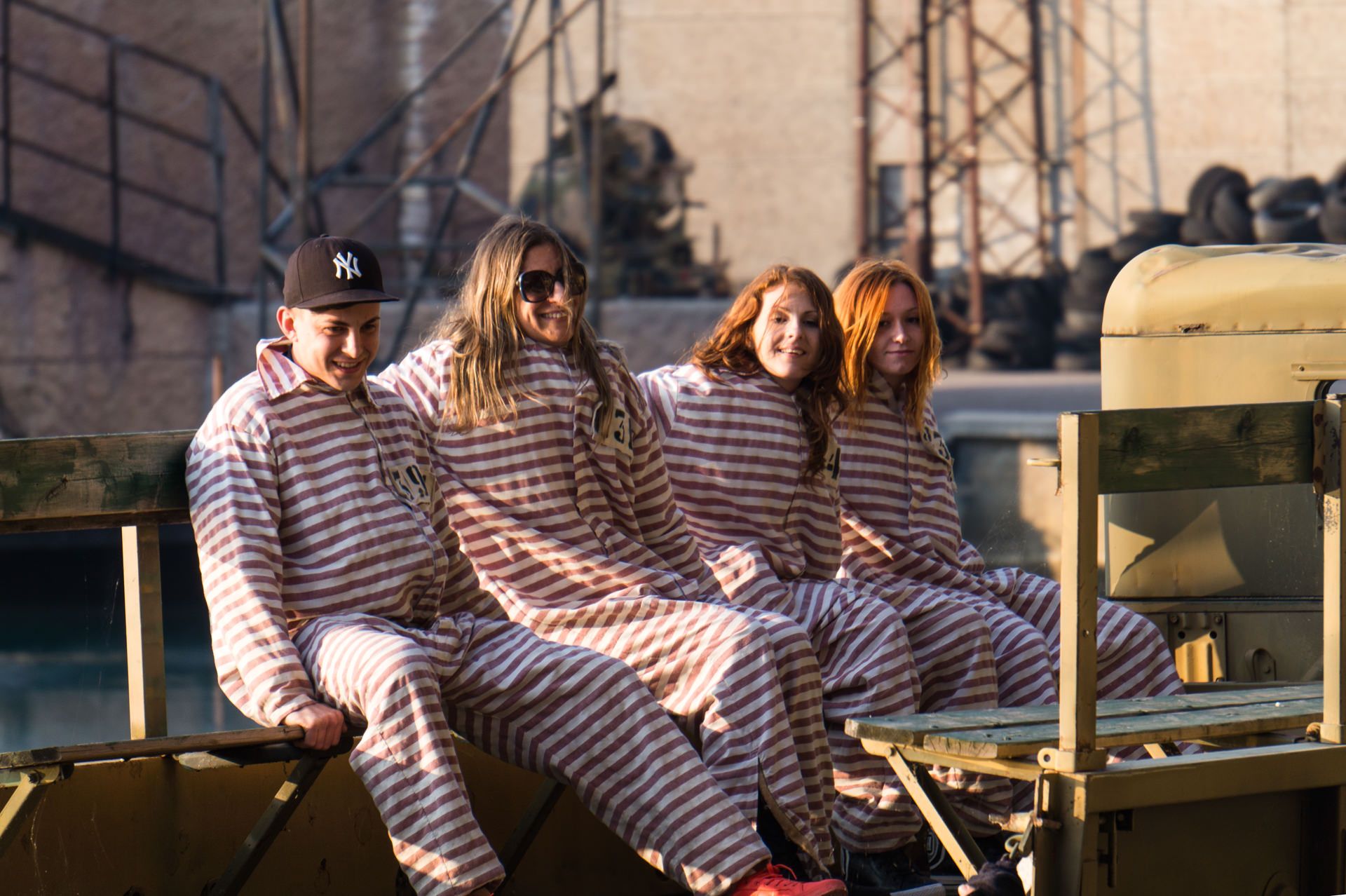
Although the rush at the big roller coasters was always manageable and appropriate, the park was very well visited. In fact, during the visit it seemed as if the park was almost overcrowded, this was mainly due to the general preferences of the Spanish and so it should not surprise anyone that the waiting time before each show was over an hour. This is also the reason why we left the Scooby Doo musical and the Police Academy stunt show. One could think that this was a big mistake, as the shows in Spain are generally not as negligible as those of German amusement parks, but on the other hand we could not have managed the park completely in one day. In fact, the offer of these at Parque Warner Madrid is also significantly lower than at the amusement park Port Aventura near Salou, whose recipe for success is actually due to the big show theatres. Here, the park might add another theatre or at least show the shows more often.

Parque Warner Cinematic

However, this does not work for the evening show Parque Warner Cinematic, as it only really comes into effect after dark. This is a fountain show with projections of well-known Warner Bros. films and commercials for upcoming films of the studio. The show, which takes place on the lake in the Movie World Studios, is supported by fire and laser effects, as well as a quite appealing final fireworks display. The show was already worth seeing on the occasion of the 10th anniversary of the park and even now not much has changed. Definitely worth seeing, especially as it is a great ending of a great park day.

Pictures Parque Warner Madrid

Conclusion Parque Warner Madrid

Parque Warner Madrid is still a very great theme park and in my opinion still the best park in Spain. Compared to four years ago, the number of visitors has developed quite well, which unfortunately makes the Pase Correcaminos very annoying, especially since it can be used almost everywhere, unlike Port Aventura. Except for Batman, which features a one train operation, the handling was much quicker than before and in the case of the roller coaster Stuntfall even exemplary. At least for the time being one is on a good way that should be maintained. But if the rush should be as high on the next visit, I will definitely treat myself to a Pase Correcaminos.


What is your opinion about the spanish theme park Parque Warner Madrid? Just write it here below the report in the comment field or visit or our social media channels:


Baron Hooghmoed, Prime comes before the fall!

Preface

No other amusement park made it so easy this year to visit the park as easy as Efteling. In order to promote his new roller coaster Baron 1898, the park gave me, as many other people, a free ticket out of the blue. Therefore, in the middle of October – shortly before the ticket expired – on a very rainy day, I took a trip to the Dutch village of Kaatsheuvel.

Efteling

The Efteling amusement park originated as a fairytale forest in 1952, but originally as a nature park in the 1930s, where a total of 10 fairy tales were told. Under the direction of the artist Anton Pieck, after whom the central square with a few smaller carousels in the Marerijk area is named, the fairy tale forest grew steadily and – unlike most other theme parks – never lost its importance. Beside the talking tree Sprookjesboom, which tells the children the fairy tales of Sprookjesbos in Dutch, you will find some bizarre and very interesting things, such as the Indian water lilies or the flying fakir. Especially with smaller children you can easily spend most of the time in the park in this area.

Droomvlucht

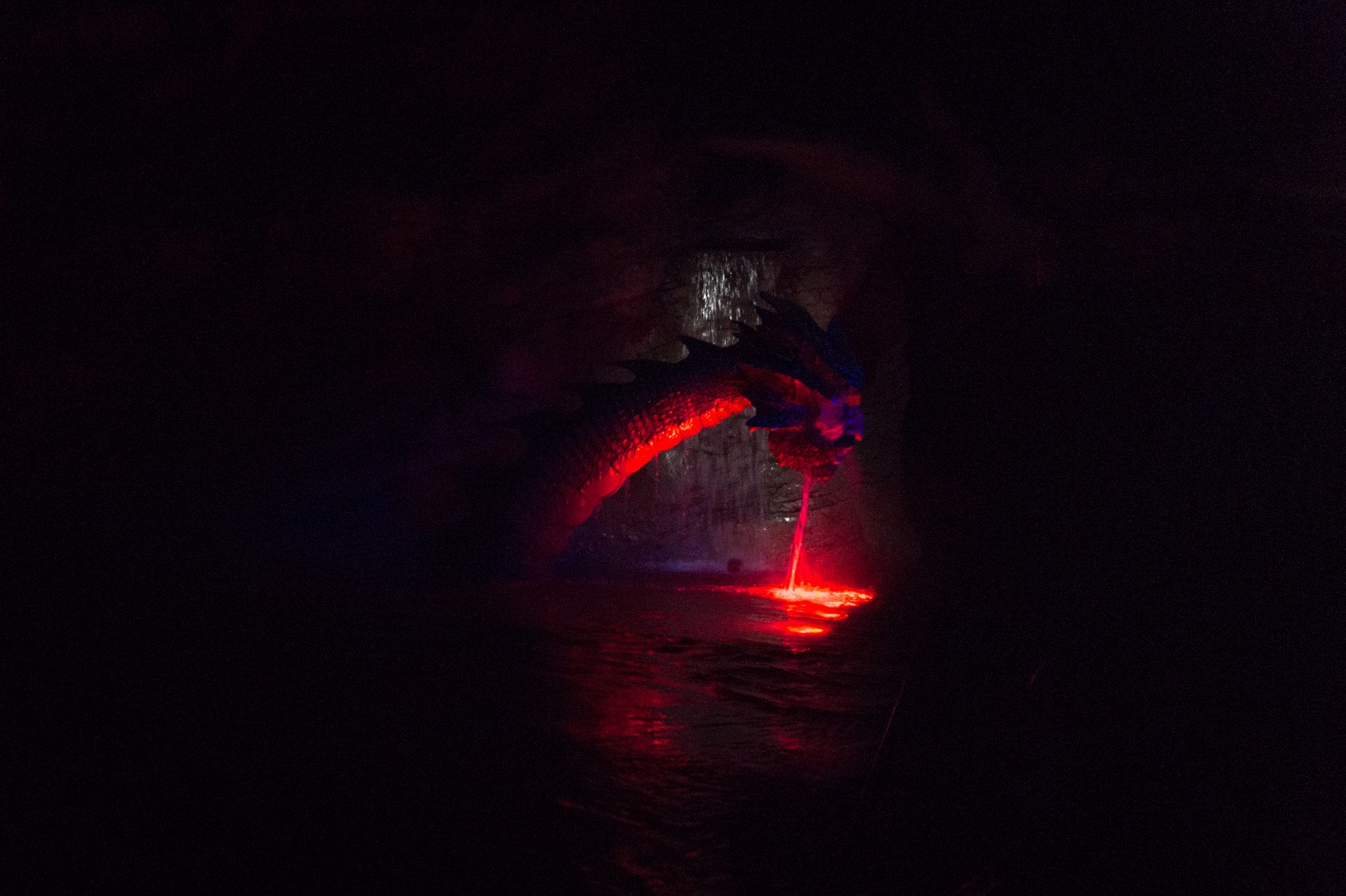
However, the most popular and most visited attraction in the Efteling since 1993 has been the Droomvlucht dark ride, which takes you past larger scenes of fairies, elves, trolls and other fairy-tale creatures in suspended gondolas. Although the dream flight, as the English name suggests, could hardly be more cheesy and superimposed, the ride through the dream scenes is definitely fun and the descent taking place in a 1080° helix is truly unusual.

Villa Volta

Next to the Ravelijn show, for which translations are available, there is the prototype of all modern Mad House attractions, the Villa Volta. The story of the Bokkenrijders, a band of robbers from the 18th century, is presented. Hugo van den Loosche Duynen is the aged landlord of the villa, who robbed a deserted, but richly stocked abbey with his gang and was cursed by a suddenly appearing woman and since then cannot find his peace anywhere. Only a person with a clear conscience can release his spell, which is why Hugo invited volunteers to his house.

A Mad House is a ride in which a gondola, with two rows opposite each other, in a rotating drum is swivelled about 30° to both sides. The rotating, highly decorated drum gives the impression of turning upside down in a room, the pivoting of the passenger carrier underlines this by the generated accelerations. The event is accompanied by suitable music and lighting, and if necessary by various other effects. The Villa Volta is not only the pioneer of this type of attraction, but also one of its best examples.

Volk van Laaf

In the village of the people of Laaf you can watch the Laaf during their daily life or take a monorail tour through the colonnades of the houses. The people of Laaf are reminiscent of Holle Bolle Gijs, who can be found throughout the park. These are talking garbage cans that say “paper here!” and encourage the little guests of the park to throw their garbage into the gullets of the never-full inhabitants of the park.

Monsieur Cannibale

Monsieur Cannibale also likes to eat one with pleasure, although it is only a teacup ride in which you sit in some bigger cooking pots instead of cups. The ride is not so interesting because of the heavy to turn gondolas, but the catchy tune of the song of the same name by Sacha Distel certainly contributes to it.

Carnaval Festival

The best you can do in the Reizenrijk is to travel, therefore a ride in the cars of the Carnaval Festival dark ride should not be missed. Accompanied by a merciless catchy tune, you accompany the jester Jokie on his always cheerful journey around the world, whereby the clichés of the corresponding countries were excellently staged. Carnaval Festival does not need to shy from the comparison with Disneyland Parks’ role model It’s a small World, as the ride offers everything a good dark ride needs to offer and in my opinion is even a bit better, as it is much less annoying.

Vogel Rok

Located next door is the dark roller coaster Vogel Rok, which immerses you in the world of the stories of 1001 Nights, at least in the stories of Sindbad the Seafarer. After the train has left the station it passes a short gradient within a right turn, whereupon the lifthill of the ride follows. Accompanied by laser effects we climb to the top of the lift and then immediately enter the main drop of the ride. With a slope of 55°, the train now races towards the ground in a left-hand bend. The height difference of 21m results in a speed of 67 km/h, which is kept constant in a very wide left turn close to the ground. Shortly thereafter the train shoots up and approaches the ground again in a slightly smaller radius. In the following valley we change direction. A curvy hill, past one of the name-giving birds, later we pass through an uphill helix, at the end of which we are eaten by a snake. Then, we pass a block brake before racing towards the ground in a left turn. The track then increases in height before the radius of the curve narrows down into a downward helix. The train now moves off the ground one last time and dives into a tunnel of lights. After that the brakes are reached and immediately after another right turn there is the station, which is usually approached with the loud music of the onboard sound system.

Vogel Rok is a great roller coaster of the type MK-900 by the Dutch manufacturer Vekoma, which delivers a short but thoroughly thrilling yet always harmonious ride. It is amazing how fast you can accumulate your laps on this coaster, if you stay a while when the park is less busy.

Gondoletta and Pagode

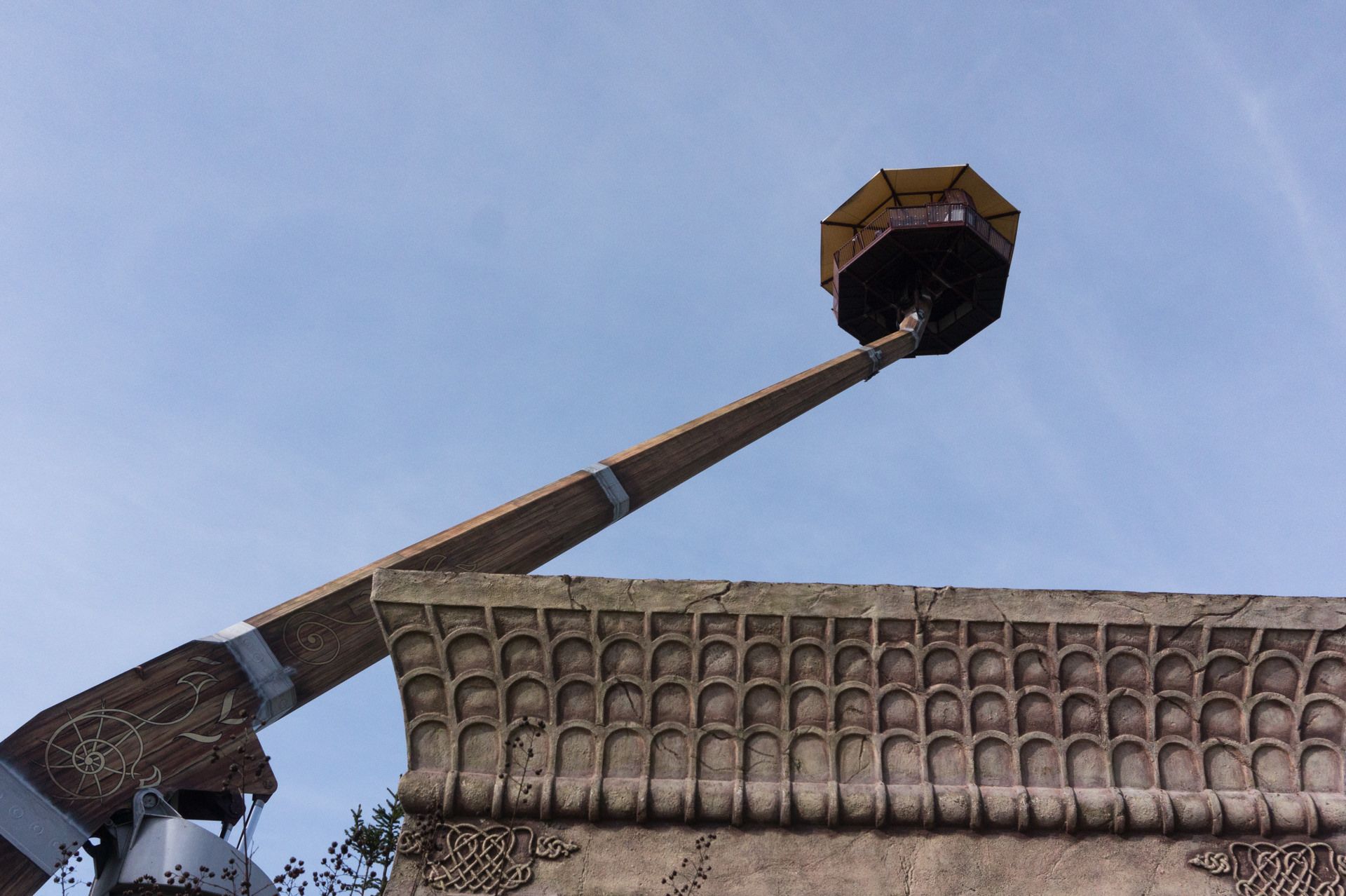
For those who like it a little more relaxed, the boat trip Gondoletta is the perfect choice. For 20 minutes the extra long Tow-Boat Ride of the company Intamin takes you across the entire lake and it is quite big. Since this year, in addition to the obligatory feeding of birds and the resulting siege of countless water birds, you have a really great view of the roller coaster Baron 1898. A similarly interesting view is guaranteed from the observation ride Pagode, a Flying Island also from the manufacturer Intamin, which brings you to a height of 45m without any tower structure. This happens basically by an oversized lever at whose end the passenger gondola is suspended and at whose other end the oversized counterweight is located.

Halve Maen, D’Oude Tuffer and Polka Marina

The swinging ship Halve Maen, which is currently the highest ship swing in Europe, can also be classified as a relaxing ride. Next to it you will find the vintage car ride D’oude Tuffer, which allows its cars to travel the long distance with rapid pace. Equally interesting, although only due to the outwardly inclined curves, is the Polka Marina ride by Vekoma, which always makes me smile.

Python

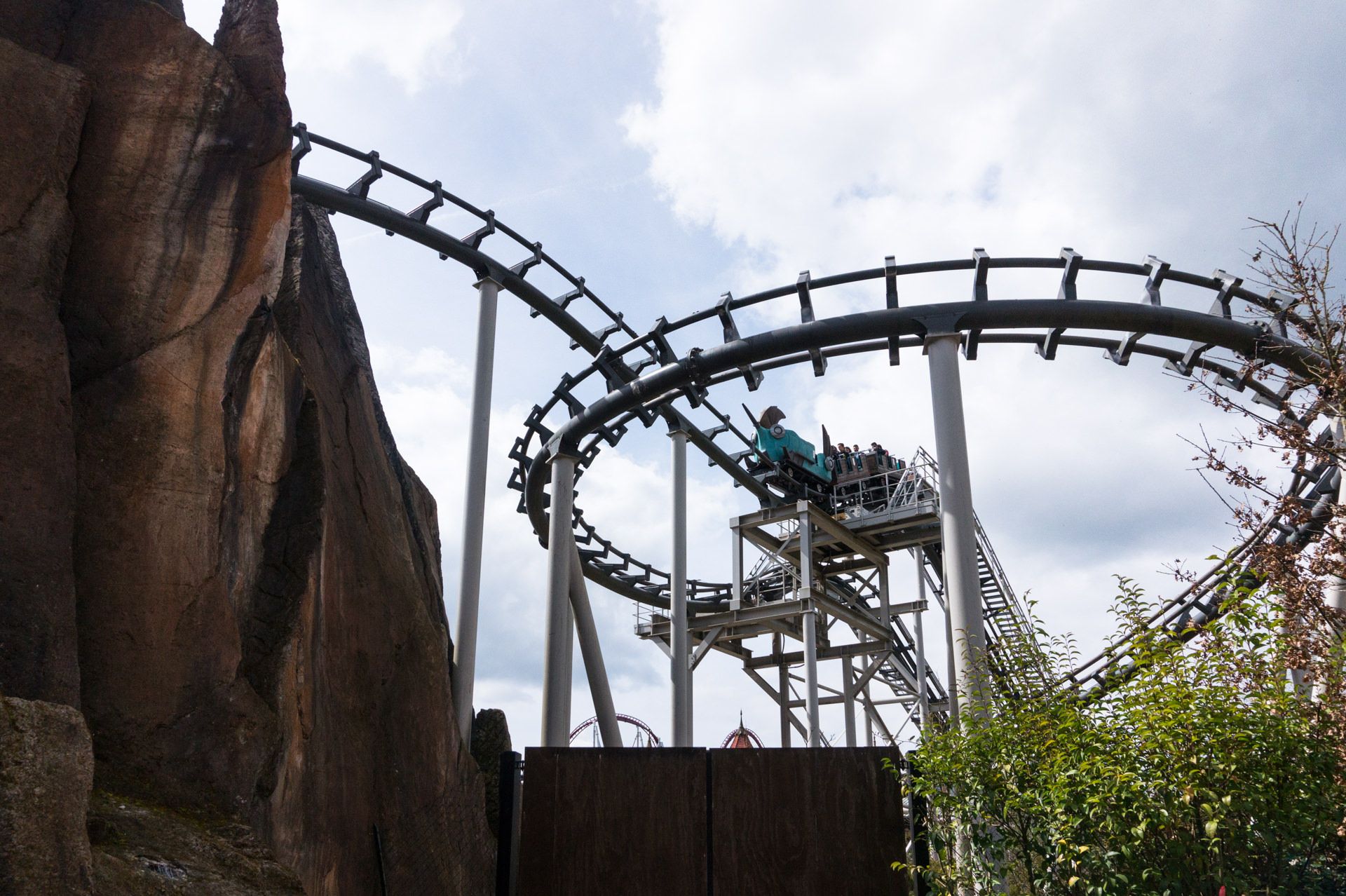
However, the things you are interested in in the Ruigrijk area are certainly not flat rides of the area, rather the roller coasters that reign this corner of the park. The first one was the Python steel roller coaster in 1981, which carried its passengers not only through one loop, but two consecutive loops. In fact Python was the highest steel roller coaster in Europe at that time and with its four inversions the most exciting roller coaster on the continent. Just as exciting as the coaster Carolina Cyclone of the American amusement park Carowinds, which was the first roller coaster worldwide to entertain its passengers with four turn-overs a year before. Efteling was therefore thinking big even back then!

The train leaves the station on a small gradient, followed by a left turn. Shortly after the train enters the lift chain, which brings it to 29m. A small slope and another 180° left turn follow before the train races down the main shot. Then the train passes through a powerful valley and enters the first loop, whereupon the game repeats itself in a second loop. On a straight incline the train gains some height and immediately throws itself into a curve. This leads the train to the starting position of the corkscrews, into which one enters at a remarkable angle. While the carriages screw their way through the corkscrews, the world is upside down two more times. After a small hill an upward spiral follows. Immediately afterwards the braking track is reached.

Python is a great roller coaster of an older design, which doesn’t have to hide itself due to its truly intense performance, especially in the evening. After the original Arrow trains, as well as the second train generation of the manufacturer Vekoma and trains of the manufacturer KumbaK had been used on the track, modern trains of the fourth train generation by Vekoma now enrich the the ride. Unfortunately I could not test them during the current visit, but the KumbaK trains gave a solid impression during a past visit.

Joris en de Draak

Wooden roller coasters have a long tradition in Efteling, dating back to 1991 when Pegasus, an absolutely boring and slowed down roller coaster for children, was built in the park. It was the first wooden roller coaster in the Netherlands. A year after its removal, Efteling build Joris en de Draak. This ride introduced two more wooden roller coasters of the popular manufacturer Great Coaster International (GCI) to the park. The background story is dedicated to the patron saint of the English, the dragon slaughterer Georg. The layout is divided into two tracks, Vuur and Water, both of which are duelling each other whilst showing different but somewhat balanced riding characteristics.

Both sides start parallel to each other, but a few meters apart, with a small gradient out of the station to which the lift hill is immediately added. Once at the top, both sides make an S-curve and a turn mirror-inverted to each other, so that the sides meet in the middle and thus deliver a race during the first drop. The trains then shoot through the first valley, which is immediately followed by a triple up, i.e. a triple combination of hills that always leads upwards. In the following right turn the sides lose each other.

With a double down, Water is showing its wild side right at the beginning of its independence. In a bumpy curve you fight your way to the right side of the course to cross more hills along the lake. In the same manner the train now makes a turn to the left.

Meanwhile Vuur also passes under its opponent in a double-down. In a flattened right bend you cross the truss of the lift hill whereupon a drop takes place immediately above the sidewalk. With a short look at the Vliegende Hollander a left turn is initiated. Over several hills one makes one’s way over the lake, whereby these are not so frequently present as on Water. A smooth right curve, which serves as a turn, follows. Thereupon both sides run next to each other again.

After a short straigth section, a smaller slope follows, to which a rather wild combination of right-left curves is attached, whereby both sides can show track sections inclined to the wrong direction. Soon the finish is reached and the winner of the race will be announced at the brake track. Afterwards you pass through the maintenance house and two left turns to the respective station, where you enter under fanfare or loud booing.

Joris en de Draak offers two good wooden roller coasters, but the rides are quite different and therefore not quite the same. Water offers the apparently wilder ride, because it is going over smaller hills and also the curves seem a little more daring, while Vuur is more careful with its gradients and therefore a little more efficient to tear his passengers back and forth. I can hardly explain why I preferred Water during my last visit in Efteling, as it was Vuur who convinced me more this time.

Vliegende Hollander

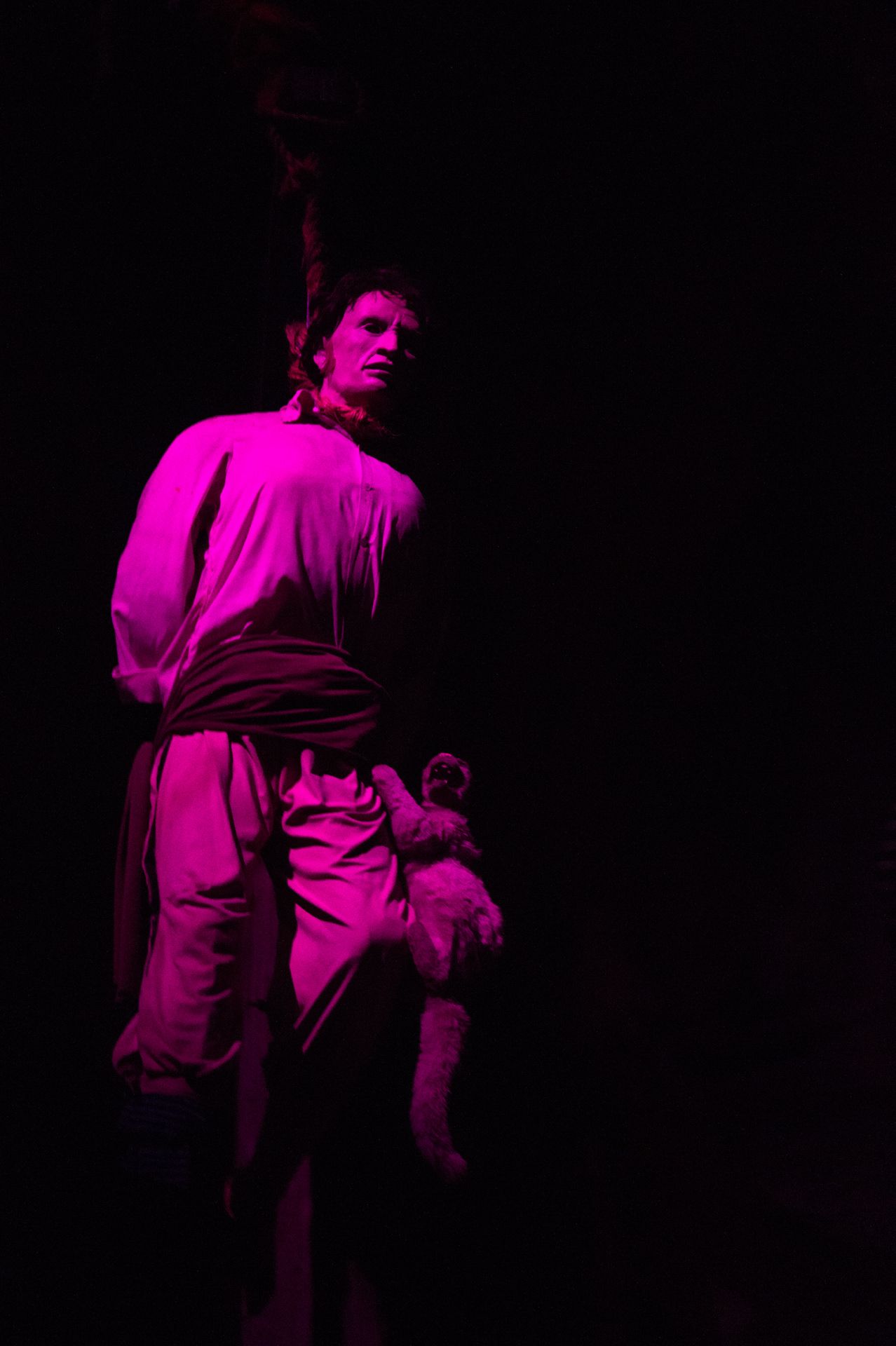
On the other side of the lake there is the Vliegende Hollander, a water roller coaster with a moving history. By this I don’t mean the problematic manufacturing process of the installation, where even another company was called in to solve the initial problems, but the story of Willem van der Decken, the captain of the Dutchman, a ship of the United East India Company. Due to his greed, the captain is more and more subject to piracy and even storms and holidays, when it was forbidden to set sail, didn’t stop him. “I will sail, storm or not, Easter or not. I will sail, even until Judgement Day,” said Willem, drawing a curse on him. Damned for eternity to sail the seven seas of the world, the Flying Dutchman races across the sea as a ghost ship with his black hull and burning sails.

The journey begins in a 17th century seaport. After leaving the station you can see in the first scene how your own boat sets sail. Fog is coming up and is getting denser, only a lamp at the bow gives some light. A storm comes up and with it the Flying Dutchman shows itself to the passengers. Through the hull one enters the interior of the ghost ship. A surprising drop follows and thereupon a rise, in which one is held immediately by a brake. Here Willem van der Decken shows his true face, whereupon the lift chain grabs and brings the boat to a height of about 22m. Immediately a steep turn follows out of the building towards the ground and through a fog-flooded building. A camelback is attached and shortly afterwards a horseshoe, i.e. an elevated turn, which you pass through with a considerable cross slope.  A short ascent leads to a block brake. This is followed by a small drop and a long bend, which then turns into a shot into the water basin. After the watering, the boat is transported back to the station by circulating chains.

The Vliegende Hollander offers an almost perfect mix of a dark ride and a water roller coaster, which was skillfully staged. The part in front of the lift hill is so atmospheric that you could almost skip the ending. But this one also does a good job, even if the finish could be wetter.

Baron 1898

On a highly atmospheric path, which also provides some nice insights into the roller coaster part of the water coaster, you can walk to this year’s novelty, the Dive Coaster Baron 1898. Even from far away, the appearance is convincing by its industrial charm and the framework structure, which carries the lift, as well as the first drop. The Rijksmijn winding tower transports the miners down into the shaft, where they are to mine as much gold as possible on behalf of Baron Hooghmoed. But the Witte Wieven, white women in Dutch folklore, who watch over the gold, want to prevent this. Gustave Hooghmoed doesn’t listen to the warning, so he urges the miners to climb into the mine. With a fearless “Glück Auf!” he says goodbye to his workers.

After boarding the train and lowering of the floor, the train starts moving towards the next room. In a musical way the Witte Wieven reappears. This time, it is not just a simple warning and they announce the sabotage of the descent, as pride comes before the fall. At a fast pace we climb the steep lift, which brings us to the starting height of 30m. Arrived at the top, a small section continues straight ahead whereupon we are pushed over the edge. Now we are held in this position for a few seconds until a bell rings and releases the train. From here we descend the vertical drop into a fog-flooded tunnel. The 37.5m difference in altitude produce a speed of about 90 km/h. At top speed we now enter the first inversion, an Immelmann with a relatively late rotation around its own axis. With a lot of power we pass through the following valley before we turn upside down in a Zero-G Roll. A short straight section later the train increases in height in a helix and immediately decreases in a small drop, whereby the transition takes place a little rough. After another hill we take a right turn, which releases us into the braking track. This is followed by the return to the station.

The exit from the station is via a gallery, which leads into a narrow corridor and, after a long staircase, releases the miner from the building. Funnily enough, an employee handed a CD with the Baron 1898 remix by DJ Hardwell as a personal souvenir. On the way back home the CD was heard almost continuously, although the connection to the Baron 1898 was not really clear. It’s just a nice song, which serves ideally as background music and an even nicer little gift from the amusement park.

The Baron 1898 is without exaggeration the best designed dive coaster in the world. Although it is only a compact version of this type of roller coaster, the ride in combination with the lush design and the worth seeing implementation of the storyline is a truly first-class roller coaster. The used baggage system, in connection with the tickets for the two shafts and the corresponding rows, works very well, so that from my point of view there is hardly any potential for improvement.

Piraña

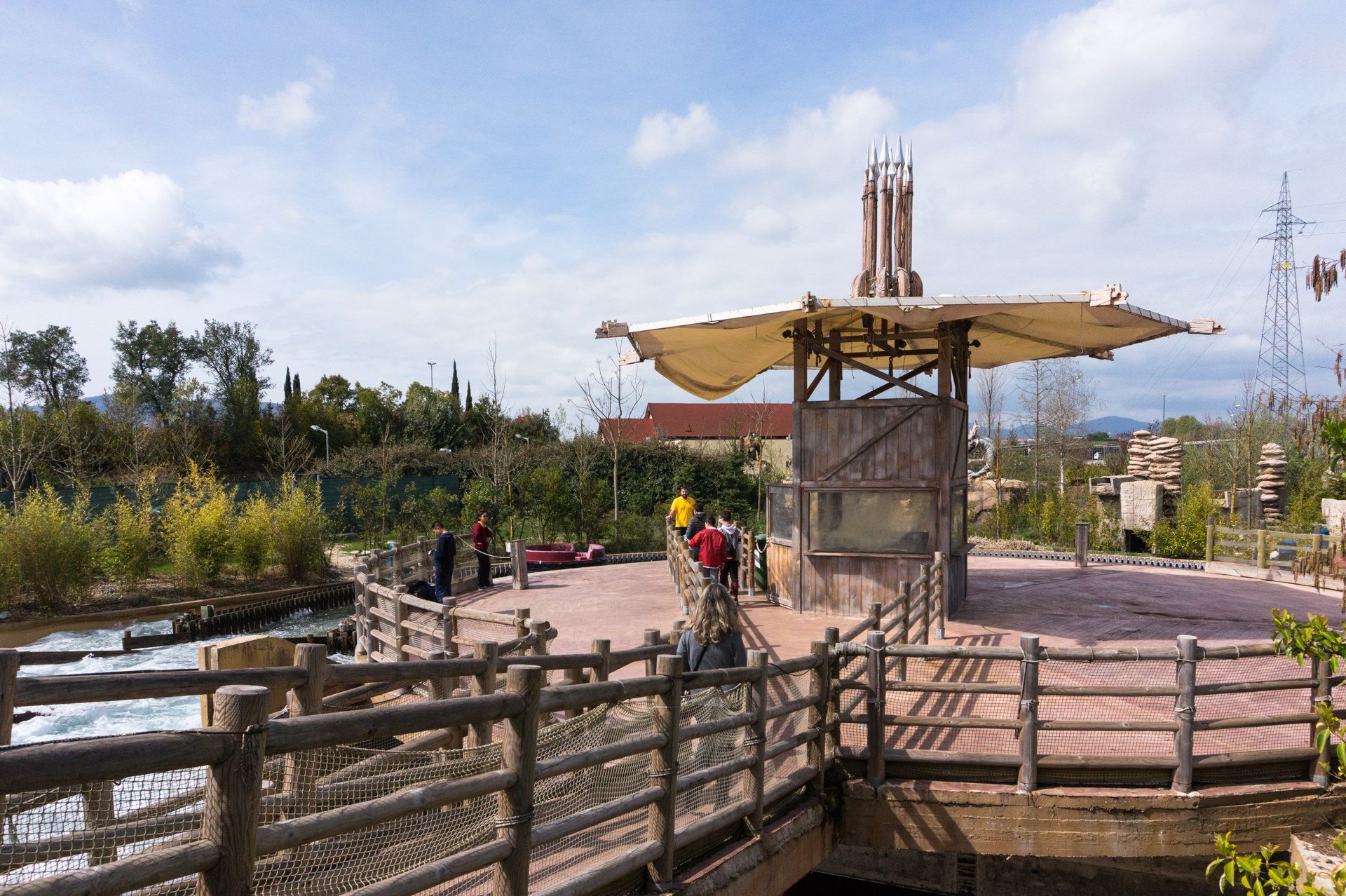
One of the first major attractions of the amusement park is the Rapid River Piraña, opened in 1983, which was also the first of its kind in Europe. The ride in the round-boats along the concrete canal, which has some rapids and other elements, is good and can easily get you wet. There is also a possibility to get the passangers wet from the outside of the ride that can be used free of charge, but which can soak you with a bit of bad luck.

Spookslot

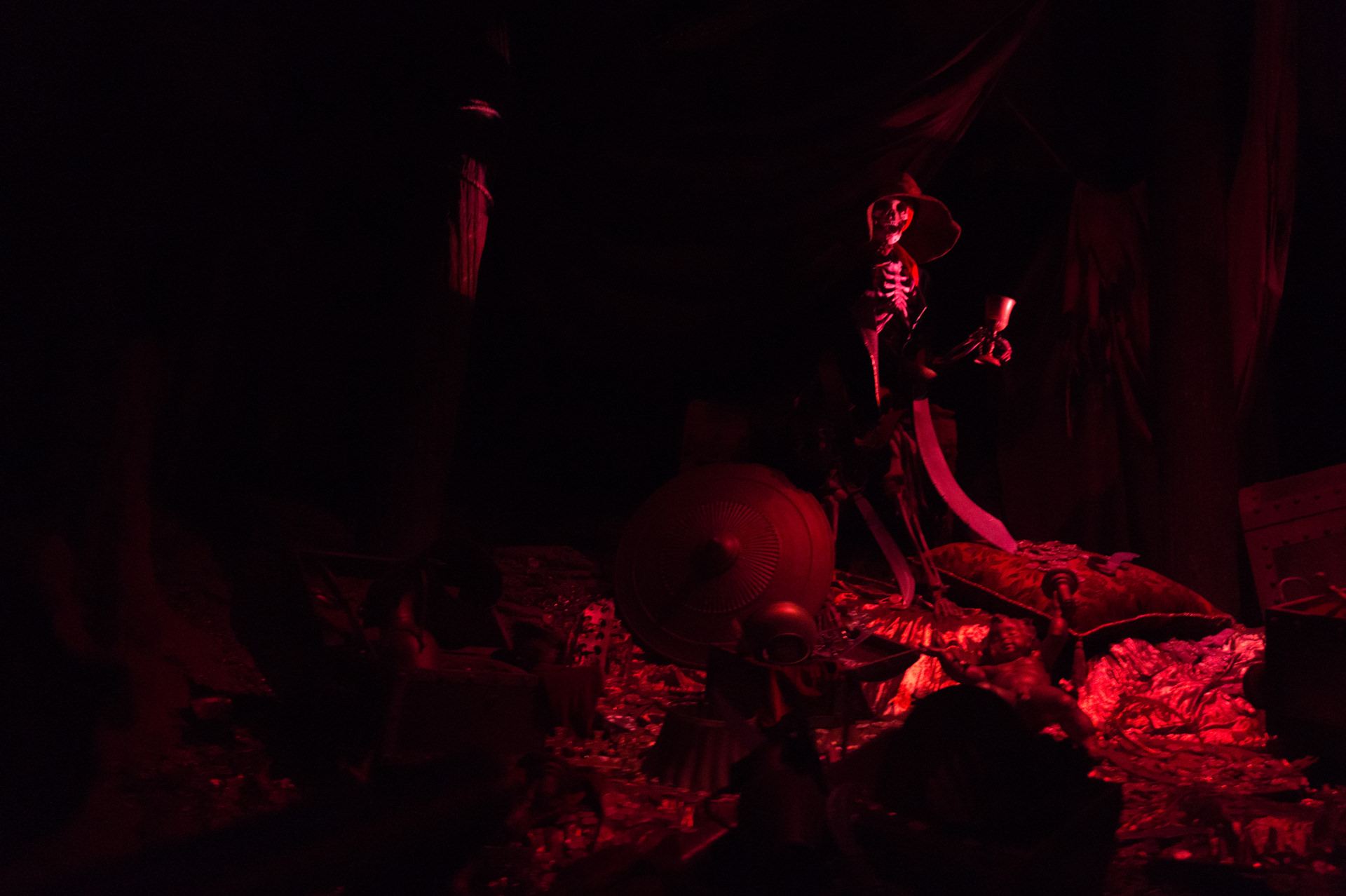
The Spookslot is one of the most famous and oldest attractions of the Efteling amusement park, although you should not expect a classic ghost train when you enter the haunted castle, although the outward appearance and the design of the queue make you expect a dark ride. Instead, you will find yourself in a larger room with several standing rows and watch a show worth seeing with countless mechanical figures.

Panda Droom

The ancient 3D film Panda Vision at the 4D cinema Panda Droom in the immediate vicinity is not quite as worth seeing. Anyhow, the special effects are rather special and should not be missed. In contrast to the many other venues in which this film was shown, the film was created especially for the Efteling in cooperation with the WWF, which is why animal welfare is far more important here through a preshow and further information options in the exit area.

Bob

In 1984 a truly new roller coaster concept from Intamin opened in the USA and, as so often the case, found its way to the Efteling a year later. The idea of a roller coaster with gondolas running free in a canal instead of on rails is not new since the flying turns of the 30’s, but the gondolas of the Swiss Bobsleigh pass through steep ascents and descents.

The ride in the Bobbaan, better known as Bob, begins on a straight out of the station. After a left turn you reach the lifthill, which brings you to a height of 20m. A steep left turn takes you downhill. The following valley is driven through with an absurd force, with the first change of direction taking place immediately. A swinging S-curve combination leads you up into the first block brake. Once again we descend in a steep left turn and get stoked by the high forces in the next valley. After a right turn, a left turn leads into the next block brake and also here the change of direction takes place in a powerful way. Also this block brake is left in the usual way. As we already have experienced before, the next valley is passed with a lot of momentum before a simple right helix leads us upwards. The car now crosses the last block brake and crashes towards the ground one last time, however this time in a right turn. A last change of direction, but not so brute, follows. After this turn the brakes follow and shortly after we reach the station.

Bob is a unique roller coaster, at least in Europe, although the American models now also have an exotic status. In comparison to the bobsleigh runs of the manufacturer Mack, which are better known in this country, the Swiss Bob can distinguish itself above all through its smooth running and the more adventurous course with its brilliant dynamics. The ride is simply fun and produces a permanent grin in my face which is why I always like getting on Bob again and again.

Fata Morgana

In a similar way I am very satisfied with the dark ride Fata Morgana, which convinces or better said overwhelms me with its oriental design. Although the ride was put into operation in 1986, it seems very modern and timeless with its human-like mechanical figures. The individual scenes are well equipped and very detailed, whereby the journey does not become boring even after several times. In addition, there is a continuous storyline with single moments of tension.

Aquanura

Every evening Aquanura, one of the biggest water shows in the world, takes place directly at the lake. It picks up the songs and rides that were experienced during the day and processes them with water, light and fire effects. During the day this is quite impressive, but at night it is definitely better.

Pictures Efteling

Conclusion Efteling

Efteling has always been a great amusement park, but it’s funny how often I forget about it, otherwise I would have visited the park more often. The park has so much to offer and with Baron 1898 and Aquanura even more, which is why I would like to call Efteling the best amusement park in Europe and not just because the park gave me the admission and a CD out of the blue. Despite the terrible weather, the park managed to entertain us very well, although our ride in the first row of Baron 1898 was by no means pleasant. With this year’s novelty everything has been done right, so I am looking forward to future projects from the park.


What are your thoughts about the Dive Coaster Baron 1898 and the theme park Efteling?  Just write it in the comment box below the report or visit our social media channels:


Bavaria’s strongest piece of leisure

Preface

On my way to Munich, I have already passed Bavaria’s strongest piece of leisure twice; the first time ignorant of the existence of the amusement park as a child, the second time out of respect for my passenger, who had promised to visit the park to another person for years, and a rather strict daily schedule. Since I accompanied my father on a bicycle tour along the Tauber river to the Main river, starting in Rothenburg ob der Tauber, the 30km long detour off the A7 motorway to the Freizeit-Land Geiselwind was finally tackled.

Freizeit-Land Geiselwind

The amusement park, which opened in 1969, has its origins as a bird and pony fairy tale park, a mixture that was already extraordinary back then. Although remains of the fairy tale park have been preserved, the animal enclosures dominate the amusement park, which has also featured an increasing number of rides since the 1980s. Since then, these rides have generated the greatest interest. At the same time the zoo is quite respectable and, similar to Weltvogelpark in Walsrode in Lower Saxony, it can boast a great variety of species in sufficiently large aviaries and enclosures.

T-Rex World

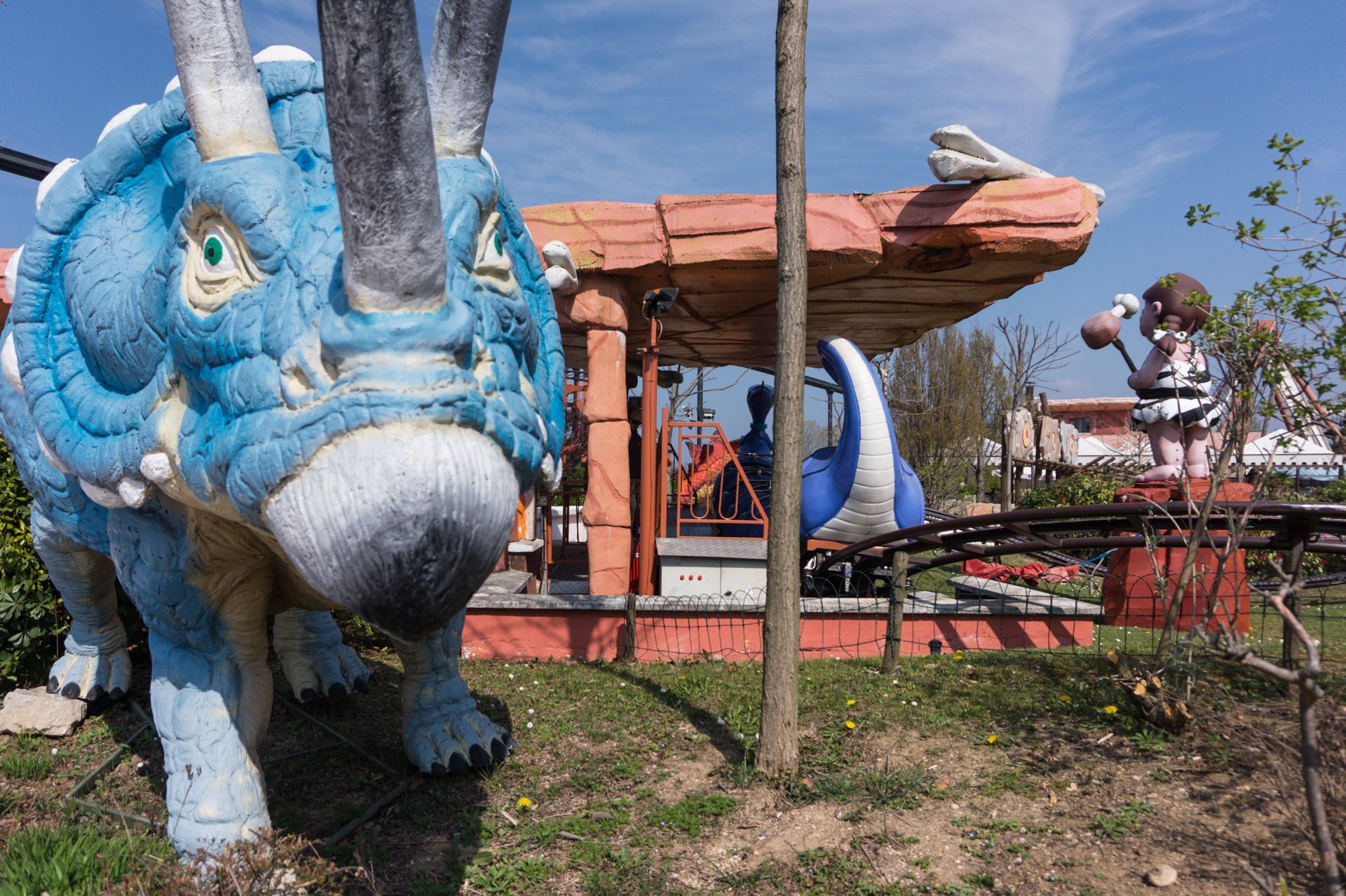
In terms of design, however, the Freizeit-Land Geiselwind is dominated by extinct creatures. In addition to a railway in dinosaur look and numerous figures, the dinosaurs are particularly popular in T-Rex World. This is a small exhibition worth seeing with animatronics, which were skillfully staged. Interestingly, the exhibition here convinced me more than the guided exhibition of newer Era T-Rex in the Portuguese amusement park Zoomarine, despite the much smaller size.

T-Rex Tower

In front of the hall is the T-Rex Tower, a Shot ‘n’ Drop by the manufacturer HUSS, a vertical ride that has become extinct at least at German fairs. While Robrahn’s Countdown travels through France under Fleur and Goetzke’s Freefall was sold to the Australian amusement and water park Adventure World near Perth, Roies Shot ‘n’ Drop is the only ride remaining in Germany. Like the towers mentioned above, the T-Rex Tower delivers a solid ride with a very nice shot up and drop down. Despite the lack of negative acceleration compared to the manufacturer S&S Sansei, the ride is always a little more fun due to the beautiful launch, although the end of the ride is reached after just one cycle.

The HUSS Corner

Next to two water basins with Nautic Jets and water roundabouts, which always had the longest waiting time, there is a corner exclusively consisting of rides from HUSS, as could be experienced before, in a similar constellation, in the Lower Saxony amusement parks Heide Park and Serengeti Park. Besides a stylish condor called Ikarus and a Ranger called Shuttle, you can ride an Enterprise, as well as a Break Dance. All rides offer a long ride with more or less balanced programs. I found the acceleration phases of the Ranger interesting and at the same time a bit disturbing, because it always decelerated in the valley, which was never the case with the identical Fliegender Hai ride in Hansa Park.

Wildwasserbahn

If you follow the paths further on you will come across the big log flume Wildwasserbahn with its three shots. This is a slightly modified version of the standard model of the French manufacturer Reverchon, which has been supplemented by a further downhill run. Although the ride reminds of a funfair of the past due to its large back wall, the general design of the ride, especially the nicely designed waiting area, is successful.

After the boat has left the station, one rumbles a little through the channel along the maintenance hall of the Freizeit-Land Geiselwind before taking the first lift. At the top you make a small curve behind the back wall on rollers until a friction wheel pushes the boat into the first shot. This is designed as a double gradient and releases you a little wet into the further course. One S-curve later it goes up again and a small right curve follows. Now the smallest descent of the ride follows and as fast as this one came, as fast the end of the run-out distance is already reached and you rapidly make another right turn. After a slightly longer straight, the boat accumulates for the last time in altitude. Arriving at the top, the game repeats itself and a high shot follows without any interruptions. Arrived at the bottom you get properly moistened just before you continue the rest of the way towards the station. By ingenious technology, which I actually noticed for the first time at the ride, the boats are stopped briefly before they are gently put on the conveyor belt of the station without crashing against the other boats.

Top of the World

Similarly interesting from a technical point of view, but on a much larger scale, is the Top of the World observation tower, which can be briefly described as a monster with a capacity of 132 people. The formerly largest transportable ride in the world measures a total height of 95 m, with a ride height of 72 m. The ride was built in the mid-90s by Nauta Bussink for the Bremen showman Finnendahl, who operated the 270-tonne structure until 1998. Compared to the modern free-fall towers of the manufacturer Funtime, the ride is very massive, which is already noticeable by the four outriggers. The tower itself is relatively wide, which certainly did not make transport easy. The technology of the nacelle, however, is very simple and is driven by two steel cables that are rolled up and down and thus lift and lower the counterweight and thereby influence the position of the nacelle. After the gondola has been lifted a little, a power rail ensures the supply of the motors for the rotation of the gondola. The ride itself, however, is relatively slow in both movements and thus offers a good view of the amusement park. Thereby, also the air-conditioned gondola is a very special, as most of the seats are designed as standing places and are arranged in two rows. Moreover, the view from the windows is surprisingly clear, as there are no traces of scratches and other wear and tear.

Drehgondelbahn

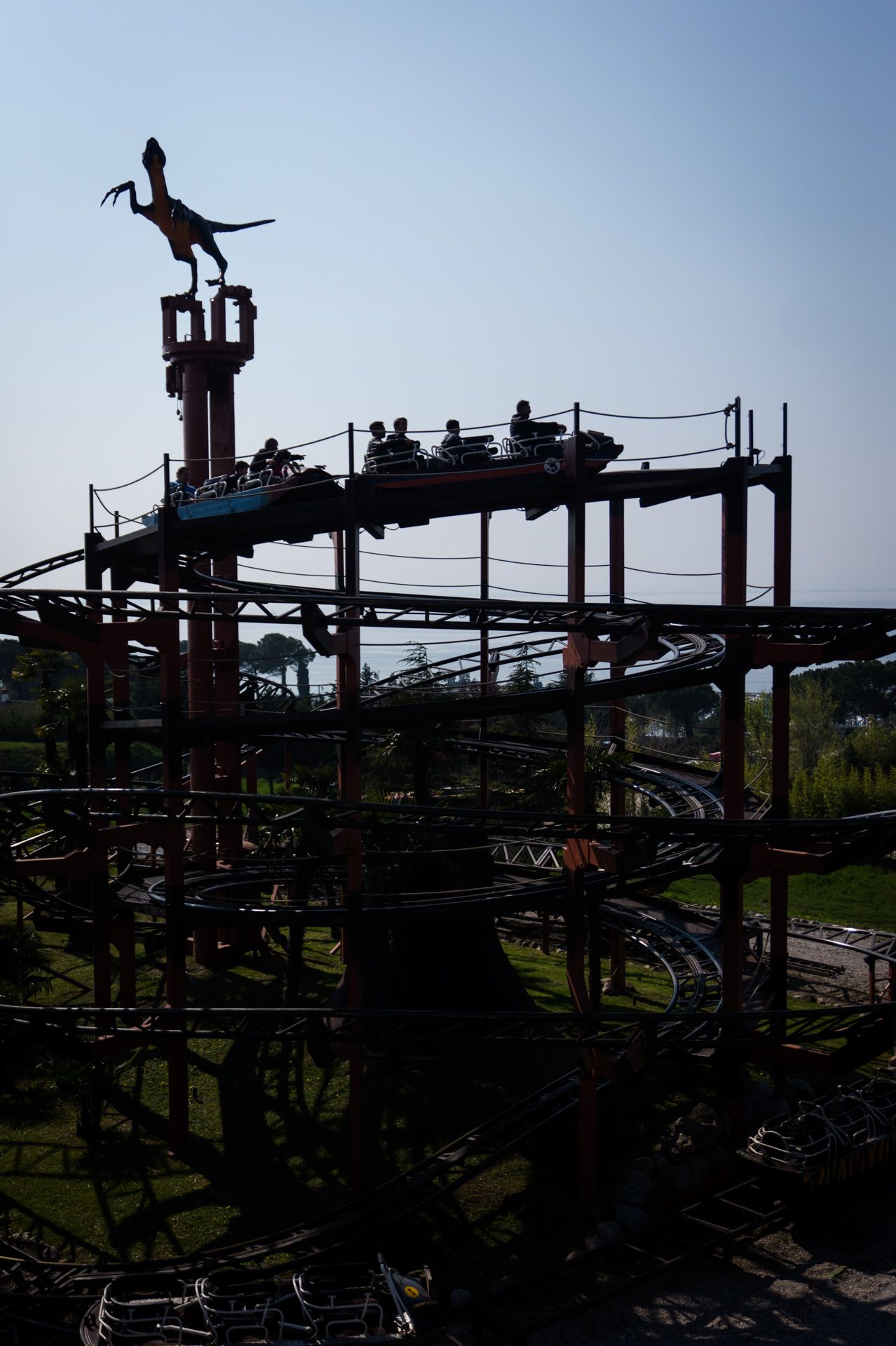
Quite inconspicuous and easily overlooked even from above is the Drehgondelbahn, a truly unique roller coaster at Freizeit-Land Geiselwind. This is the only spinning coaster of the company Zierer, which has been making its rounds in the park since 1994. This fact alone is more exciting than the actual layout of the ride, as there is only a simple oval with a descending helix in the middle. As simple as the track seems to be, as good it makes the gondolas turn, so that a thoroughly amusing ride emerges. For three rounds, one makes the way through the course before the gondolas are automatically aligned in the station.

It’s strange to find only one roller coaster of this kind from Zierer, because the potential to be a box office hit today is shown by the compact spinning coasters from SBF Visa with their even simpler layout. Especially for smaller amusement parks a ride like the Drehgondelbahn would be more than ideal, so a new edition of this classic ride would certainly not be the worst idea.

Boomerang

In an alignment with the Top of the World observation tower and the Drehgondelbahn, there is the biggest roller coaster of Geiselwind, a Vekoma Boomerang. Although it looks relatively normal from the outside it is an elaborately designed ride in Australian style, including the eponymous throwing weapon. Access to this ride is around the engine room, whereupon you are directly inside the station. Compared to similar rides, this one hardly vibrates when the train passes through, which is why, interestingly enough, televisions adorn the station.

After the driver has gripped the train, it is slowly pulled up the first ramp. At the top of the ramp it automatically disengages, whereupon the train descends and crosses the station at top speed. The train then shoots up the first manoeuvre and stands upside down for the first time, before it goes overhead again in the second half of the Cobra Roll. A classic looping, which is powerfully passed through forwards, is added. In its exit, the first brakes are applied and thus reduce the speed just before the train engages a lift chain. This in return brings the train back to its maximum height before a mechanism lowers it and thus releases the train. Now it goes backwards down the second ramp and at top speed into the loop, which has now noticeably gained pressure. The Cobra Roll, on the other hand, will pass through a little slower before the train enters the station once more and the brakes engage. The riding characteristics are, similar to the ones from the Belgian amusement parks Bellewaerde and Walibi Belgium, extremely good and invite to several rides.

Cobra

On the site of the former roller coaster Marienkäferbahn, which left Freizeit-Land Geiselwind for reasons of cost and age, this year’ s roller coaster Cobra by showman Agtsch is located. In the years before, the place was already occupied by two Wild Mice, the indoor roller coaster Black Hole and a ghost train, which is understandable on the one hand, but on the other hand is not really needed due to the already large offer of rides. Because of the barriers along the ride this place doesn’t look very nice, a non-temporary attraction would surely be an advantage here in the future.

Blauer Enzian

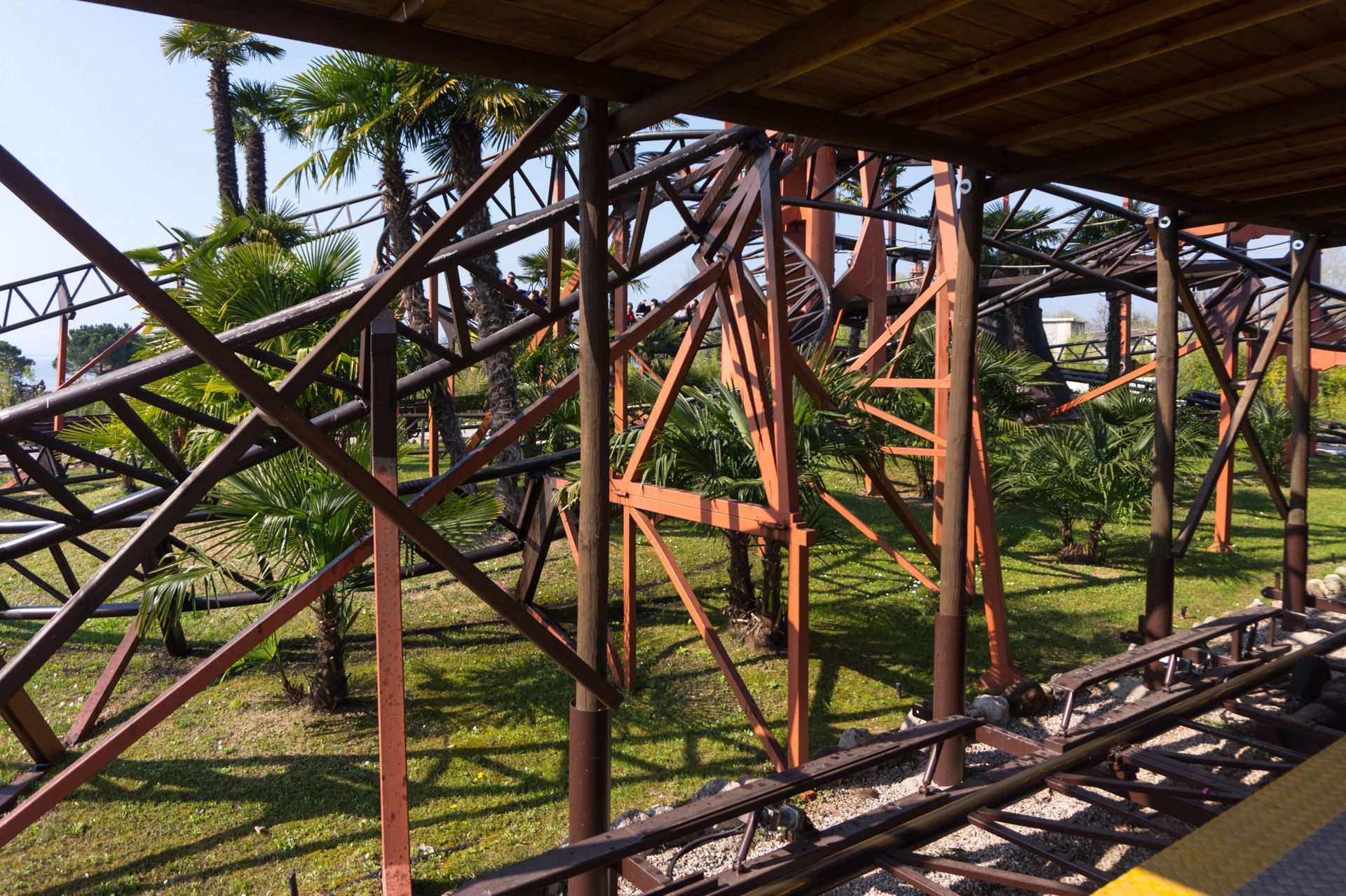
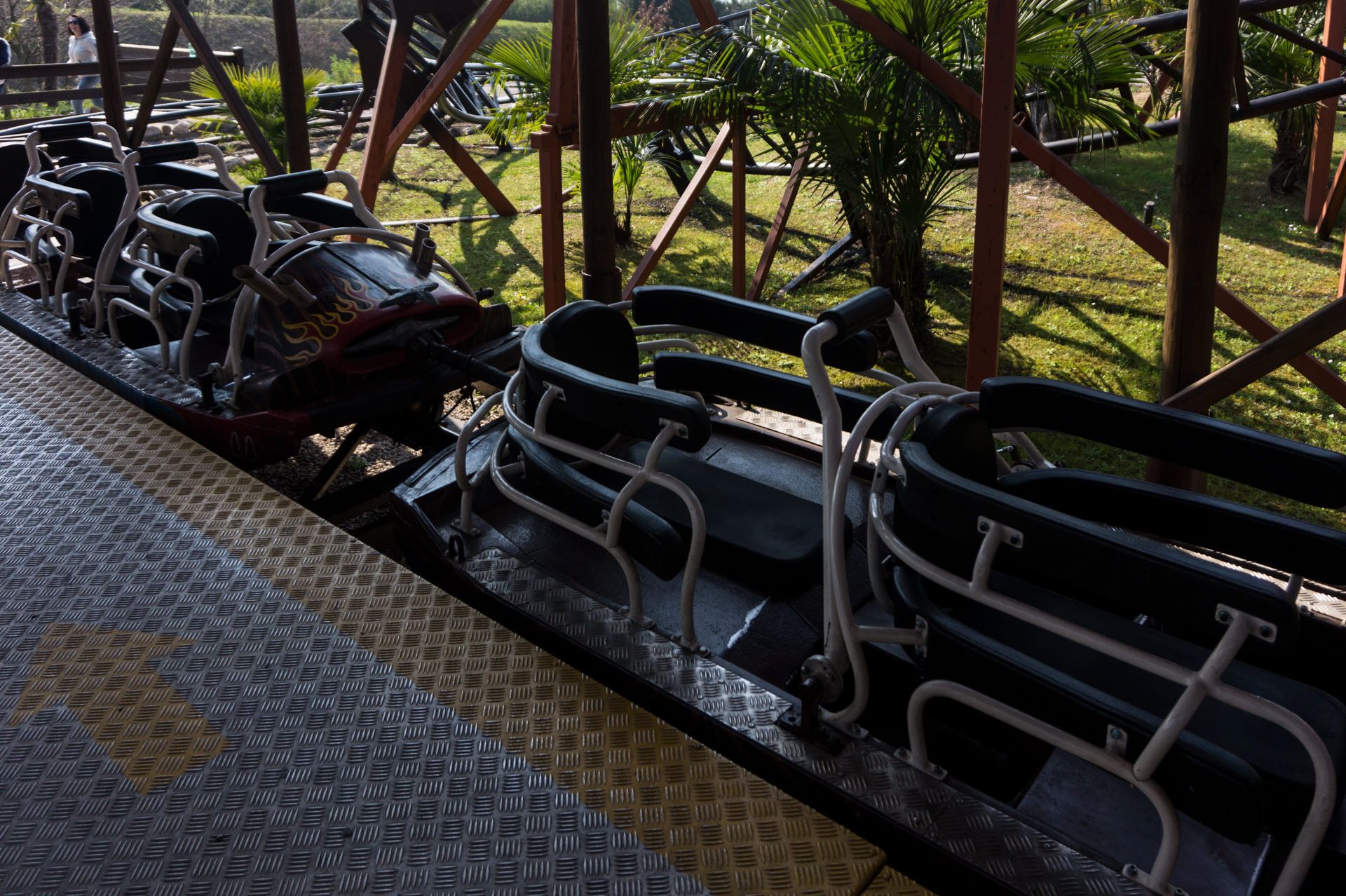
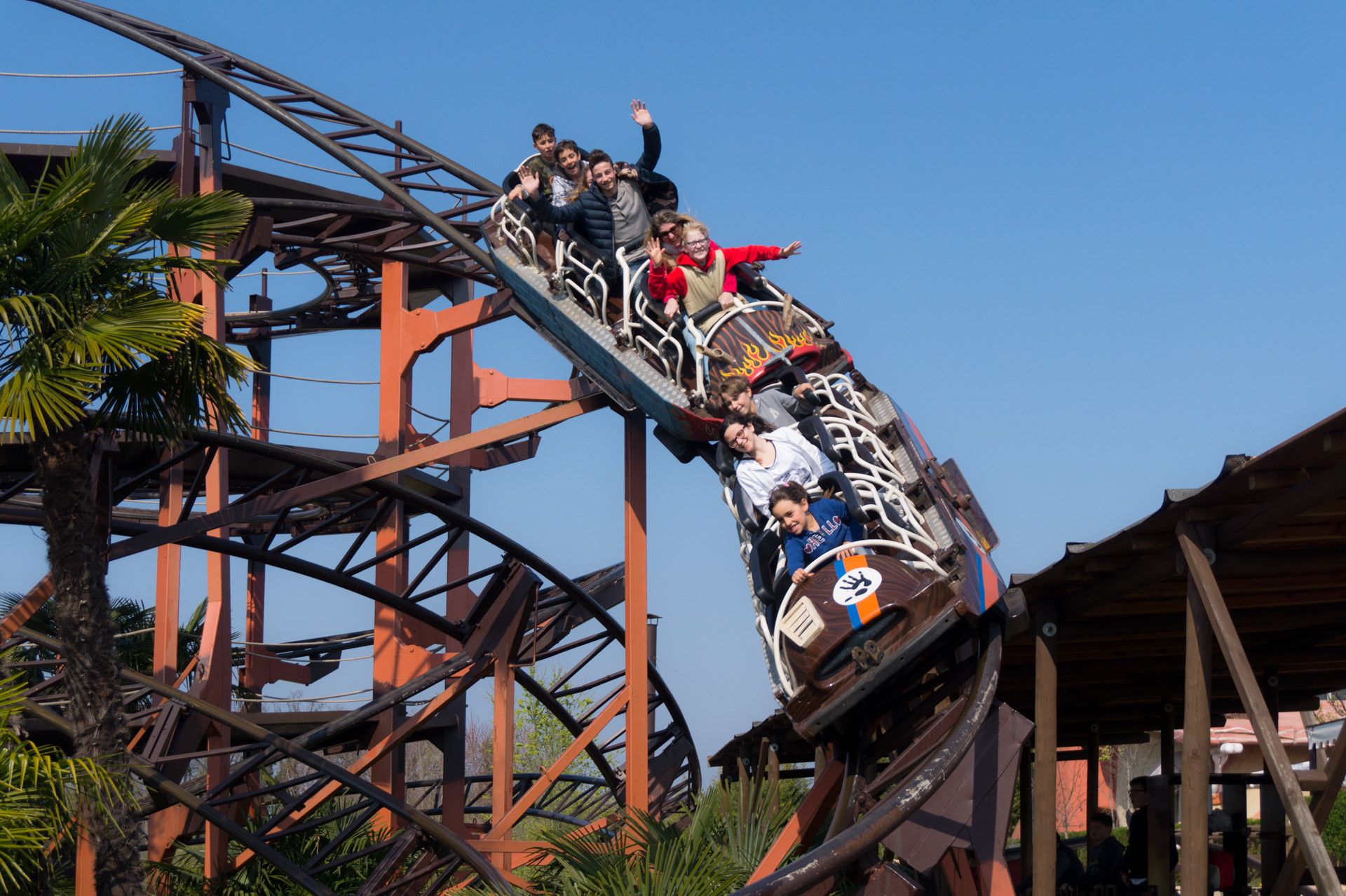
Right next door is a Blauer Enzian roller coaster of the same name from Mack. Like many rides at Freizeit-Land Geiselwind, this is a former travelling ride, which can be seen by the two water basins that make the sole of the ride heavy. Since the bridge above the station was not built, the exit happens on the same side as the entrance. Therefore, one side of the train was closed off.

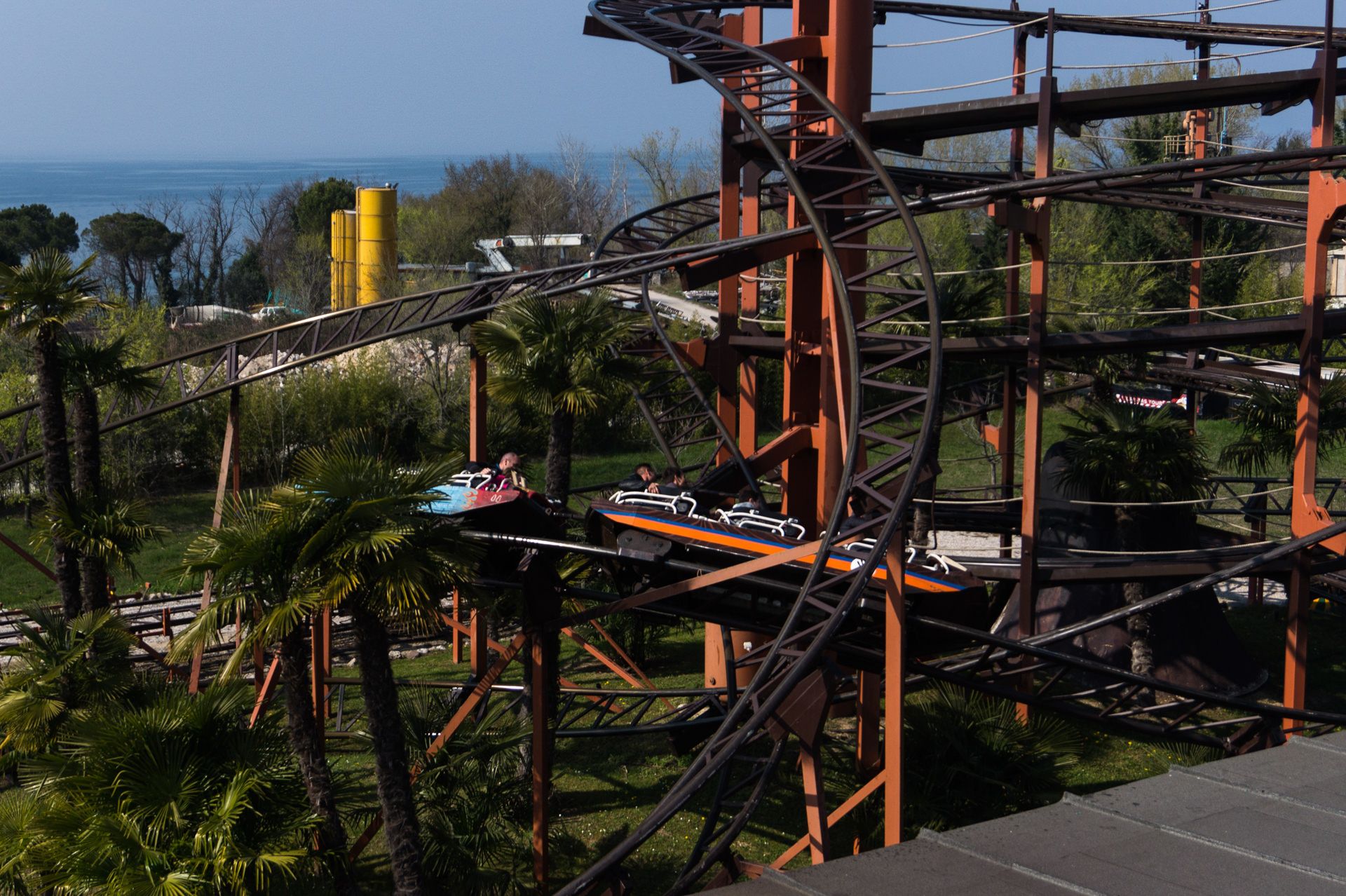
The ride begins with a wide left turn, followed by a leisurely climb. Once at the top, the train makes a downward helix to the left before climbing up a steeper straight. Now the train makes a wide downward right-hand bend, crosses under the track just passed and surrounds the first downward helix in another left-hand bend. With much more momentum, the car now crosses the station and then lap by lap the course. Except for the abrupt second change of direction, it’s a nice ride.

Fränkische Weinfahrt

In addition to a 4D cinema, which is currently showing a film in the style of Jurassic Park, the Freizeit-Land Geiselwind also offers a number of flat trips, all of which have been well designed. However, only the Fränkische Weinfahrt (Franconian Wine Ride), a teacup ride, shows the regional reference of the park. Everything else is bavarian, which also keeps the gastronomy prices in a good range.

Pictures Freizeit-Land Geiselwind

Conclusion Freizeit-Land Geiselwind

The Freizeit-Land Geiselwind is a rather neat amusement park. The rides are all in a very good condition and generally appear to be very well maintained, as are the gardens. Despite the parcel-like division of the rides, the routing does not remind of the computer game Roller Coaster Tycoon, a state of affairs that can be experienced for example in the rear part of the Erse Park in Uetze, so that a harmonious overall impression is created. Although the origin of many of the rides cannot be denied, the impression of a permanent funfair is by no means created by the nice integration of the rides. At least, the Freizeit-Land Geiselwind easily manages to entertain its visitors for a few hours and offers a good price-performance ratio, which is why I would like to call the park Bavaria’s strongest piece of leisure, which makes the park’s slogan more accurate (but the competition in this federal state is very manageable).


What is your opinion about the amusement park Freizeit-Land Geiselwind? Just write them in the comment field below the report or in our social media channels: