The history of Nagashima Spa Land
Nagashima Spa Land came into being as an addition to the resort near the city of Nagashima, which was developed in 1964. Located directly on Ise Bay, Otani Natural Gas Co, Ltd hoped to find a natural gas deposit in 1963 when they came across a hot spring while exploring for natural gas. The temporary bath that was then built quickly proved extremely popular, and Nagashimakankokaihatsu Co, Ltd was established in the same year with the aim of developing the spring, now known as Nagashima Onsen, for tourism. In November 1964, the bath was opened to visitors, followed a month later by the Nagashima Hotel. In 1966, the resort was further expanded with the opening of the second hotel and the Nagashima Spa Land, including a jet coaster.
The Nagashima Resort quickly became more popular, which is why the third hotel followed as early as 1970. The resort now consists of three hotels, the Nagashima Spa Land amusement park, the Nagano-no-Sato gardens, the Anpanman Children’s Museum, the large Mitsui Outlet Jazz Dream Nagashima outlet centre and the Yuami-no-Shima hot spring. Every year, around 5.8 million visitors come to Nagashima Resort.
Tour of the park
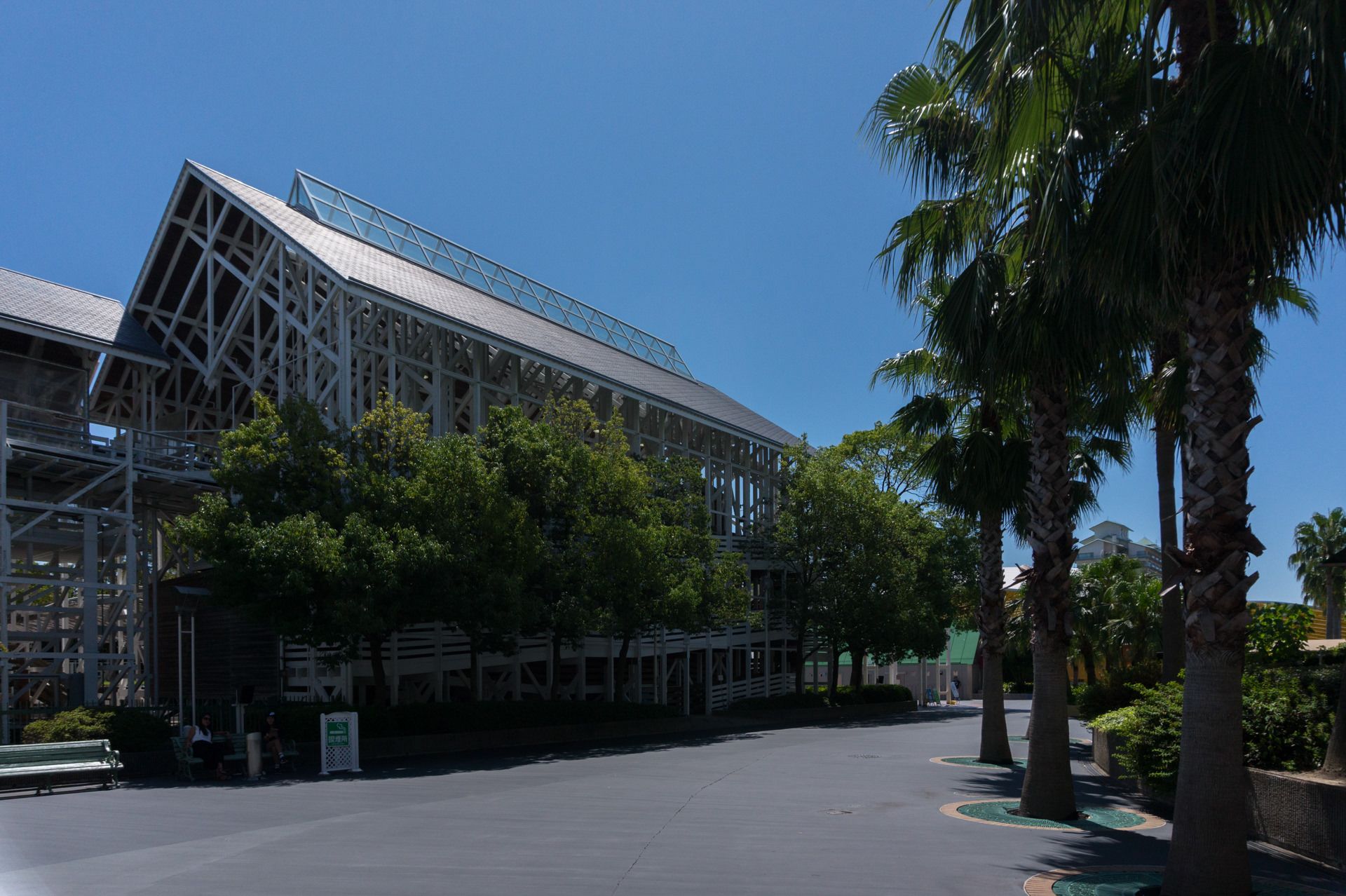
If you arrive by bus, you land at the side entrance of Nagashima Spa Land, located between the hotels and the outlet centre. From here, a path leads directly to the spacious children’s area, including a covered playground. In addition to a large number of child-friendly round rides and two small log flumes, there are two children’s roller coasters.
Children Coaster
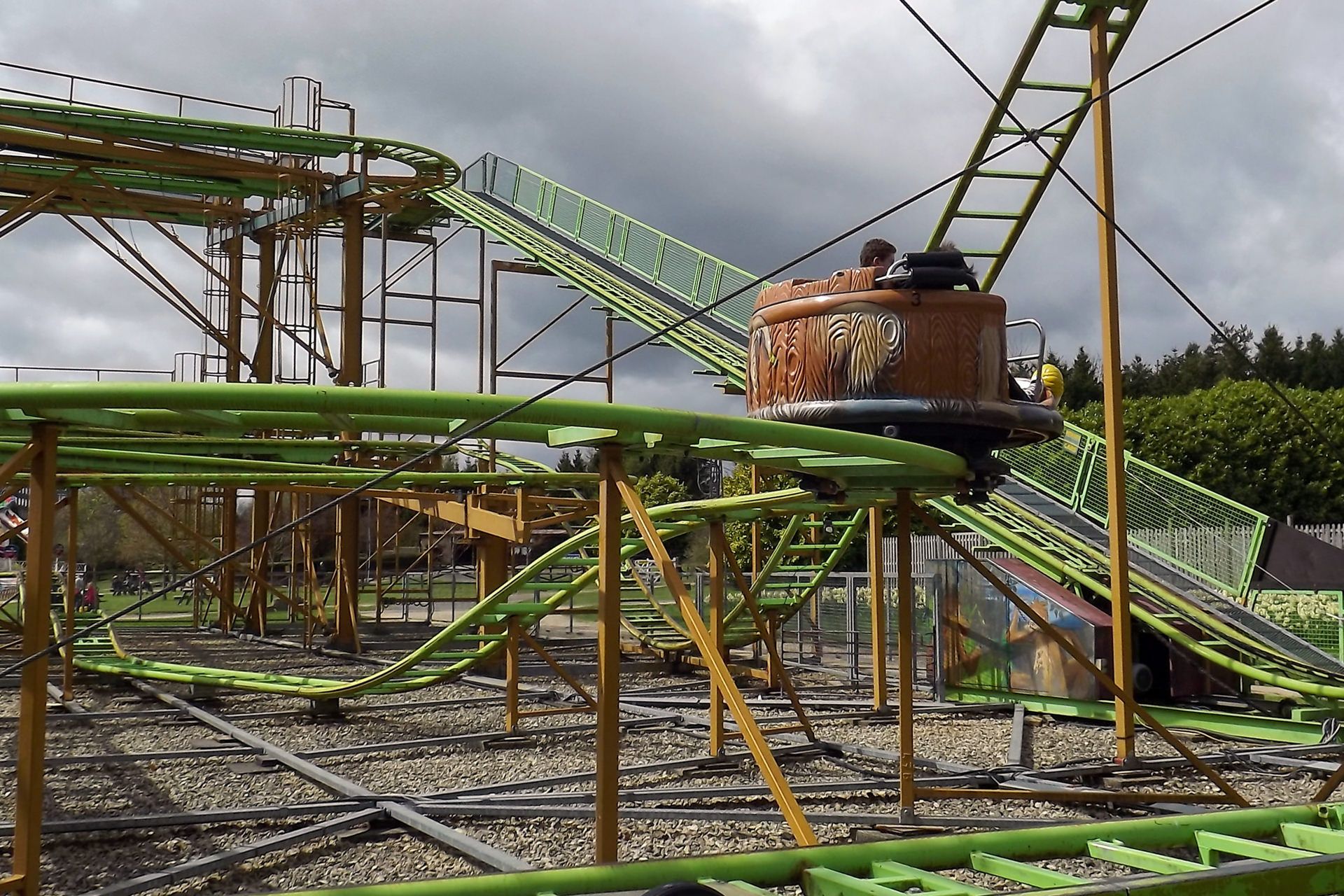
The oldest of the two children’s roller coasters at Nagashima Spa Land is the very inconspicuously placed, medium-sized ladybird ride by the manufacturer Zierer called Children Coaster. As usual, you ride two laps through the figure-8 layout and enjoy the manual braking towards the end of the ride.
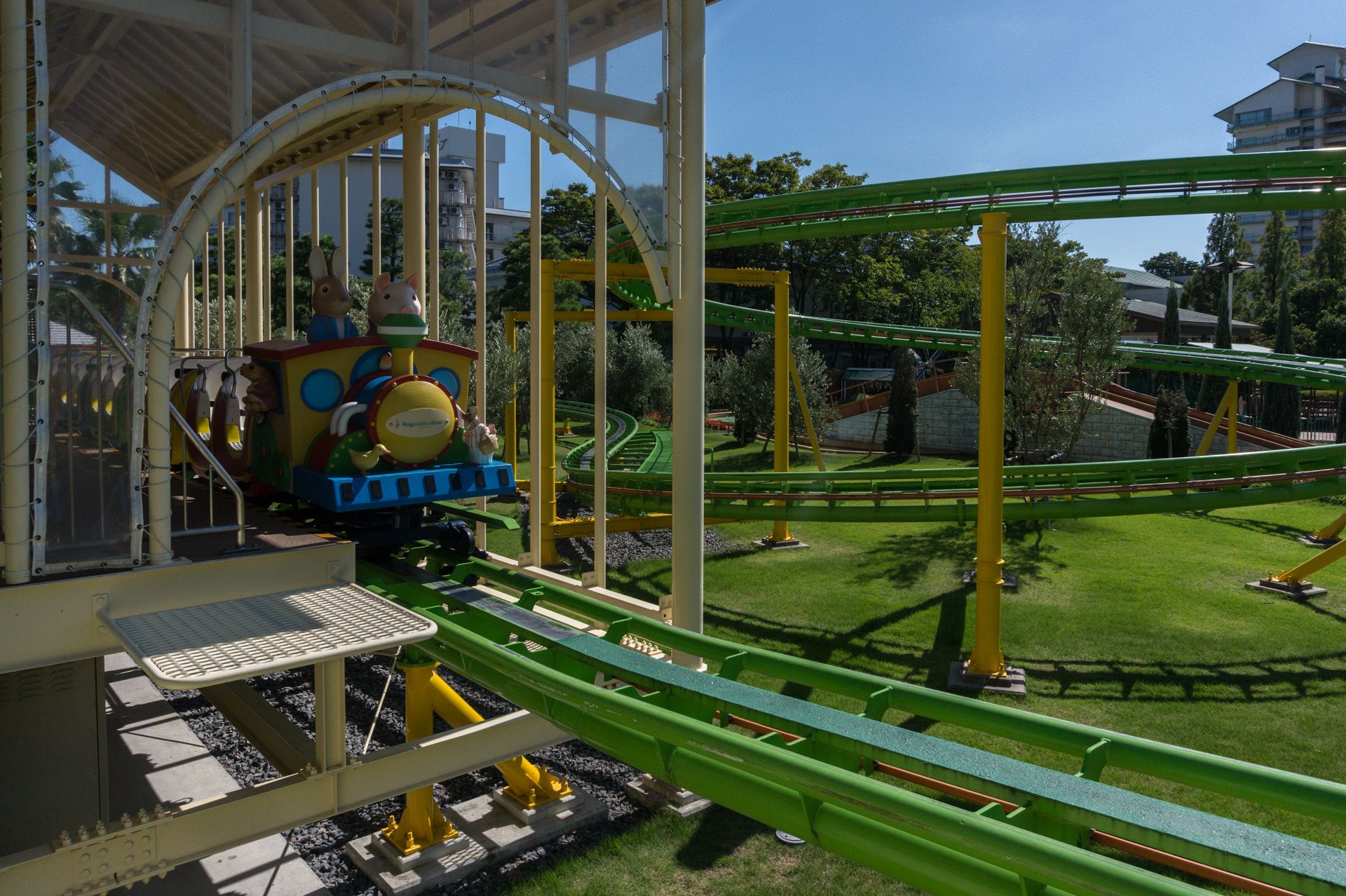
Oh, it’s beautiful here. In addition to the tried and tested fun of the time-honoured children’s roller coaster legend, characters from the classic English children’s book “The Tale of Peter Rabbit” have also found a home here. Peter Rabbit has been the mascot of Nagashima Spa Land for ages, but it was only in 2012 that a roller coaster was dedicated to him.
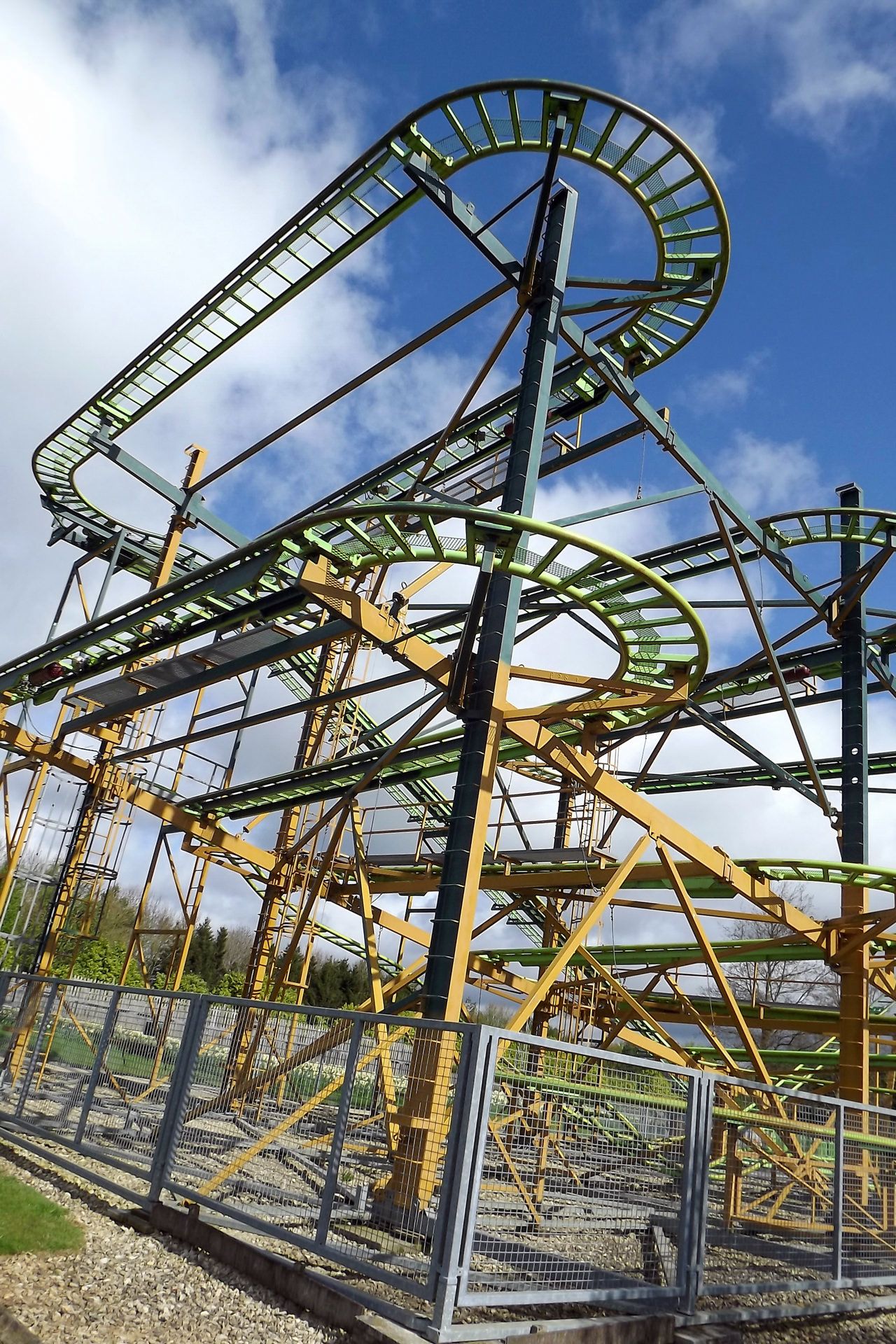
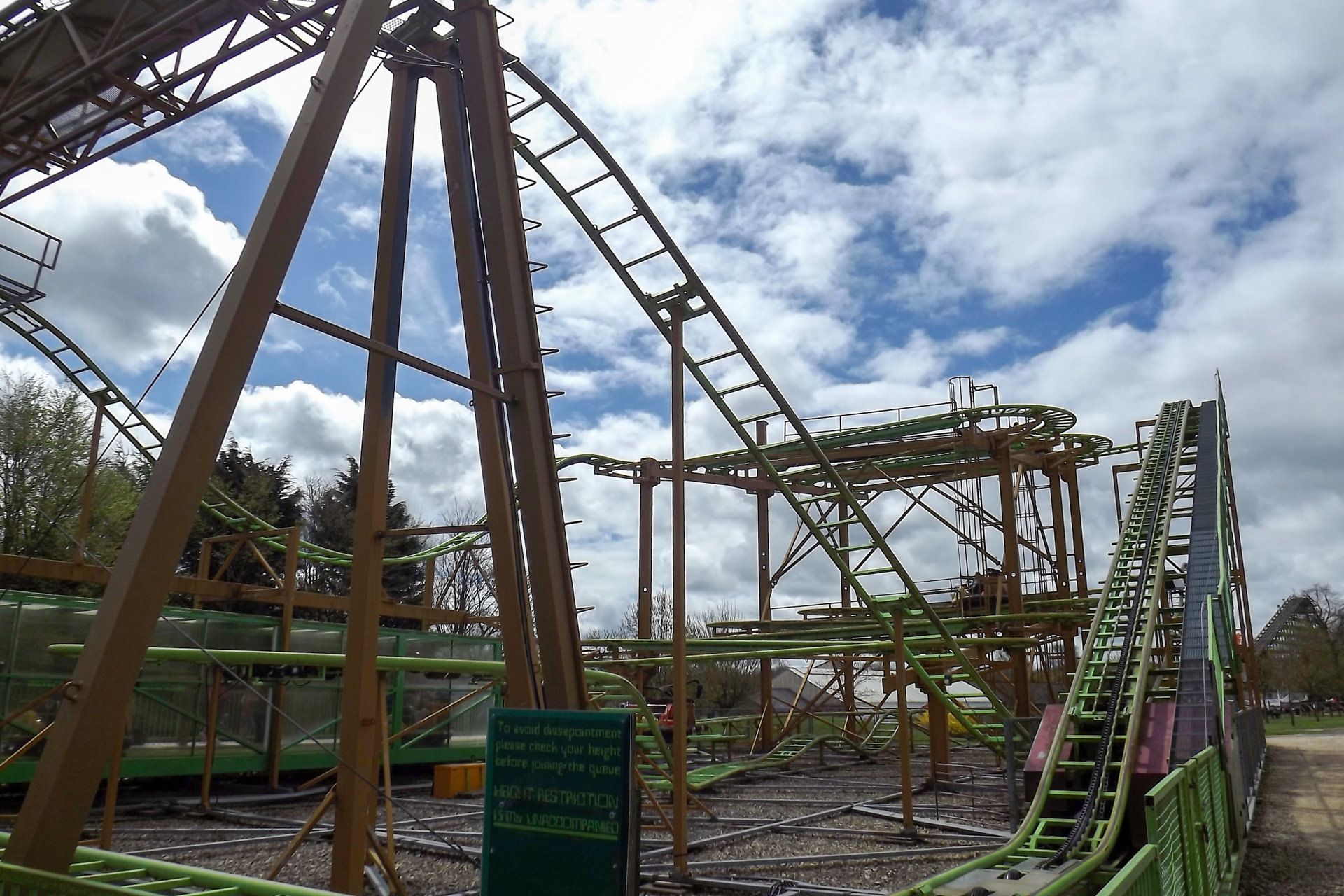
Peter Rabbit Coaster
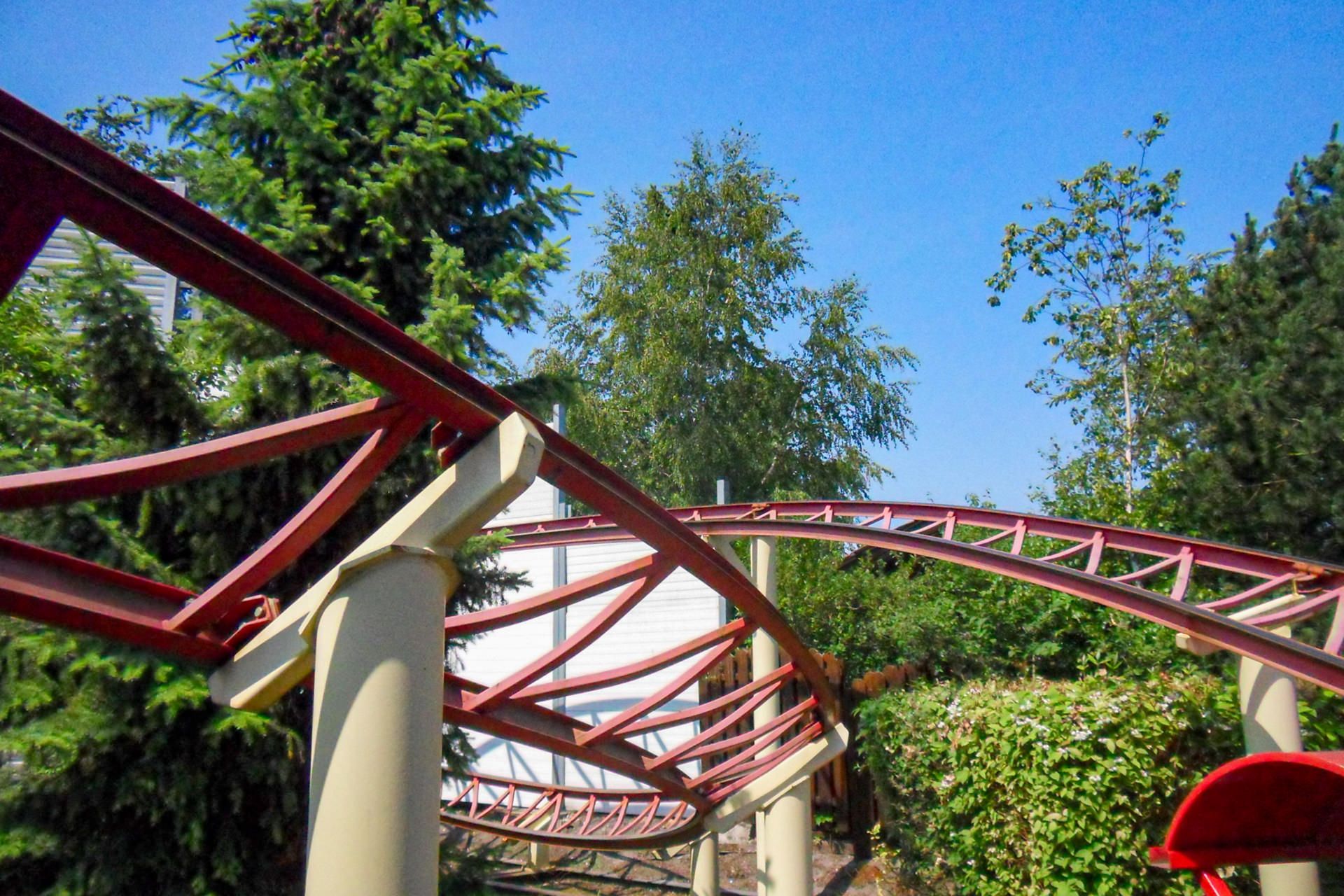
The ride on the Peter Rabbit Coaster from Hoei Sangyo begins with a wide left-hand curve in which you gain a few metres in altitude, which you immediately lose again in a somewhat narrower right-hand helix. Once you reach the ground level, you go full steam ahead after a change of direction through a curve that is just as wide as the one at the beginning of the ride. At this point the track leads straight into the station and through it. After another lap through the track course, the very nice ride ends.
Viking
Before we get too far away from Kinderland and its park mascot Peter Rabbit, we are immediately drawn to the double monorail with its two tracks running in opposite directions. Actually, on the way there, we are drawn to a completely different, extremely imposing set of rides, the likes of which cannot be found anywhere else on this planet: the Viking boat swing conglomerate.
When I first came across Nagashima Spa Land, I was immensely impressed by the Japanese people’s love of swings. Whereas in some European amusement parks there are two, at most three, boat-swing-like rides, here there is the full programme in its maximum range, including three boat swings, two rotating swings and an overhead boat swing. From that moment on, one thing was clear to me: I have to go there! And more importantly: I have to ride them all!
Because let’s be honest, who cares about the longest roller coaster in the world when there are two gigantic boat swings far above a third, normal-sized boat swing? That is insane and, above all, simply terrific.
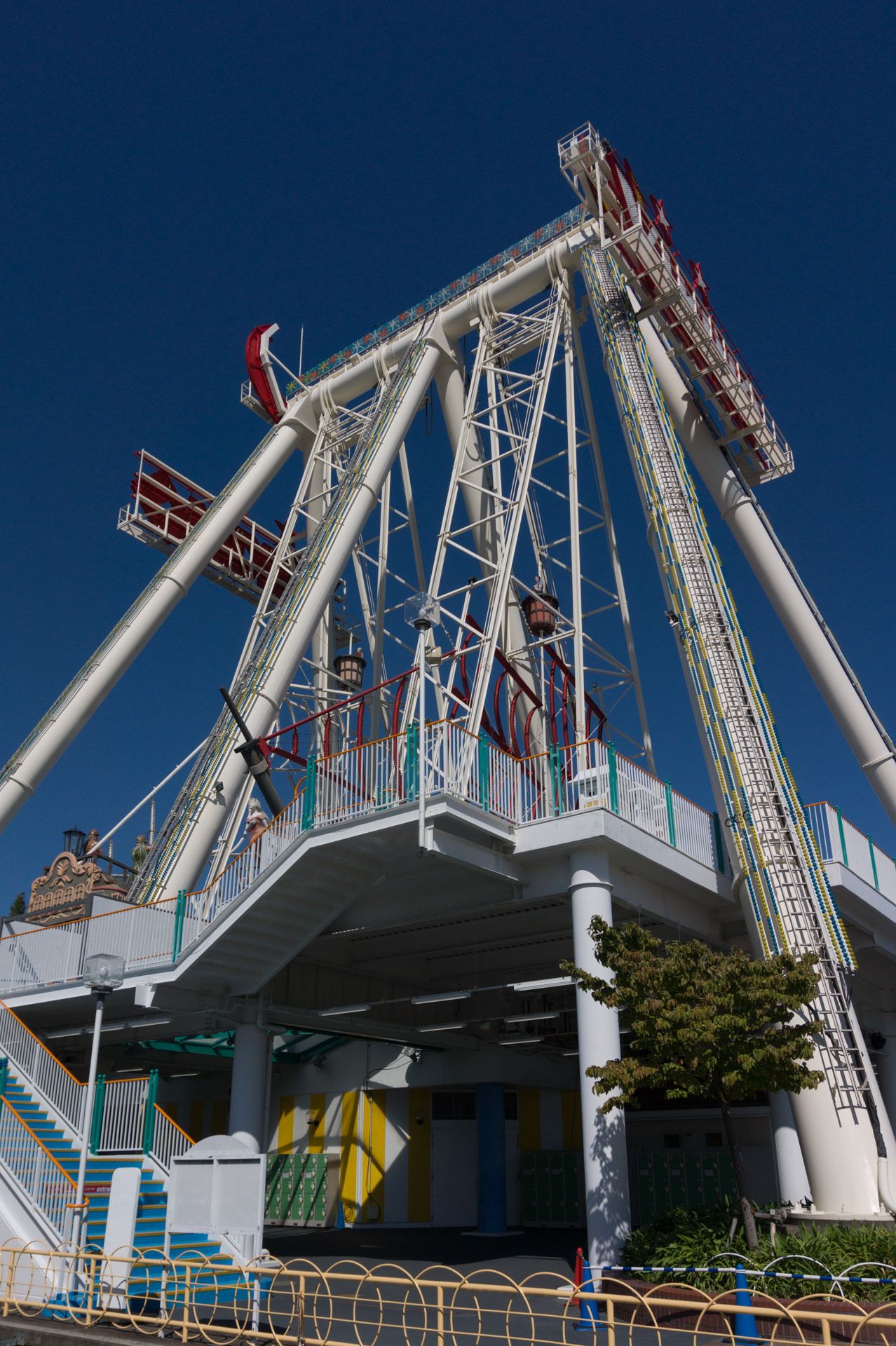
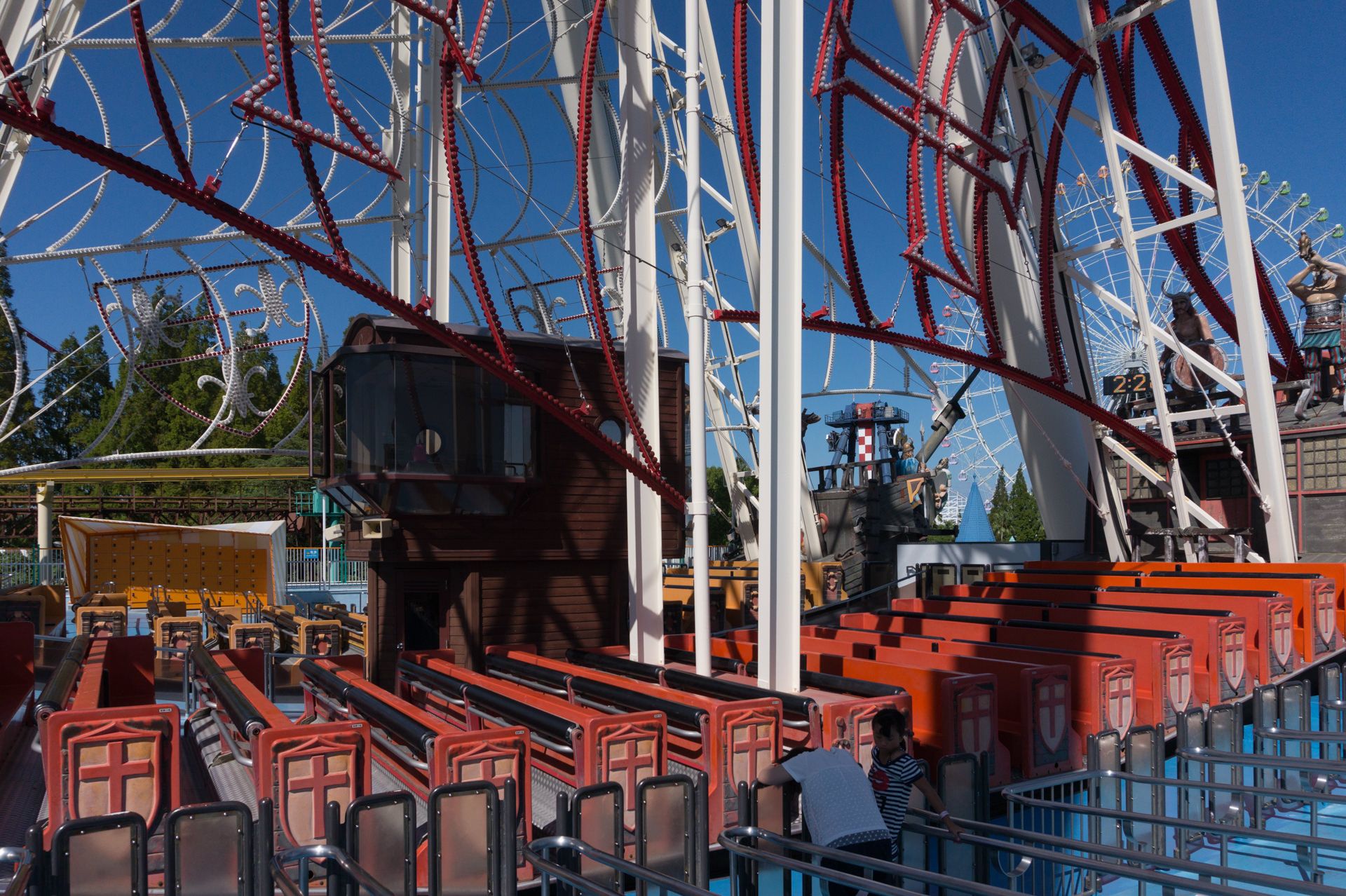
After the success of the small boat swing in 1980 and the success of the large HUSS double ride in the Toshimaen amusement park, Nagashima decided to go one better and built an equally large boat swing in 1986, also in a double ride. Now, it is somewhat difficult to trace how far the three existing large rides in Nagashima Spa Land, Toshimaen and Samsung Everland are related to each other, because although the boats are all built in the same way and are each located above various facilities, two of these rides are considered to be double rides of the HUSS Traumschiff. This is understandable, as the ride looks at first glance as if two somewhat larger ship swings of the Pirate model have been placed directly next to each other and connected to form a boat. However, the double Viking is called Twin Flying Bounty in Intamin’s reference list. The reason for this is probably the bankruptcy of the Arrow-HUSS company towards the end of 1984, after which the company reorganised itself in 1986 as HUSS Maschinenfabrik. In the intervening years, planned rides were built by other manufacturers (e.g. Ninja at Six Flags St. Louis).
But what is a Traumschiff/Twin Flying Bounty like to ride? It’s nice; the ride is actually not earth-shattering, as the basic construction itself is already incredibly inert, but seen as a whole it’s pretty nice. It’s a huge attraction of unbelievable proportions that is accessible to all park guests and doesn’t let anyone get off dissatisfied – a crowd pleaser of the highest order, so to speak. Taken together, the ship’s swing collection has a total capacity of 380 people (160 people per boat in the large swing plus 60 people in the normal-sized ship’s swing) per synchronised ride cycle. All in all, this means an hourly capacity of up to 5,000 people, which is certainly still necessary during the Golden Week and many other days. On emptier days, one of the Flying Bountys sets sail at least every 15 minutes.
Jet Coaster
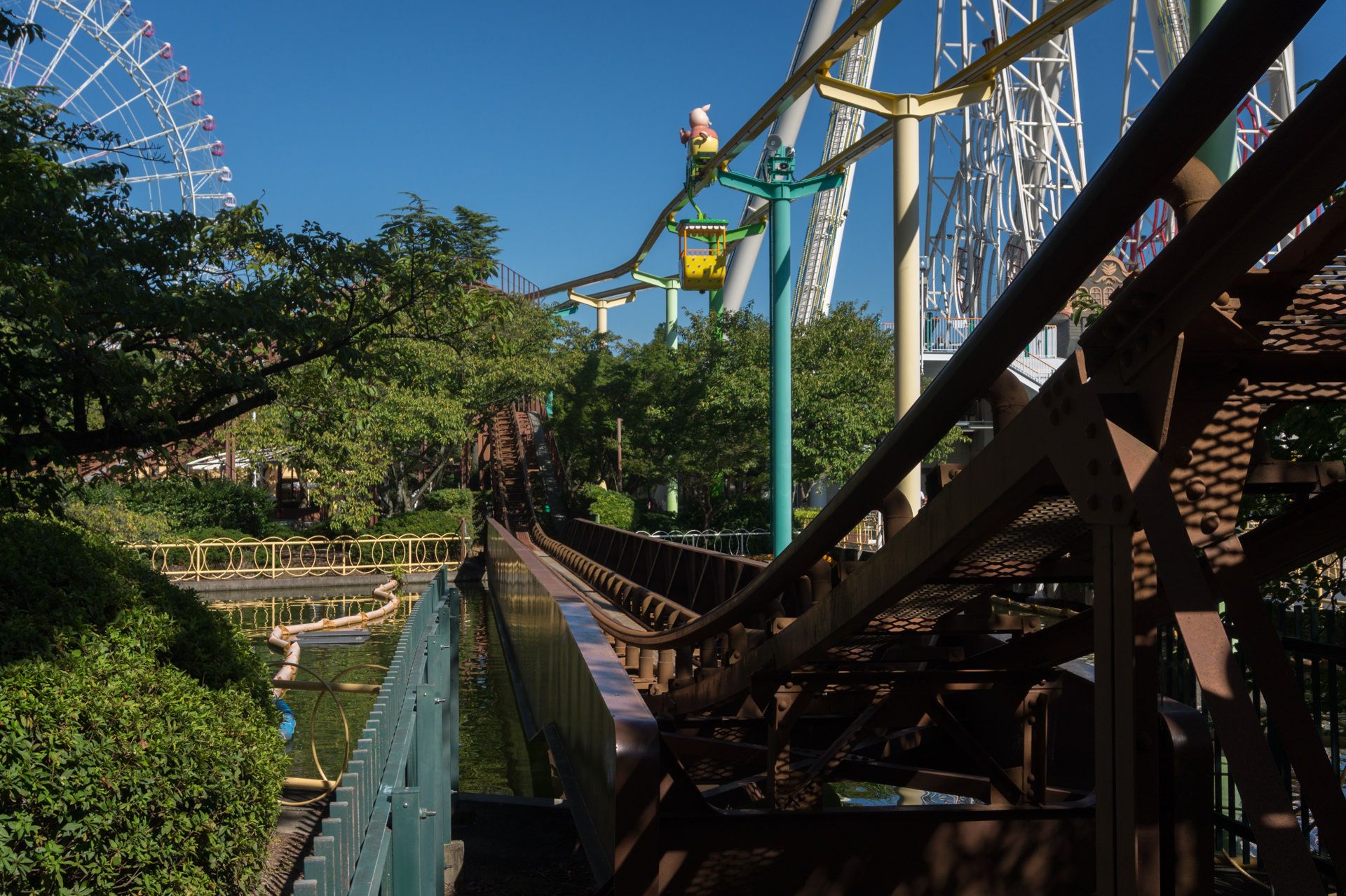
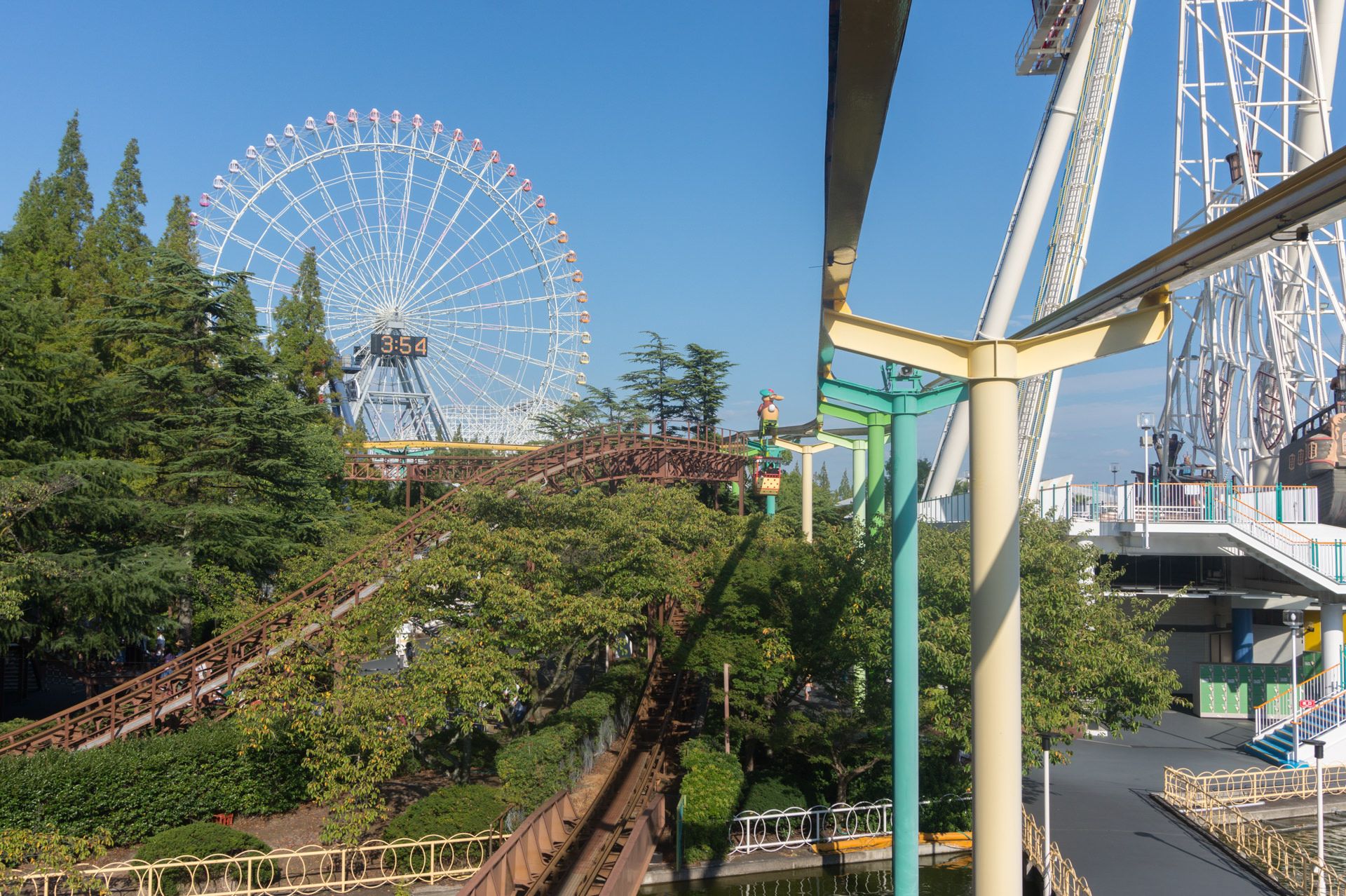
In the meantime, you can take a nice panoramic ride on the aforementioned double-track monorail that runs in opposite directions. Here you have a wonderful view of the lake and the small forest that you are circling. The park railway, a go-kart track and the oldest roller coaster in Nagashima Spa Land, the Jet Coaster, are located in the forest.
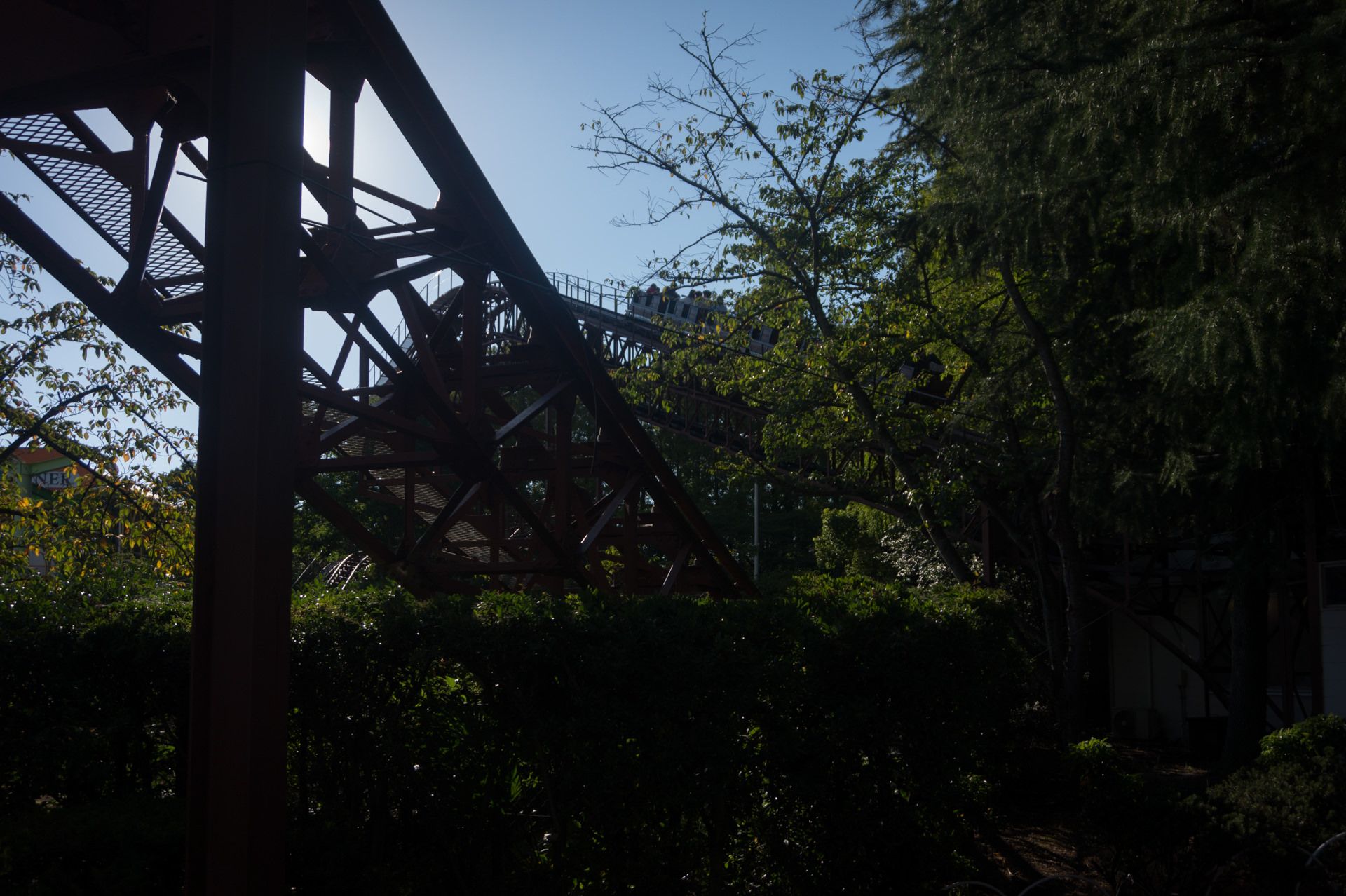
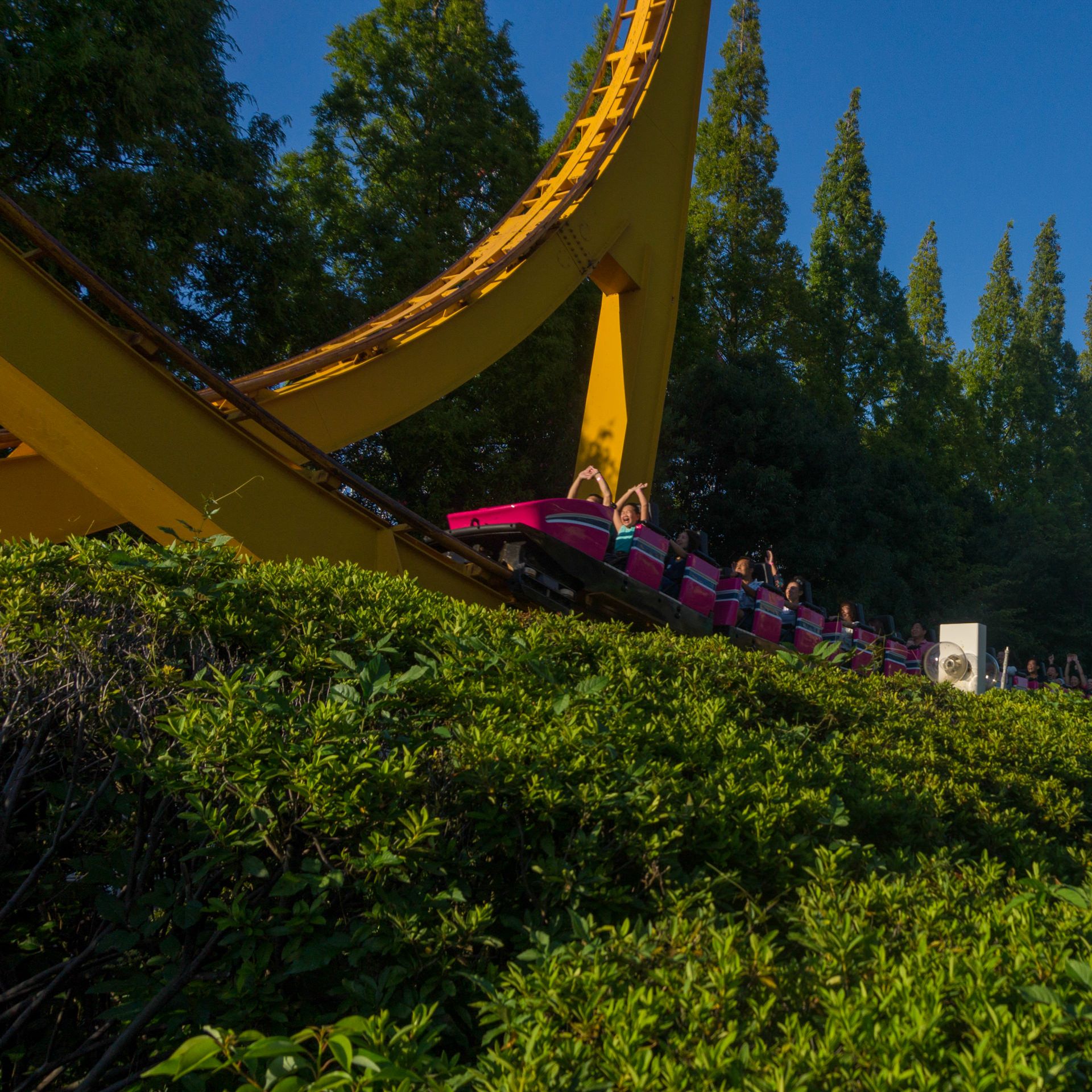
Secured only by a belt, we immediately climb the lift hill of the time-honoured lady. Now far below the treetops, we pass through a long right-hand bend, where we immediately plunge steeply to the ground in a completely untypical manner for a classic jet coaster. We climb the following hill in the same way before we take another right turn. This is followed by a somewhat flatter gradient with an even flatter ascent diagonally through the ride. The ascent then leads into a left-hand bend one level below the first bend, which is consequently ridden at a somewhat more leisurely pace. This is followed by a last exceedingly brisk descent that leads into a slightly longer straight above the lake. A final hop leads us to the station level, whereupon we also reach it after a left turn and the obligatory braking section.
The Jet Coaster is an extremely charming roller coaster that is particularly visually appealing with its framework structure. The ride through the forest is extremely fast and knows how to thrill its passengers with ease. So much so, in fact, that the longest queue was here on the second day of the visit, thanks to the unfortunately existing one-train operation. Apart from that, however, it’s a beautiful old and extremely ride-worthy treasure from the house of Togo.
Space Shot and Flying Carpet
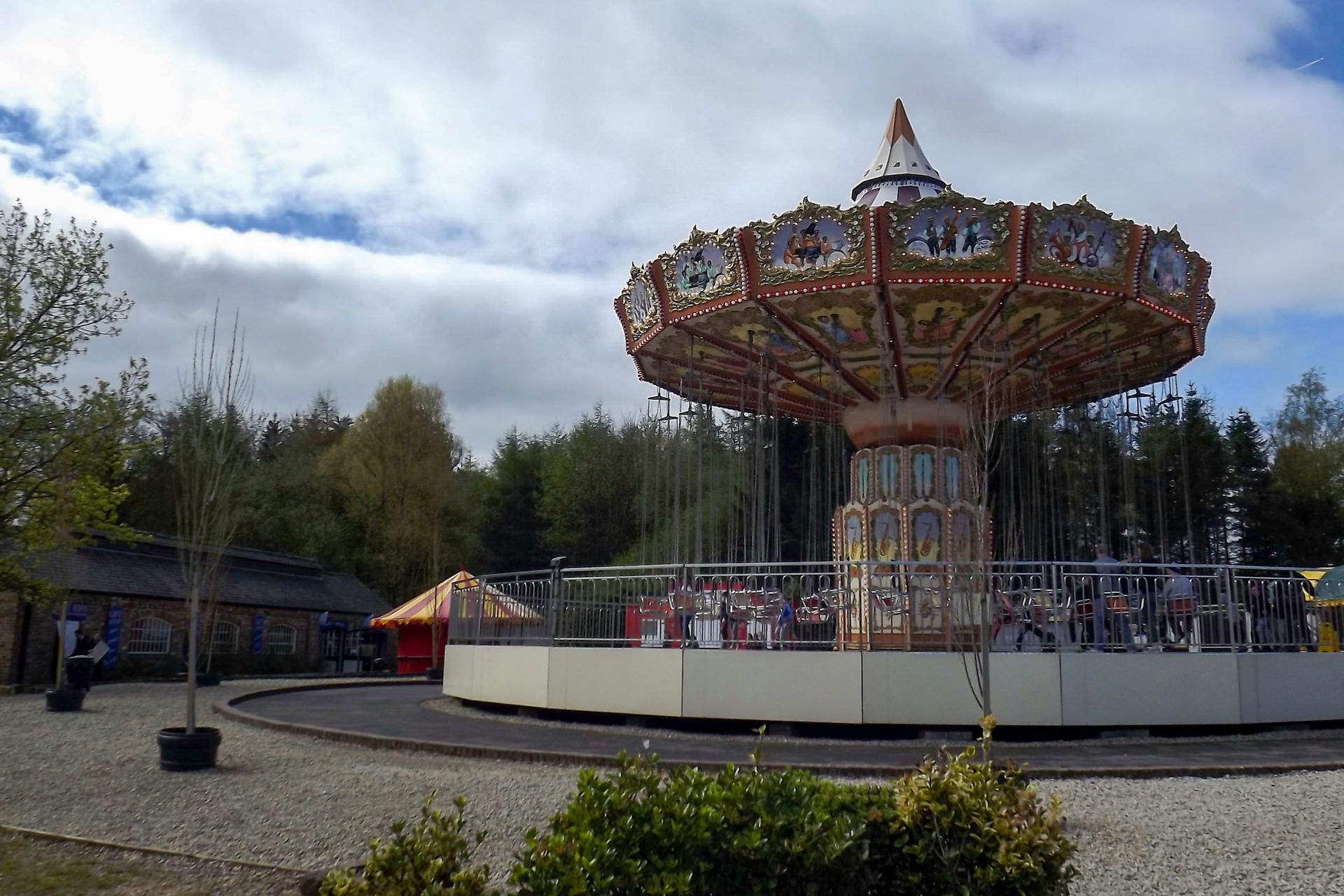
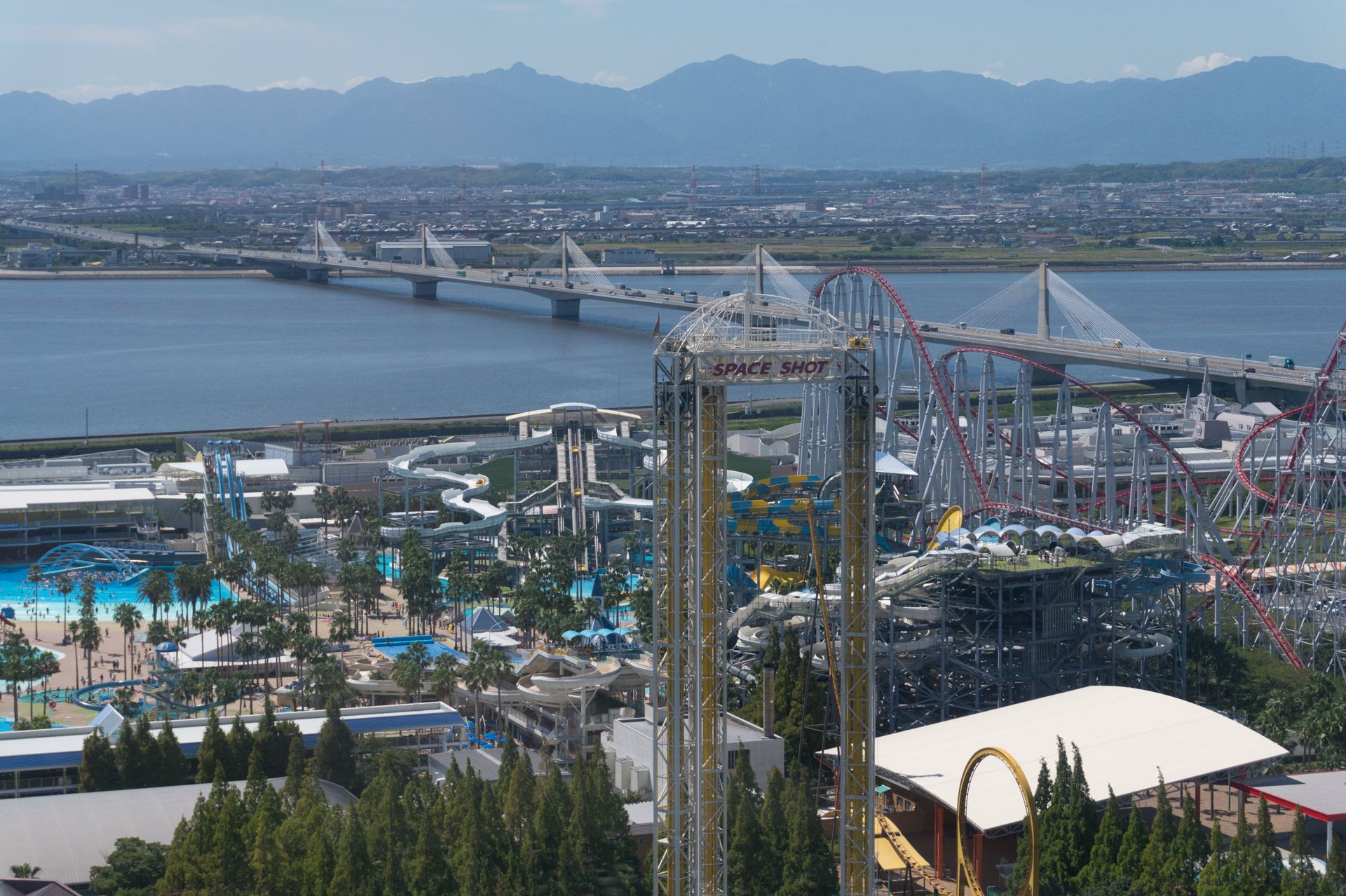
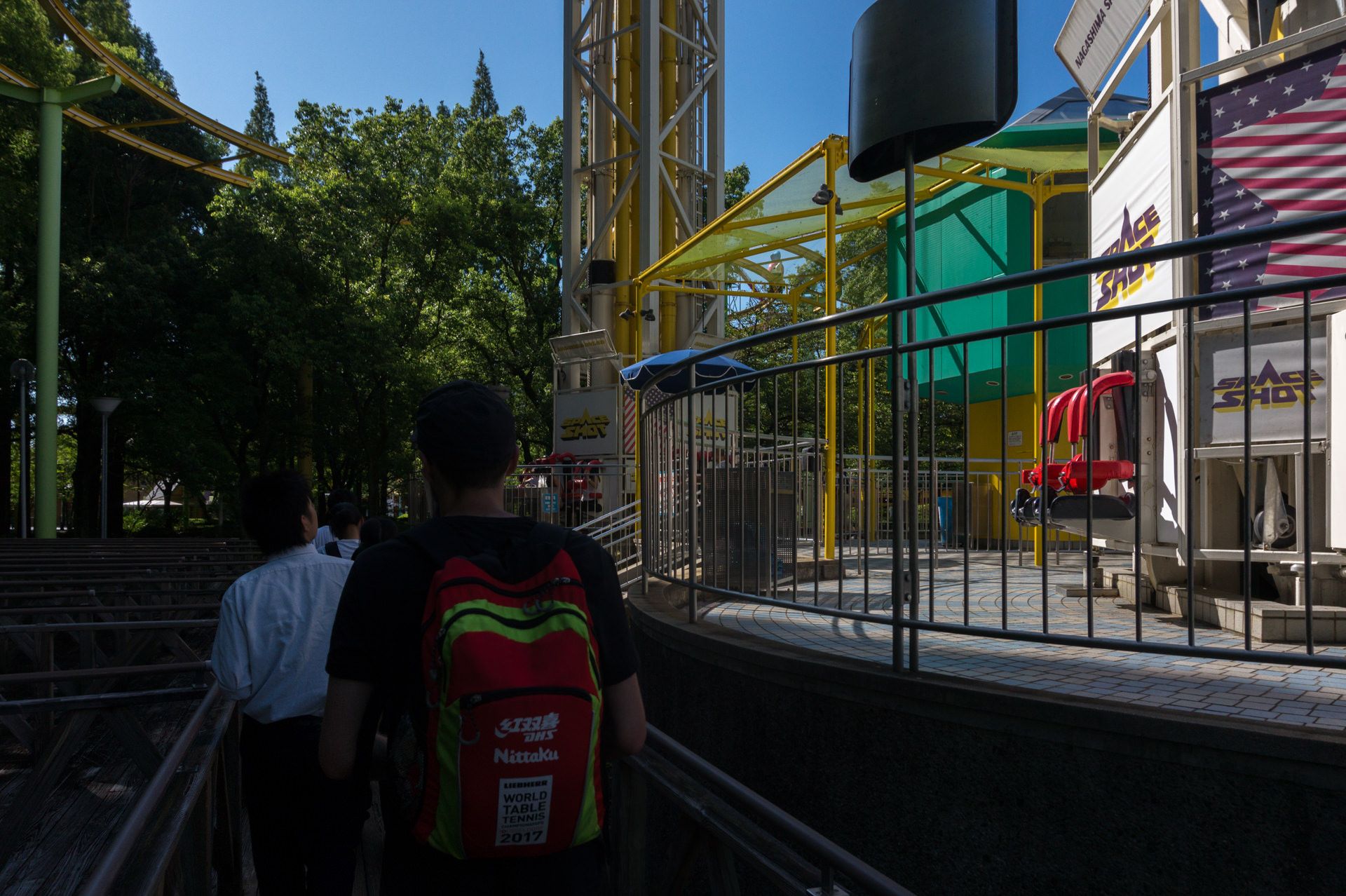
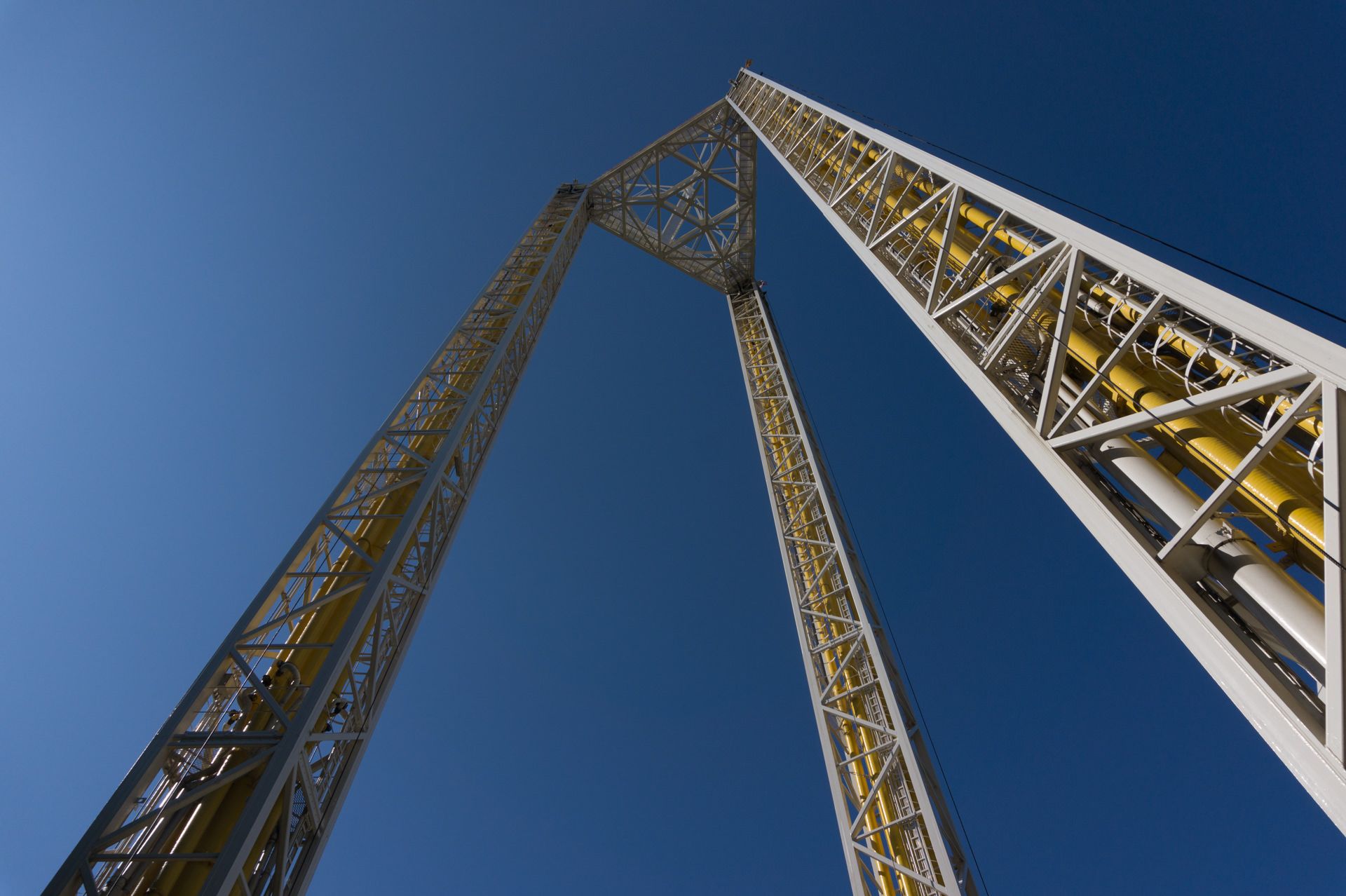
On the other side of the forest, a somewhat rare sight awaits visitors, right next to a more common one. While the S&S free fall tower triumvirate called Space Shot is still a very rare sight, a ride on a suspended flying carpet is the only one outside the Danish amusement park Tivoli Gardens. Both rides are quite convincing.
Shuttle Loop
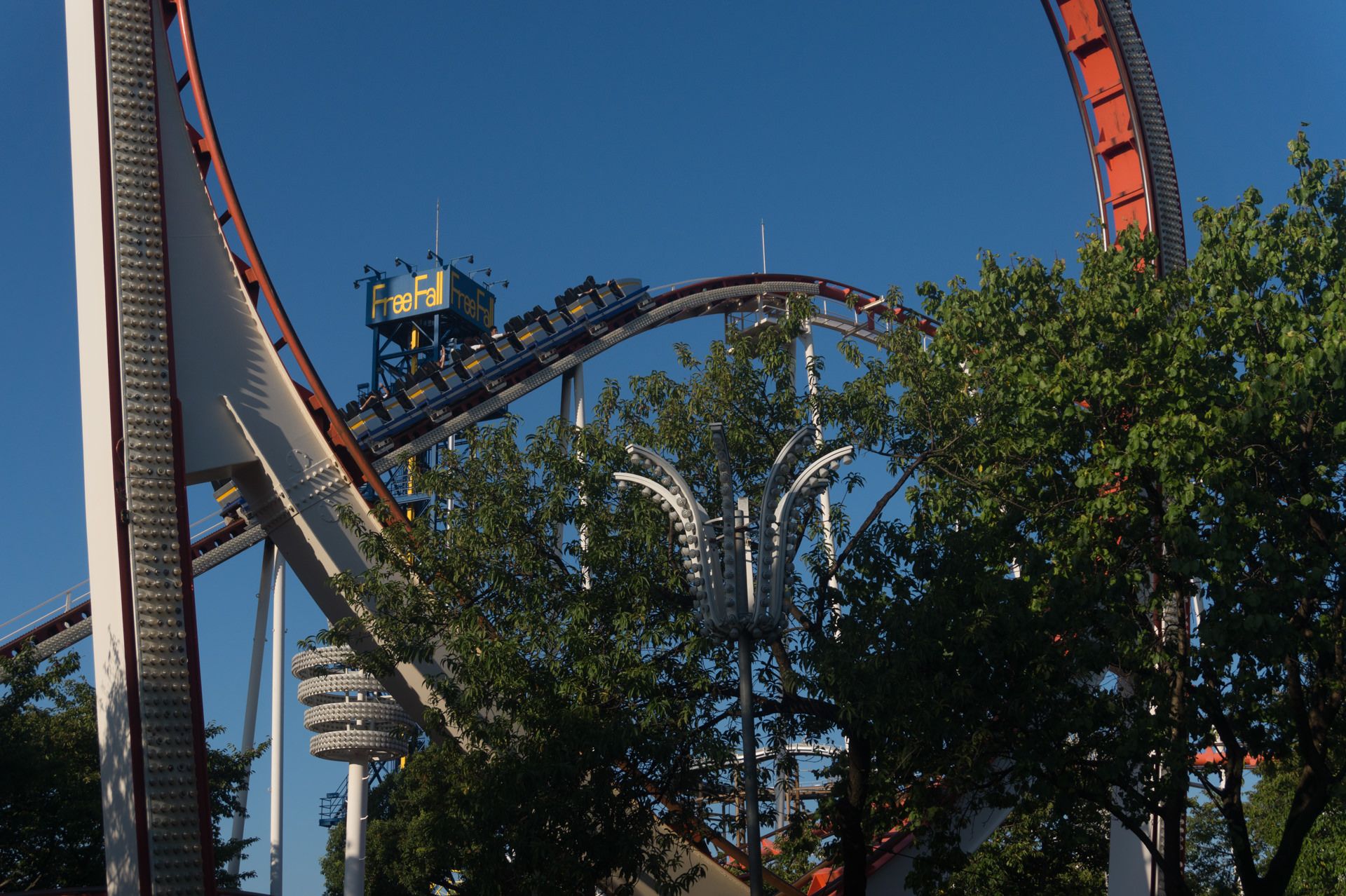
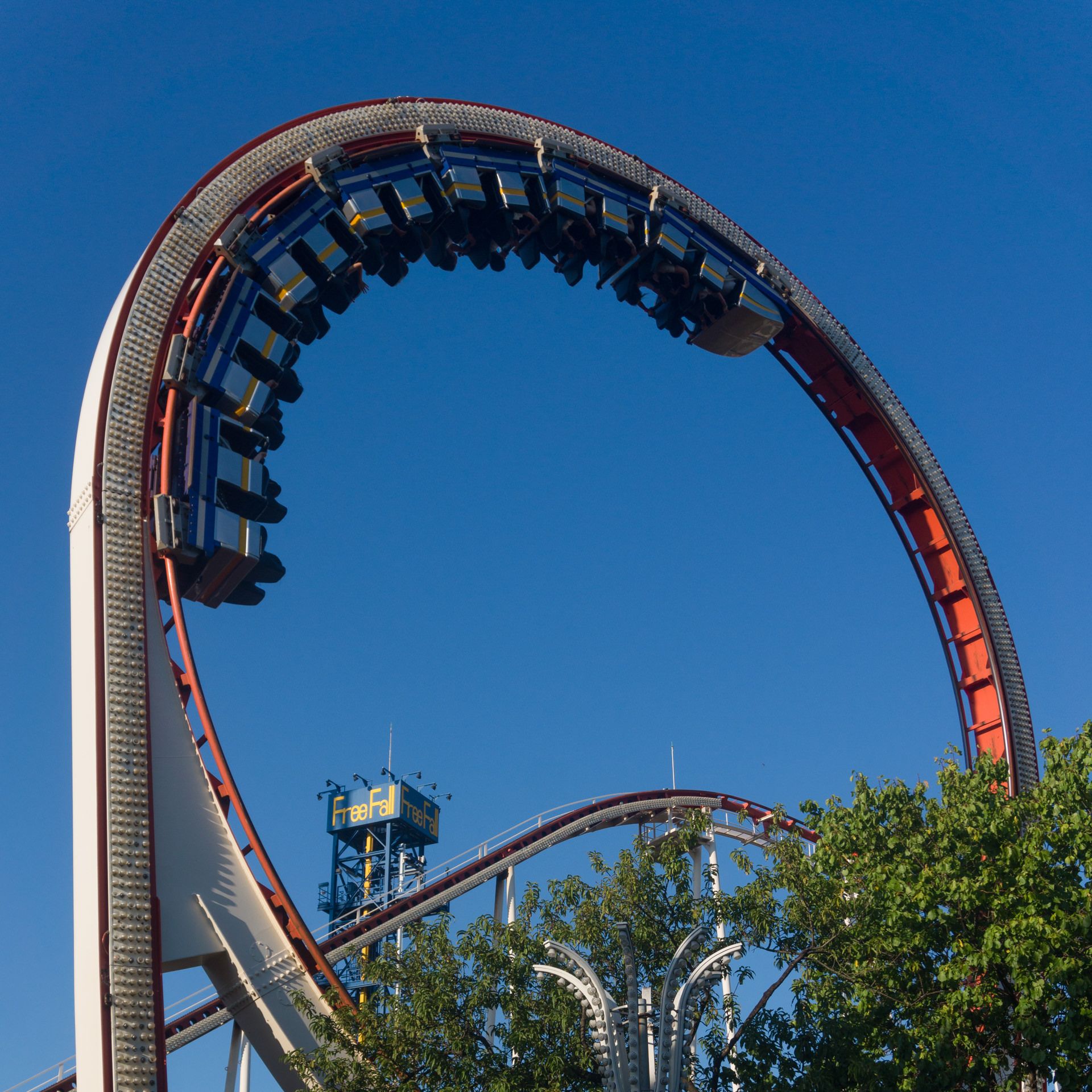
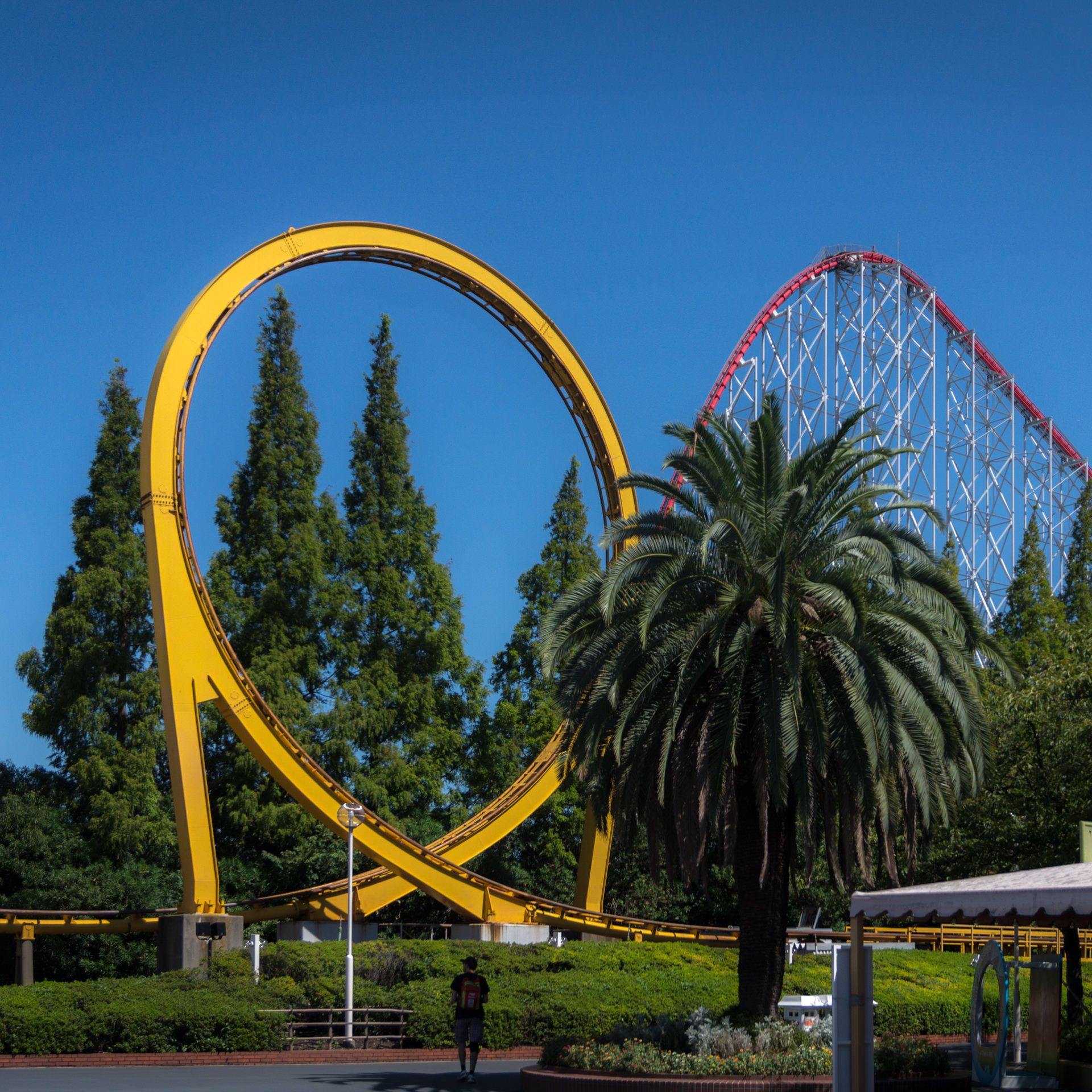
Just like the ride of the next roller coaster, whose layout can be perfectly described with the words launch, loop and reverse. You’ve probably already guessed, it’s a Shuttle Loop from Schwarzkopf. As with every roller coaster from Münsterhausen, it doesn’t take much to create an all-round satisfying ride experience, and so the ride is unusually puristic compared to the (so far) only European ride (Psyké Underground in Walibi Belgium). That’s enough, because the ride is absolutely perfect as it is, which is why you’ll want to get on again and again, and more than once in a row.
Looping Star
The same applies to the sister ride, which is only three years younger. The Shuttle Loop was apparently a great success, so that another Looping Star was ordered in Münsterhausen and the roller coaster was interestingly placed right next door.
The ride in this classic of German engineering begins quite confidently with the ascent of the lift hill. From a height of around 24m, you immediately plunge towards the ground in a steep curve to approach the only inversion figure, a loop, at full speed. With a lot of power, you then pass the element that gives the ride its name, after which you shoot upwards again to make a turn at a lofty height. But the peace and quiet doesn’t last long, because immediately the wagon group throws itself towards the ground again, which can lead to unexpected airtime, especially in the rear part of the train. In the opposite direction to the first gradient, you gain a little height again and then reduce it efficiently parallel to the lift hill. Since a straight line with a constant lateral inclination is a bit strange to ride, you are straightened out in between, but without taking into account the principle of turning around the heart line; but there are other roller coasters in Nagashima Spa Land for that (like the Ultra Twister). Leaning to the left again, you ride through another curve before you enter a hill and approach the ground again. This is followed by a fast-paced right turn, which then takes you into the braking section of the ride.
Corkscrew
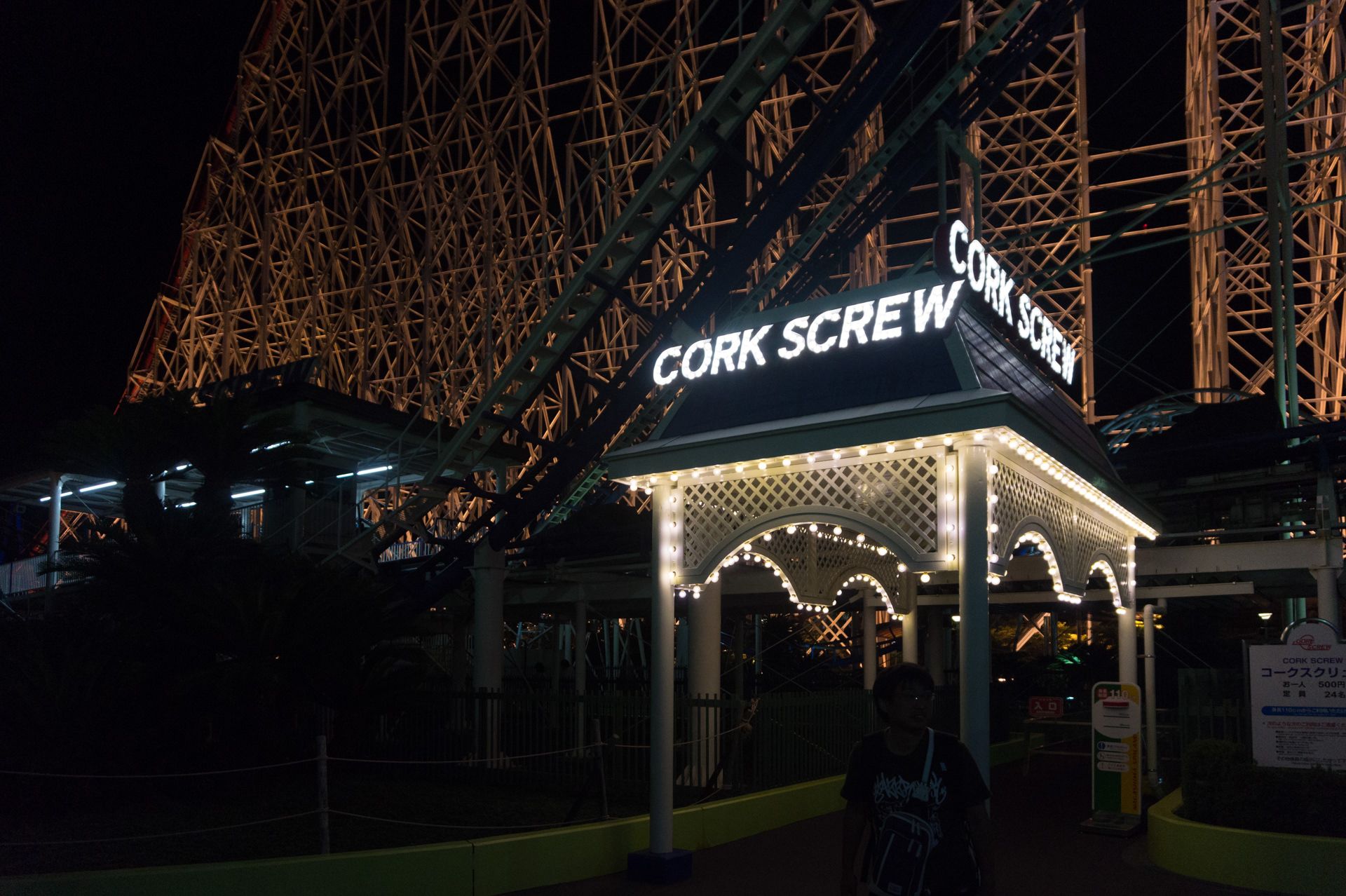
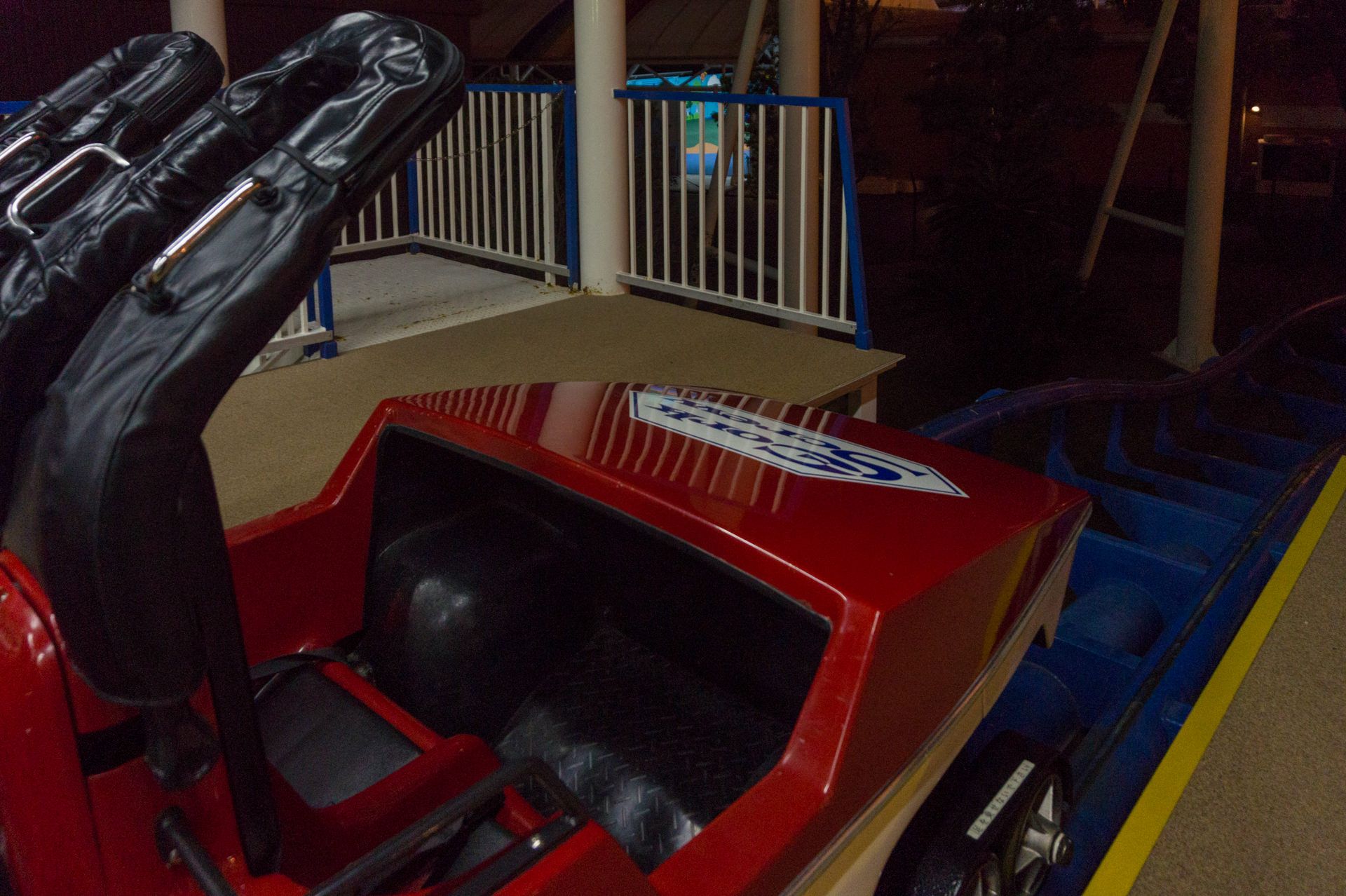
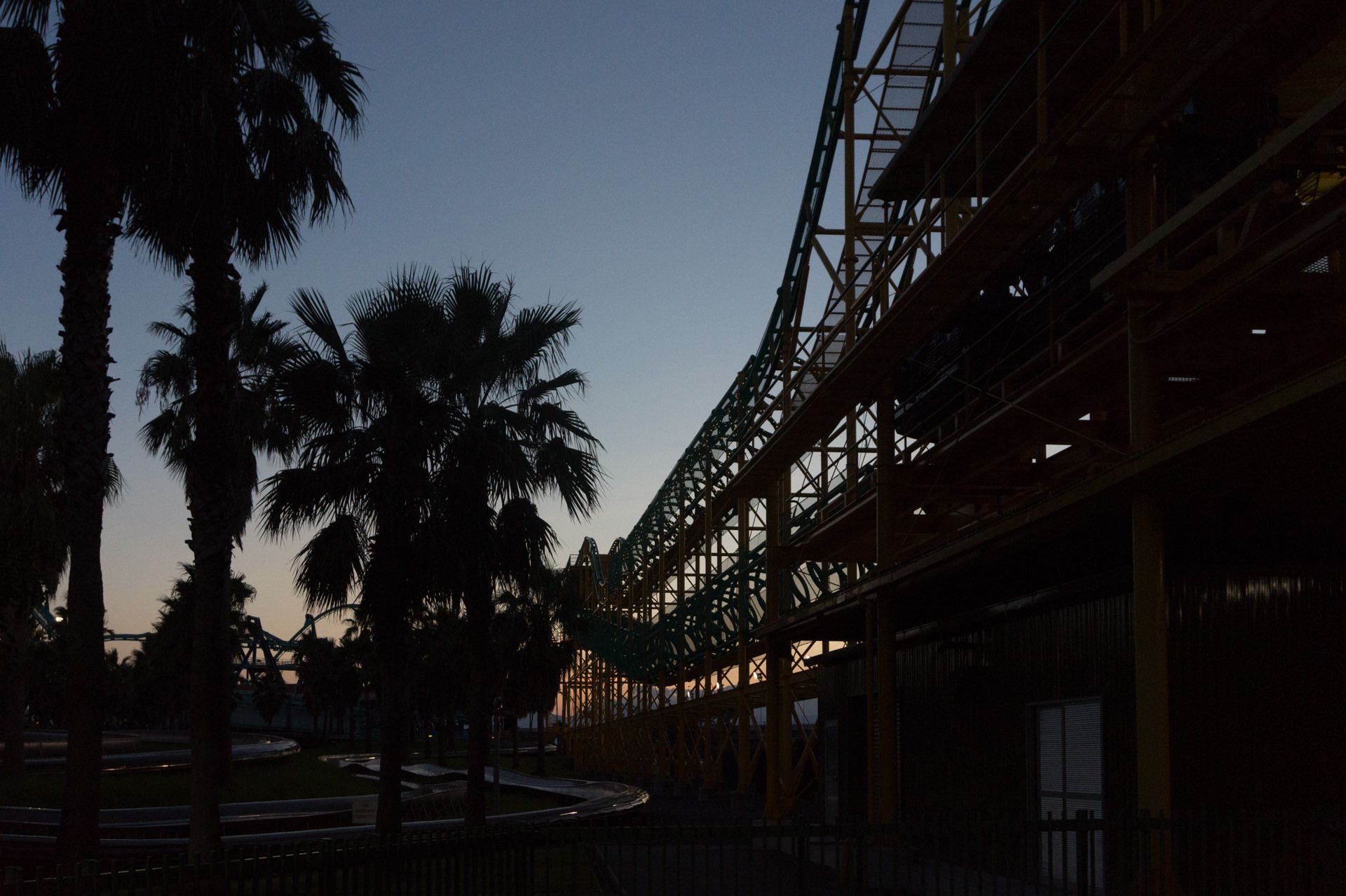
Interestingly, the rival product from Arrow has been situated directly opposite the Looping Star since the year 2012. In 1979, the Corkscrew coaster in Nagashima turned its passengers upside down twice. Interestingly, it is one of four identical rides that started operation in Japan that year – all probably inspired by the first inversion coaster in Asia, the Corkscrew at Yatsu Yuenchi.
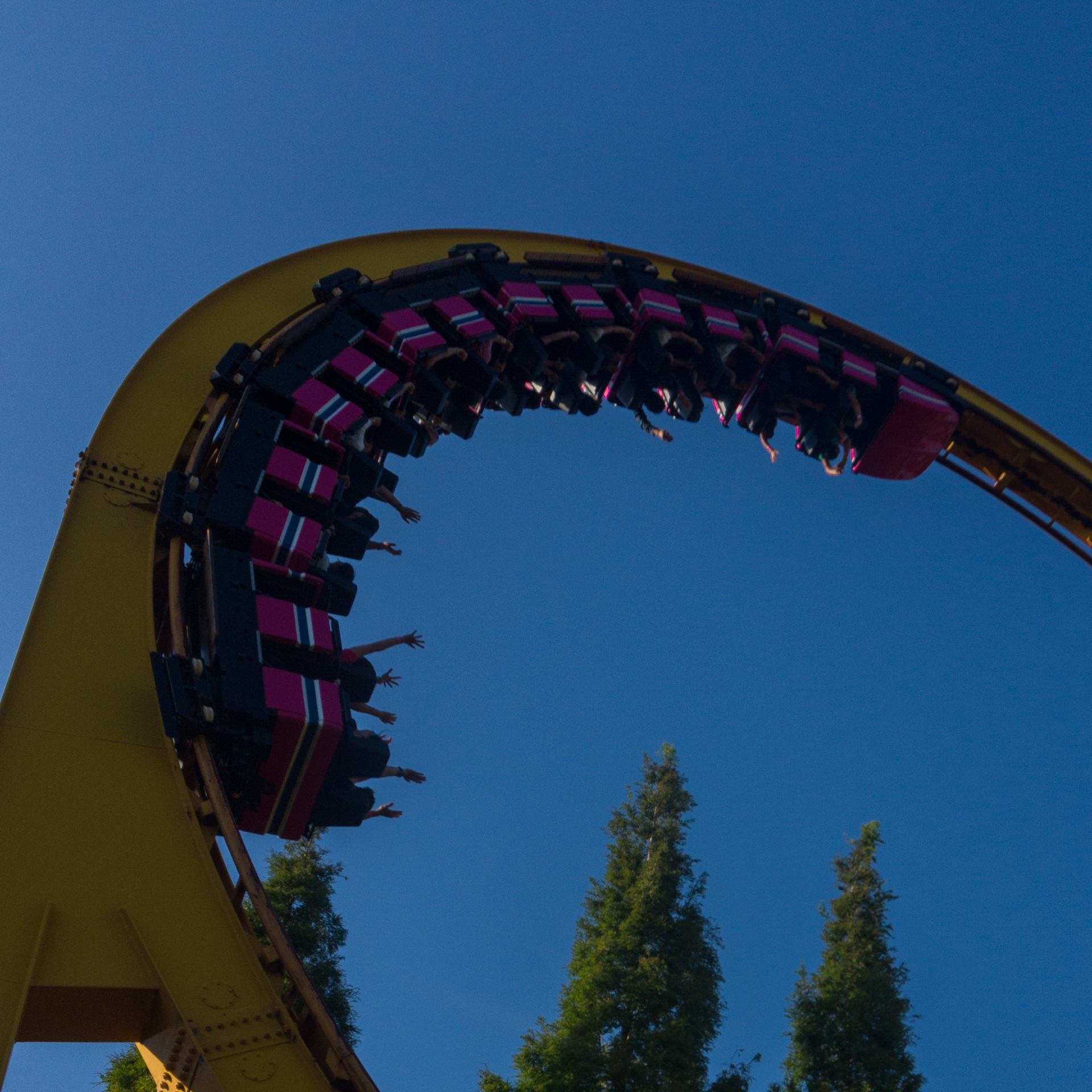
The layout is quickly reproduced. After leaving the station via a small incline, you ride through a tight turning curve, which then transfers you to the ride’s lift. Having reached a height of about 21m, you leave the lift in a short dip, whereby the necessary lateral inclination for the following turn is already generated in the same move. Once the turn is completed, the train plunges towards the ground, which leads to a pronounced airtime, especially in the rear part of the train. Now the train roars powerfully through the first valley and shortly afterwards shoots up a hill. This then quickly turns into a longer downhill curve, in whose transverse valley the train enters the corkscrew. Absolutely skilfully, the train now turns over twice. The exit of the second corkscrew then leads into the final turning curve, whereupon the brakes are already waiting.
The ride on the Corkscrew is great. Nowadays the ride is nothing earth-shattering, but in 1979 it was enough to make the masses stand on their heads. Unfortunately, the ride characteristics were below the manufacturer’s average – but that hardly matters. All in all, the ride fits perfectly into its very strong field of competitors, which is why you should definitely take a ride or two; where else would you find so many idols of the late 70s in the same corner of a park?
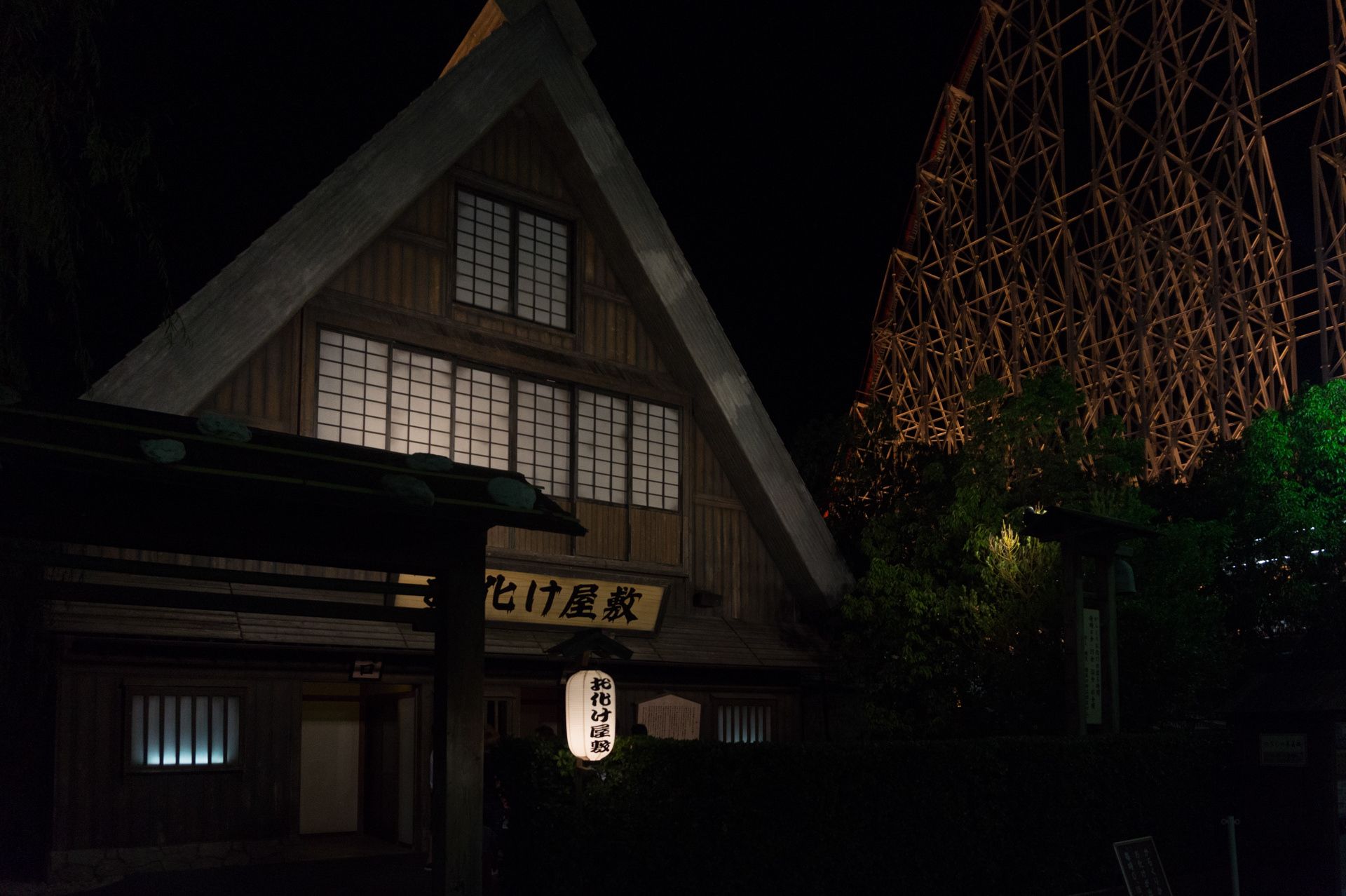
Past a typical Japanese scary house and an excellent Star Flyer, the path now leads us to the other side of a gigantic steel structure, which we save for later. Here we turn left and follow the wide main path into a dead end, where the Flying Coaster Acrobat is waiting for us.
Acrobat
Attracted by the appearance, we quickly find ourselves in the spacious waiting area below the station and decide to go to one of the two sides of the station. After climbing the stairs, we are immediately assigned to a row, whereupon we stow our personal belongings and valuables in lockers belonging to the rows. Nothing unusual as far as that goes, but at the end a security scan including a metal detector awaits us. After we have proved that all our bags are empty, we are let through to the gates and can immediately board our preferred aircraft.
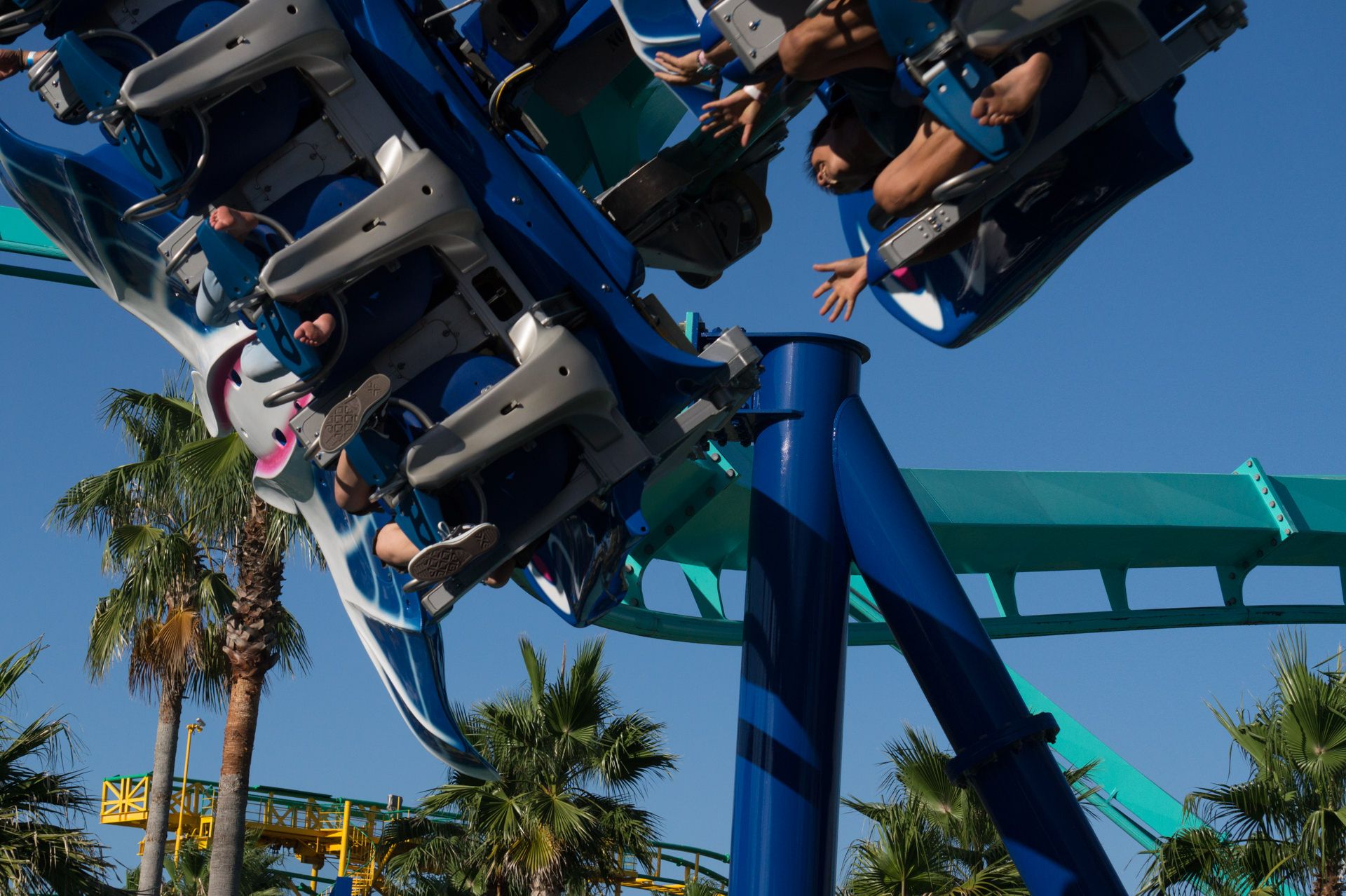
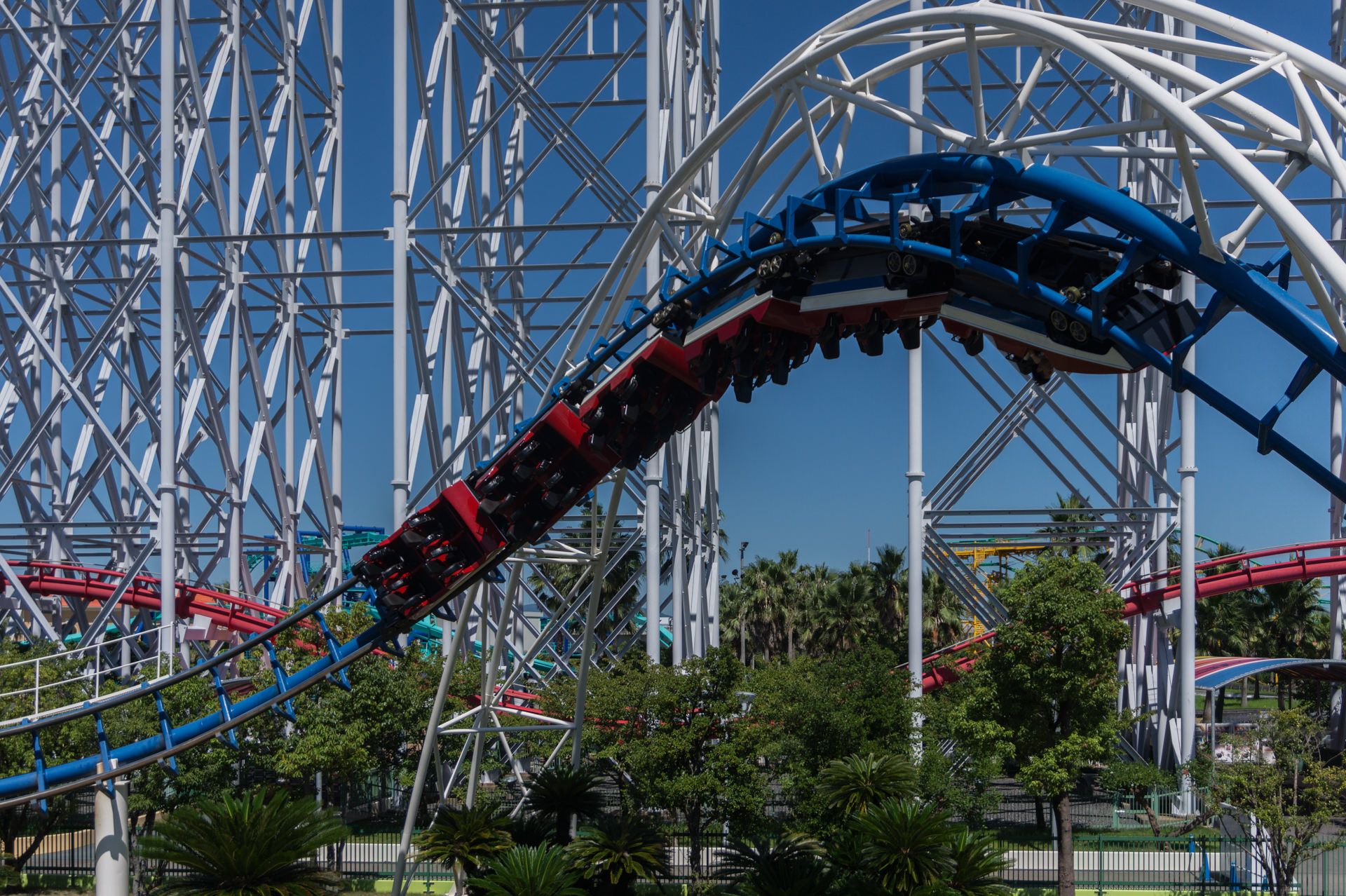
As soon as the starting position is reached, the ride can begin. We reach the ride’s lift via a switch, which takes us up to a height of 43m. Once at the top, we plunge into a steep curve to the right towards the abyss. In a wide radius we now float through the following valley and immediately climb a hill, which turns out to be the starting position for the now following Pretzel Loop. Without mercy we now plunge down, stand overhead for a short time and then watch the spectacle lying on our backs in reverse order, almost being killed by the G-Forces. Once again at high altitude, there is enough time to take a short breath, because now we cross the element we have just completed in a tame left turn. But before we know it, we are spinning around our own axis in an inline twist and hurtling towards the ground in a right turn. In a corkscrew we cross the Prezel Loop once more and soon have a look at the station of the roller coaster from behind. After a short ascent, we reach the middle block brake section of the ride, which, however, releases us into the second part of this without any major slowdown.
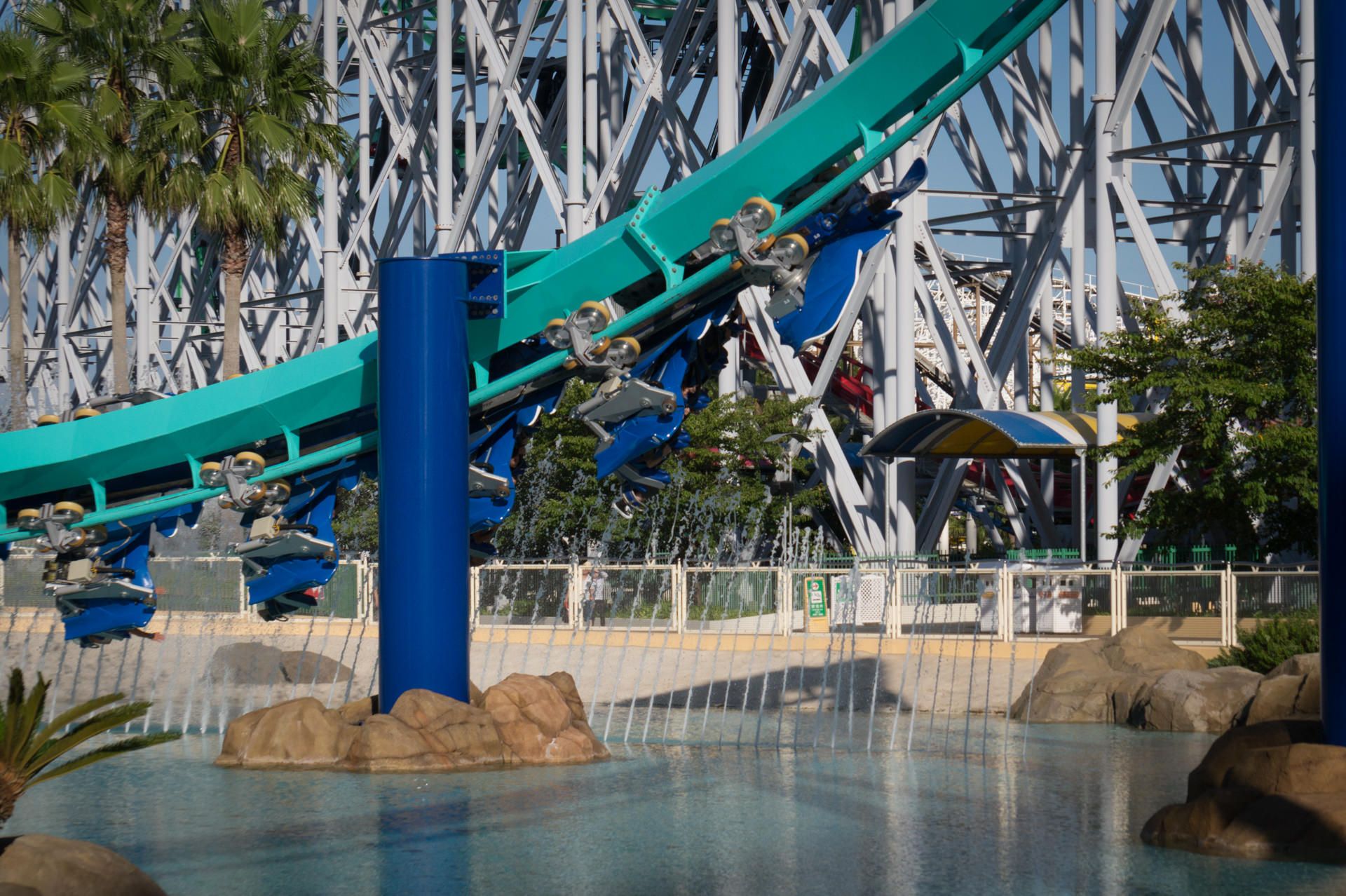
In a right-hand bend, accompanied by synchronised water fountains, we shoot across a lake. Similar to a Bavarian curve, hill follows dale and at the end of the curve there is even another inline twist waiting for the passengers. Still in this great flow, we find ourselves in a left turn, which unfortunately leads us straight into the final brake.
Acrobat is the tamer of the two Japanese flying coasters, but that doesn’t mean that the ride doesn’t try to beat you to death with the forces at its disposal. It just does it a little more subtly. While Universal’s Flying Dinosaur has one element after the other, Acrobat still has enough time to devote itself entirely to flying. This has its advantages and the ride itself seems a little more harmonious. Especially the part after the block brake is quite impressive and offers wonderful insights for the rest of the park guests. In general, the ride is wonderfully open and can be seen from all sides, so that even more guests from the nearby outlet centre will switch to the Nagashima Spa Land amusement park. It’s worth it, at least, because Acrobat is a really ingenious flying coaster in Nagashima.
Bobkart
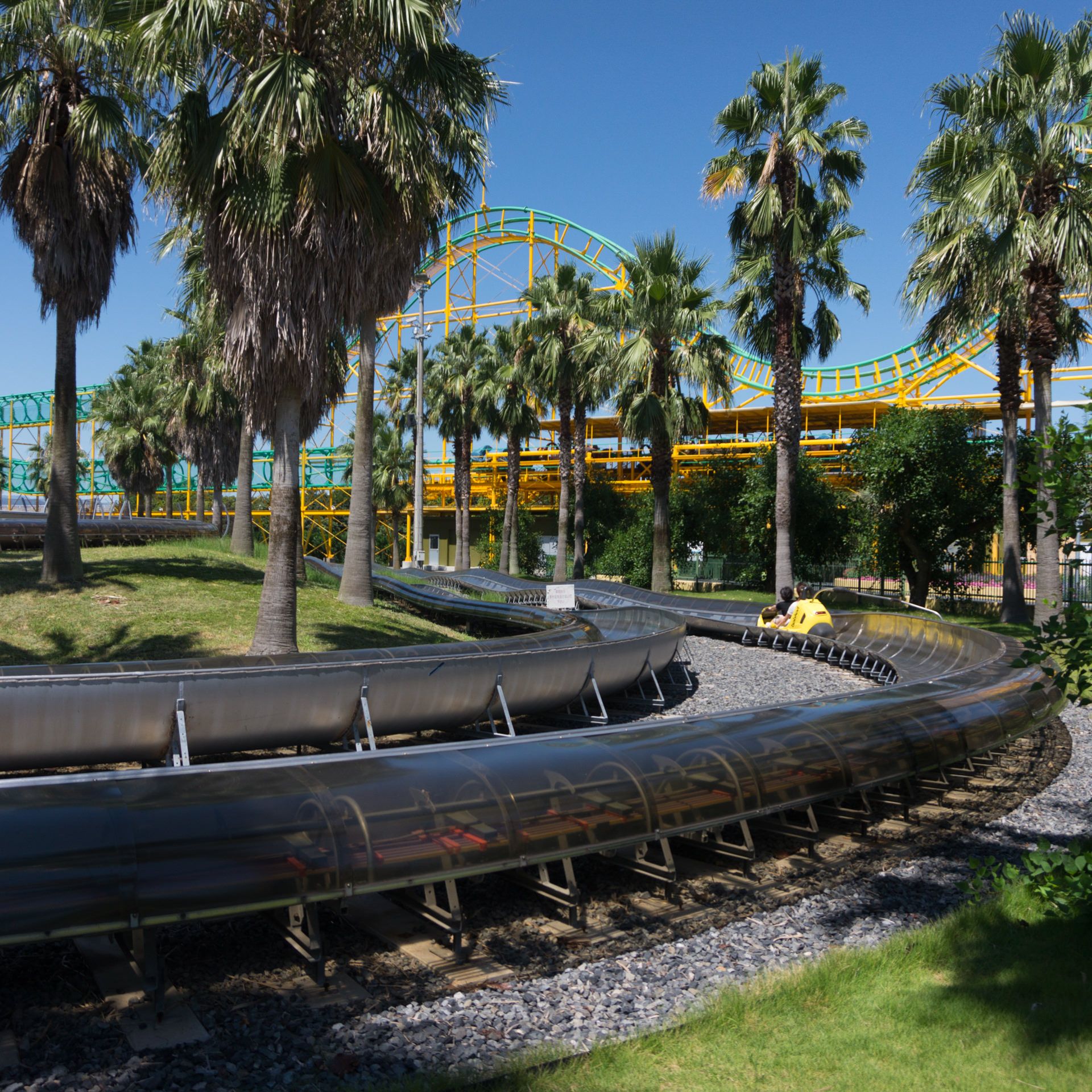
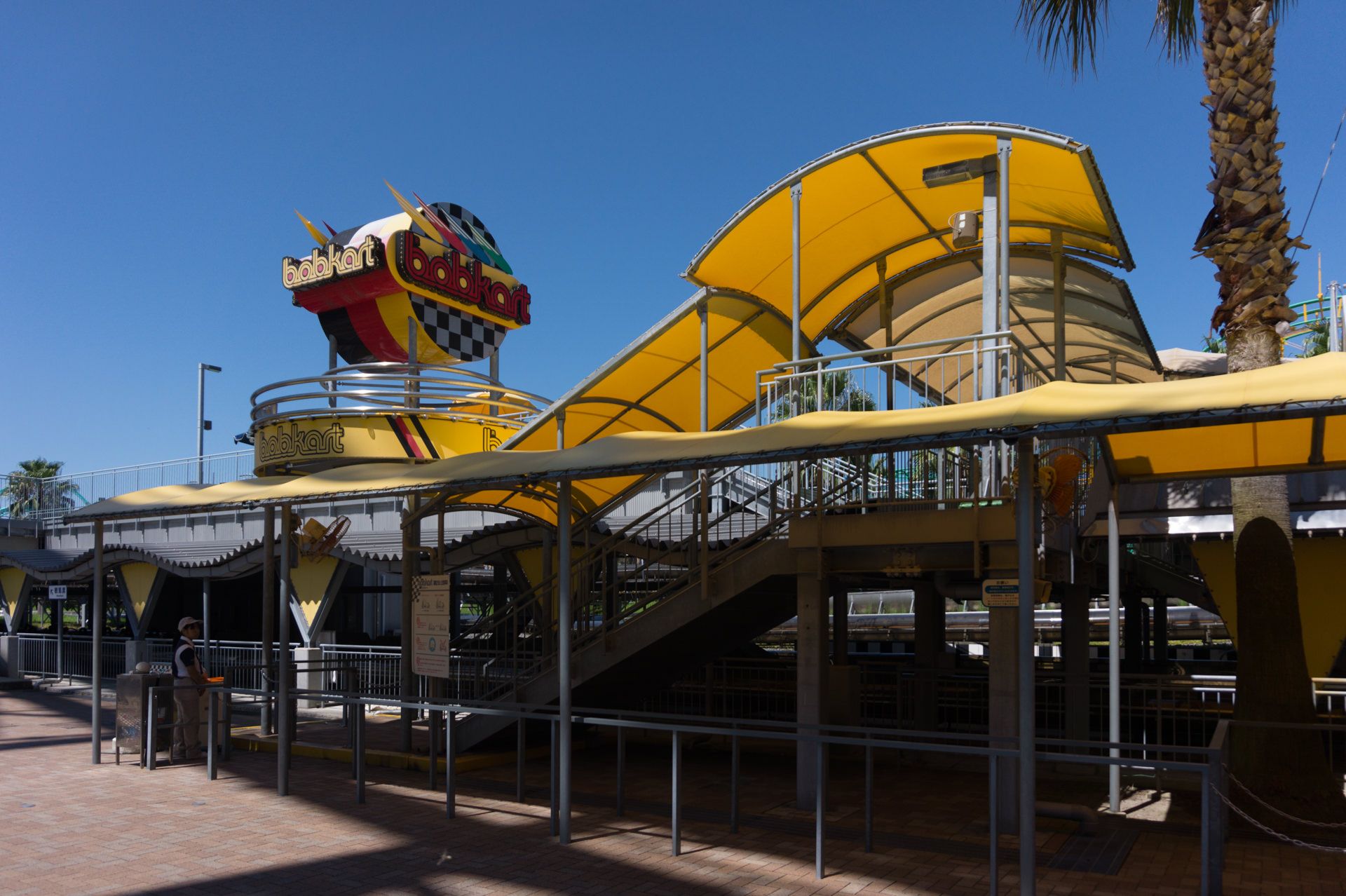
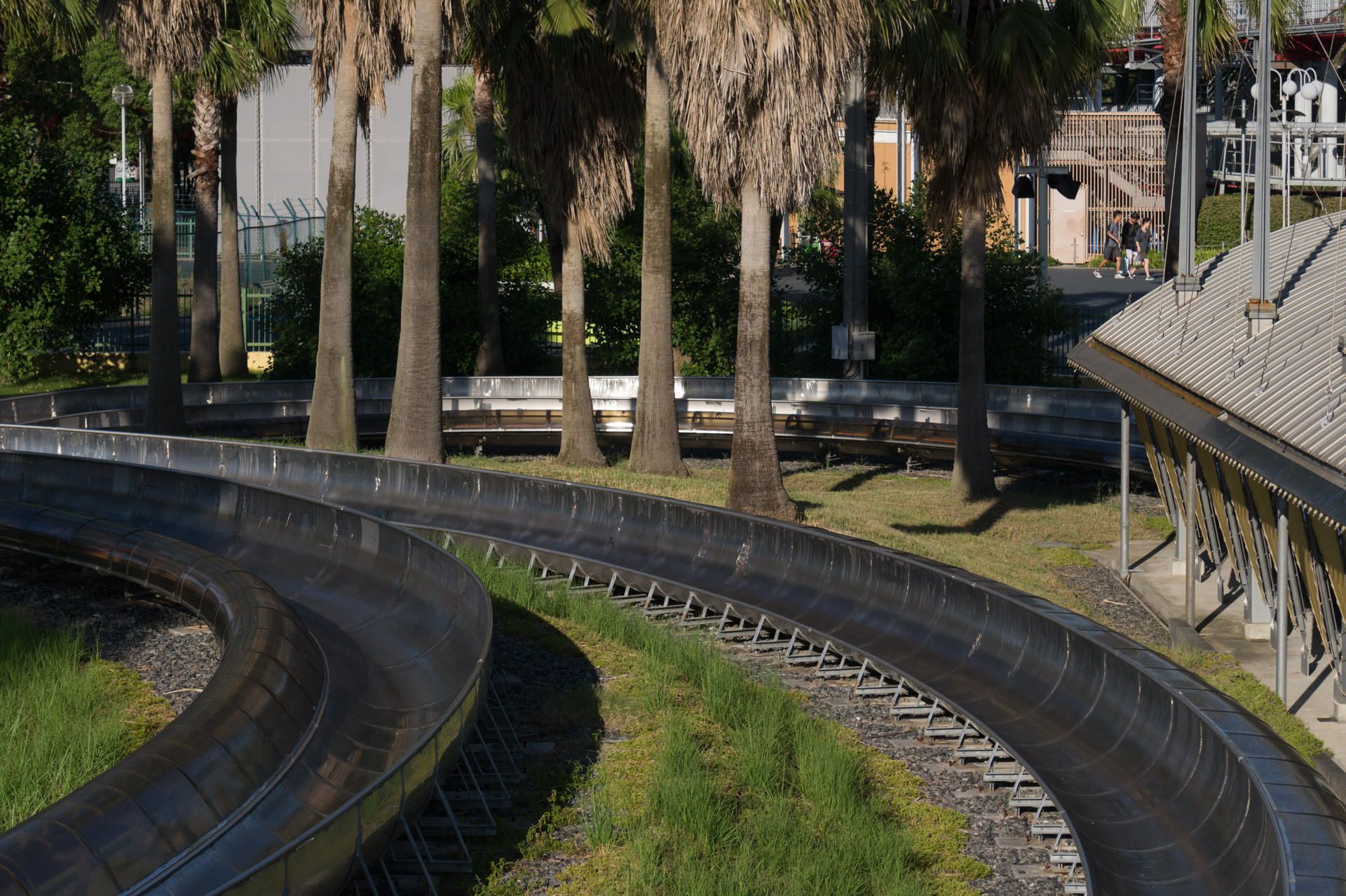
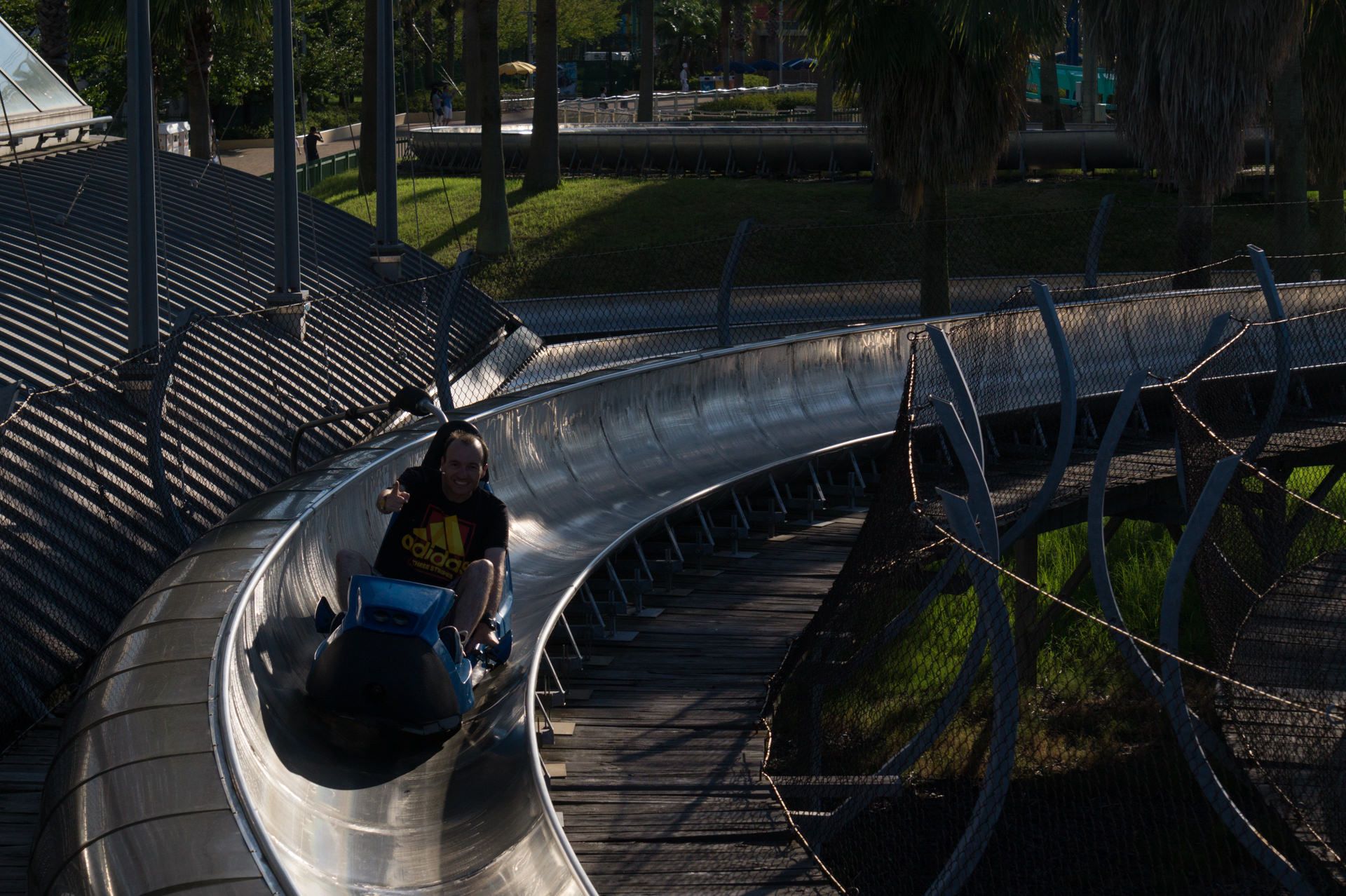
Right next to it, the Wiegand Bobkart double track has been in place since 2004. On a length of 822 and 797m, both lanes theoretically duel each other. For the time being, the track runs parallel through a very bumpy left-hand bend. The driving comfort increases significantly with the steadily increasing speed, the fun in turn through the numerous waves on the now following straight. After another left-hand bend and just as many waves, the two lanes now separate from each other.
While the right lane now turns into a short right-hand bend, the left lane continues straight ahead. In a wide left-hand bend, the right-hand lane now steadily builds up height, whereupon the left-hand lane is crossed on another undulating straight. The competing lane meanwhile devotes itself to a right-leading upward helix, whereupon both lanes run parallel again for a short moment. This quickly changes and so both tracks separate at an sharp angle. There is a reason for this, because in the following downward helix of the right lane, the left lane comes towards you. The left lane circles the helix, but then runs parallel to the track you have just completed in the right lane. After a wide right-hand bend and a short straight, the left-hand lane meets the right-hand lane again, which in the meantime has only passed through a longer straight, and both enter an upward helix in parallel.
On an elevated part of the track, both tracks now cross the just completed and future track before entering a left turn along the station. Following a downward helix to the right, both tracks then continue on the ground. After a left turn and a 180° turn, both tracks reach their destination.
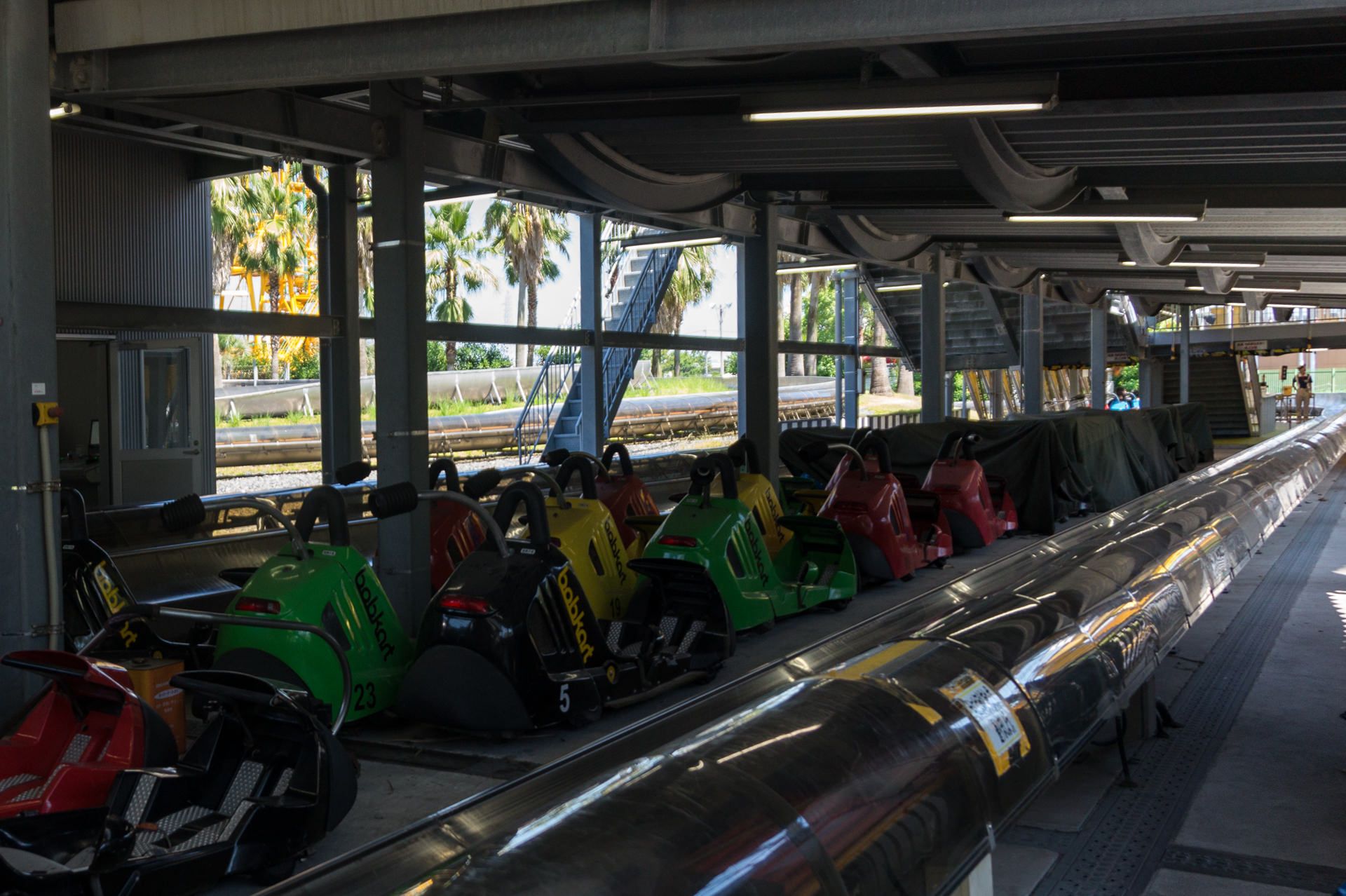
The double bobsleigh track is quite impressive, but the ride itself is only okay. Admittedly, you get a bit distracted by the rides surrounding you, but the ride over the numerous bumps is unfortunately also a bit repetitive. Although you could also look over them if the bobs ran parallel. Of the total of 28 bobsleds per side, unfortunately only about 5 were running on the first day of the visit – which was perfectly adequate in view of the crowds – and these were sent on their way one after the other per side. Whereas at the beginning both sides were served, shortly afterwards only the right lane was running. That was a pity, but also understandable, after all you can vary the capacity of the rides according to the rush in no time at all. Overall, the left lane was a little better than the right lane, but all in all, both lanes offered a good ride.
Ultra Twister
Directly behind the ride is the station of the Ultra Twister roller coaster. The standard model of the manufacturer Togo also awaits us in Nagashima, but here in a somewhat less colourful paint scheme than in the Greenland amusement park, but with ingenious lighting effects. Since we had already ridden 12 laps of the ride in Greenland, we knew what to expect and got on with pleasure.
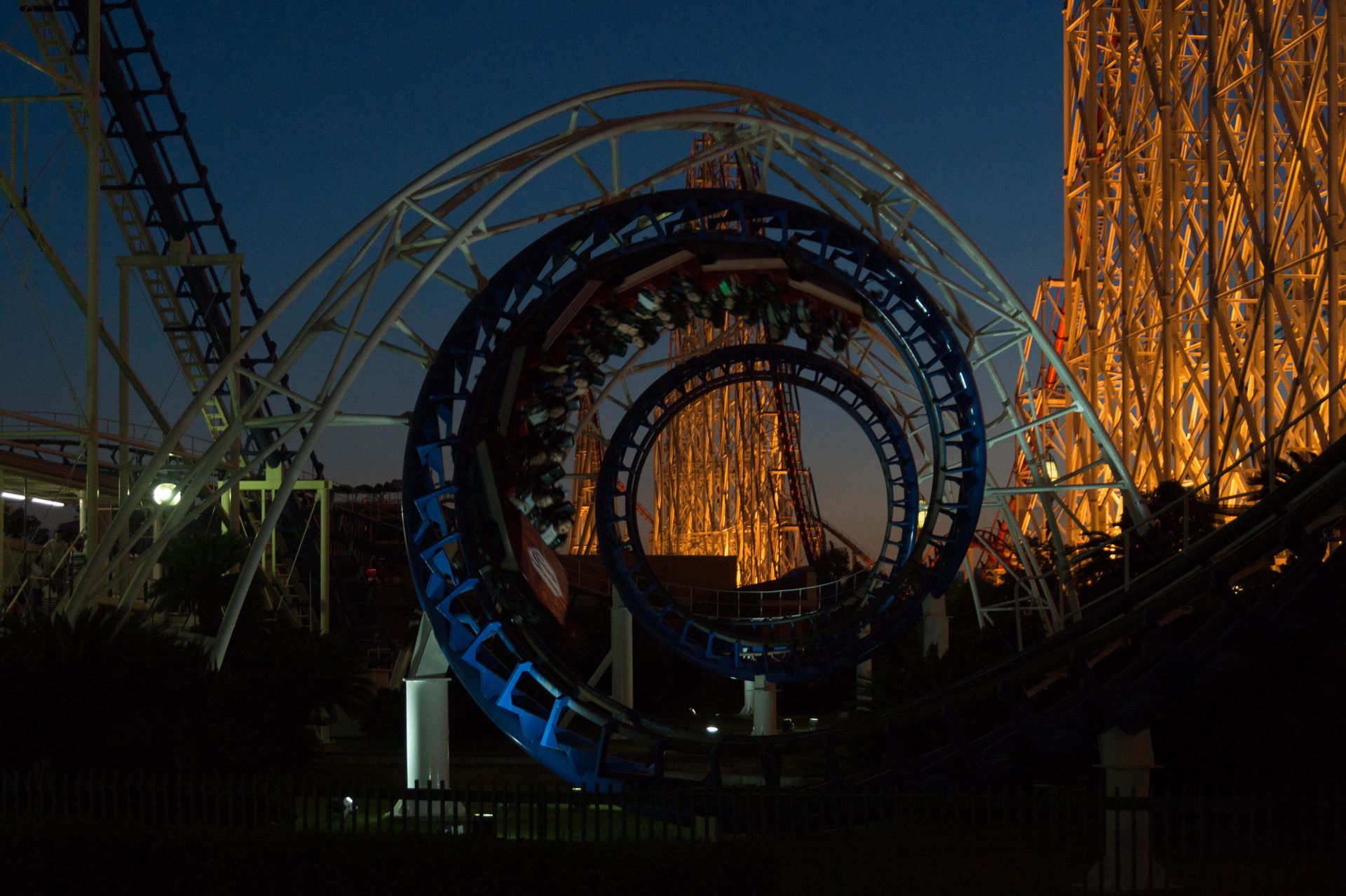
After the car has been checked, you approach the transfer element at the rear end of the track. This is then turned by 90° degrees, which is promptly followed by the ascent in the vertical lift. Having reached a height of 30m, the car crosses a very narrow crest and plunges rapidly down a steep 85° gradient. There is intense airtime in every seat, but especially in the last row. The following and quite narrow valley is driven through with extreme pressure, while the following airtime hill skillfully tries to throw you off. With strikingly high speed, you now race through a heartline roll that couldn’t be more beautiful. Shortly afterwards, you climb a small incline, at the end of which you reach the first braking section of the ride.
In a second transfer element you are now brought to the lower lane, which you follow backwards from then on. On a short descent you then steadily increase speed before the car is turned upside down a second time. As soon as the station level is reached, the third and last roll of the ride follows. Shortly afterwards, the second braking section is reached and the ride on the Ultra Twister draws to a close.
Also in Nagashima, the tube roller coaster is completely convincing. The interplay of vertical acceleration is just wonderfully brutal and always worth experiencing. Especially since the end stops are not quite as hard as in Greenland, which makes the ride all the more inviting for repeat rides. Unless you don’t burn your shoulders on a visit to the Joyful Waterpark, which you should definitely plan to do so, and torture yourself accordingly on a night ride through the ride. Nonetheless, this is also totally worth it, because the illuminated ring elements enhance the visually very appealing ride even more.
Steel Dragon 2000
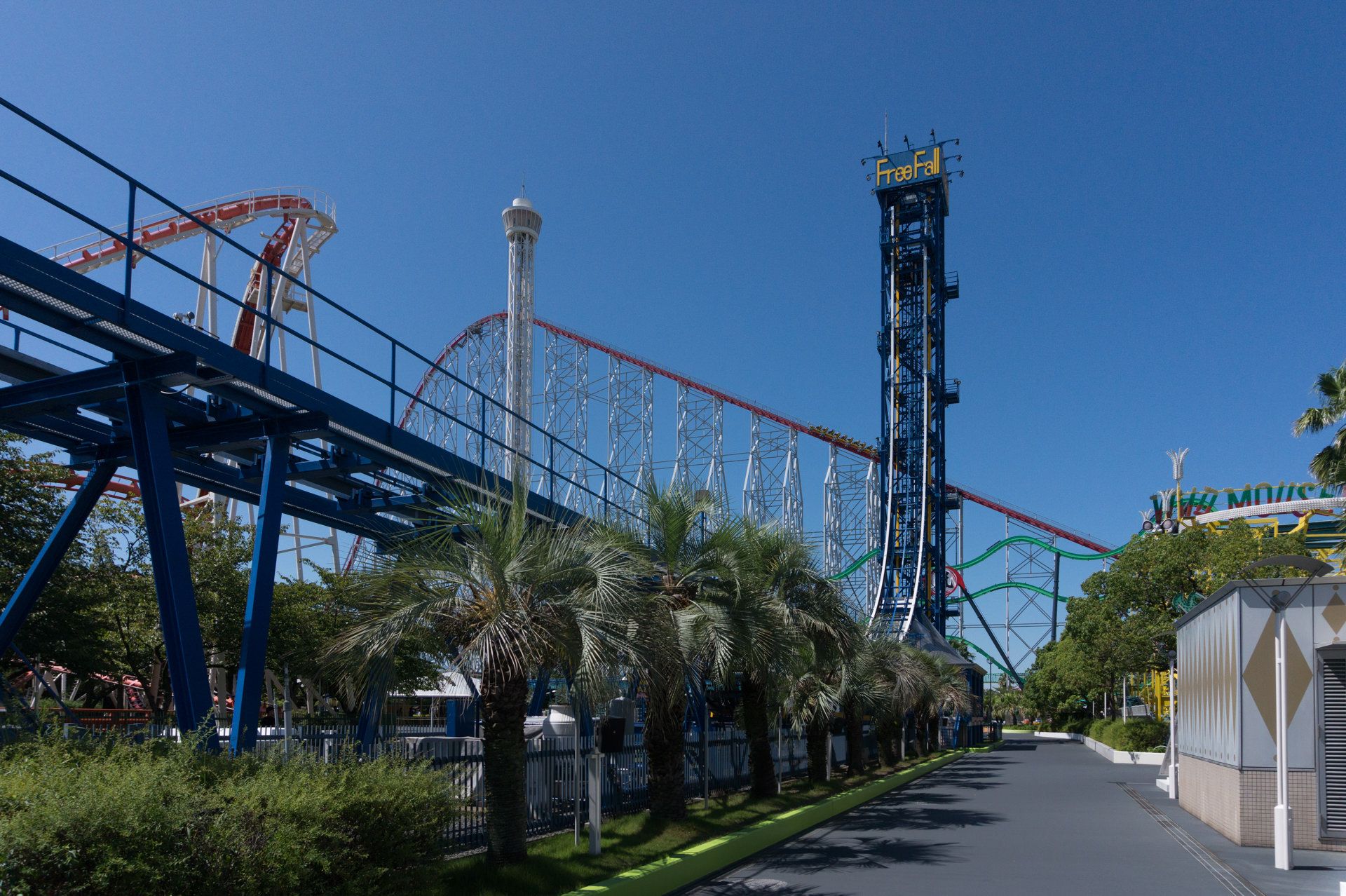
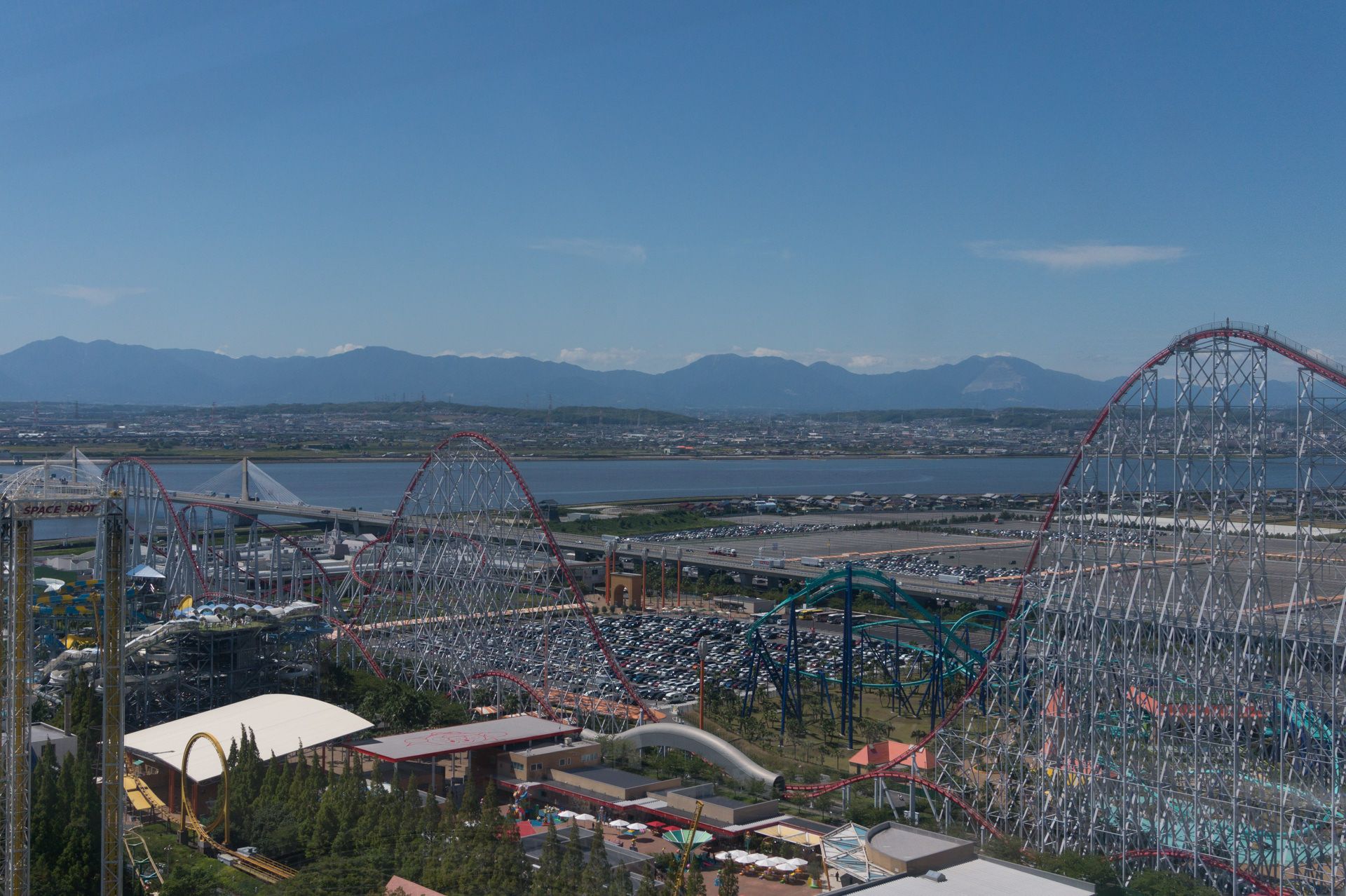
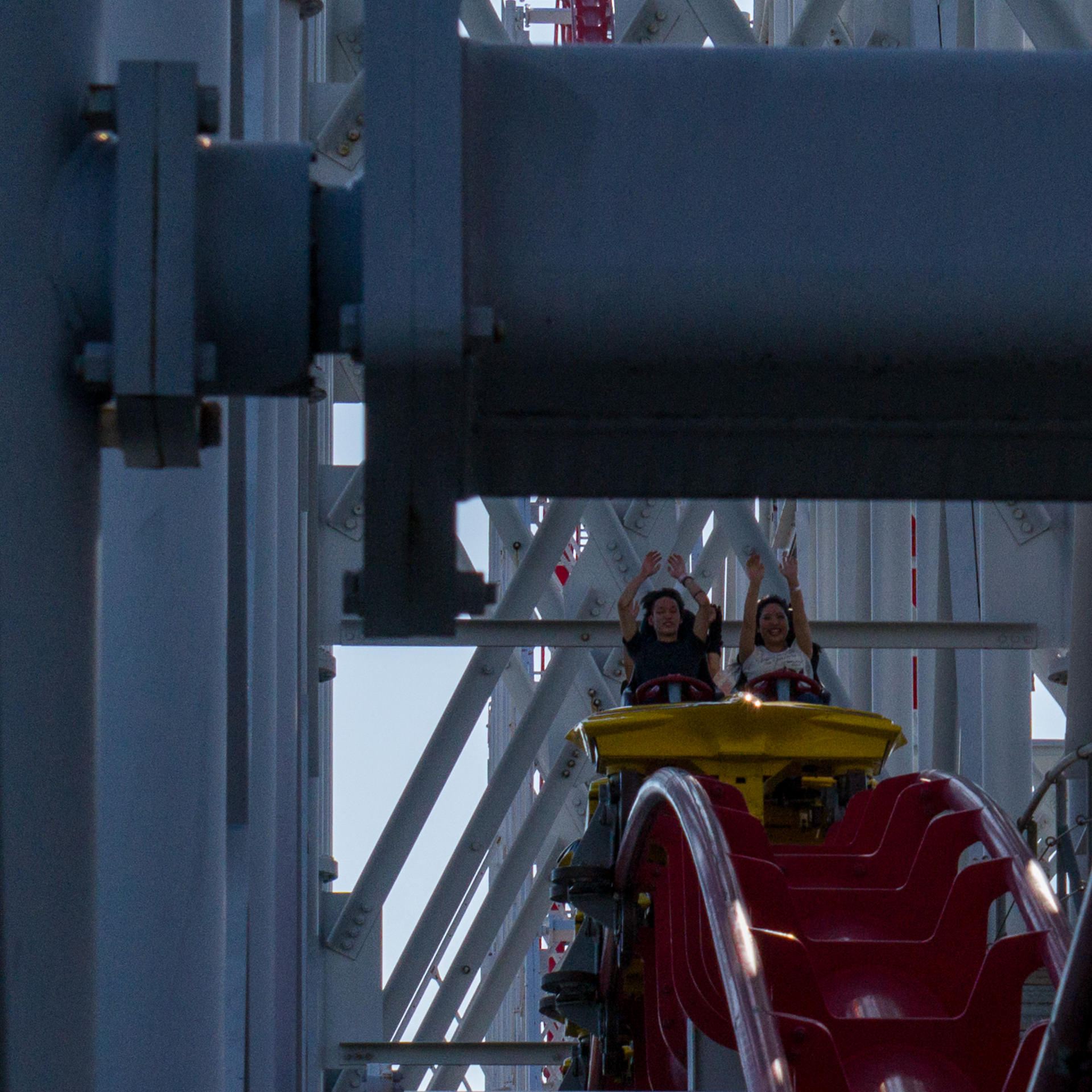
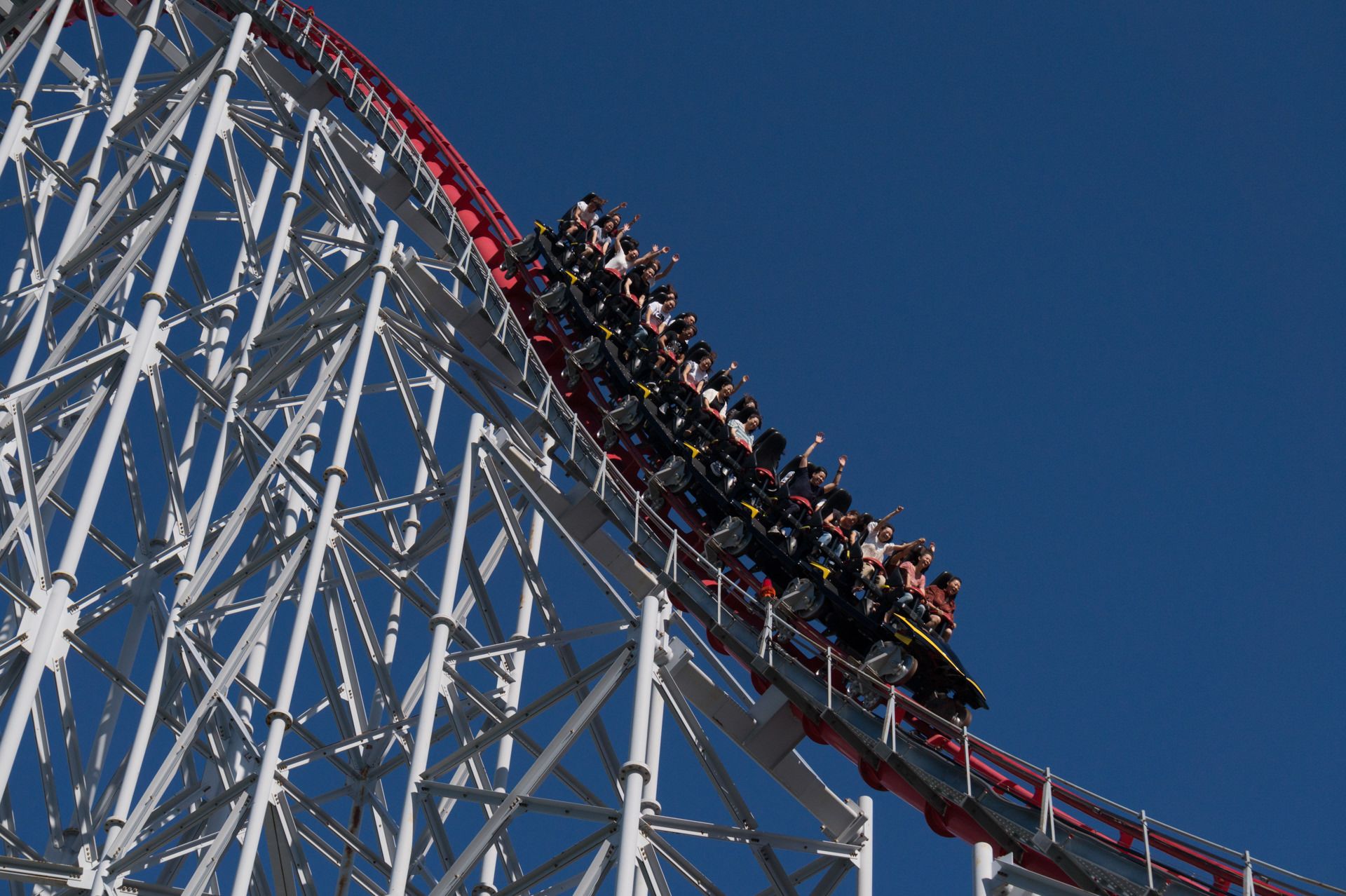
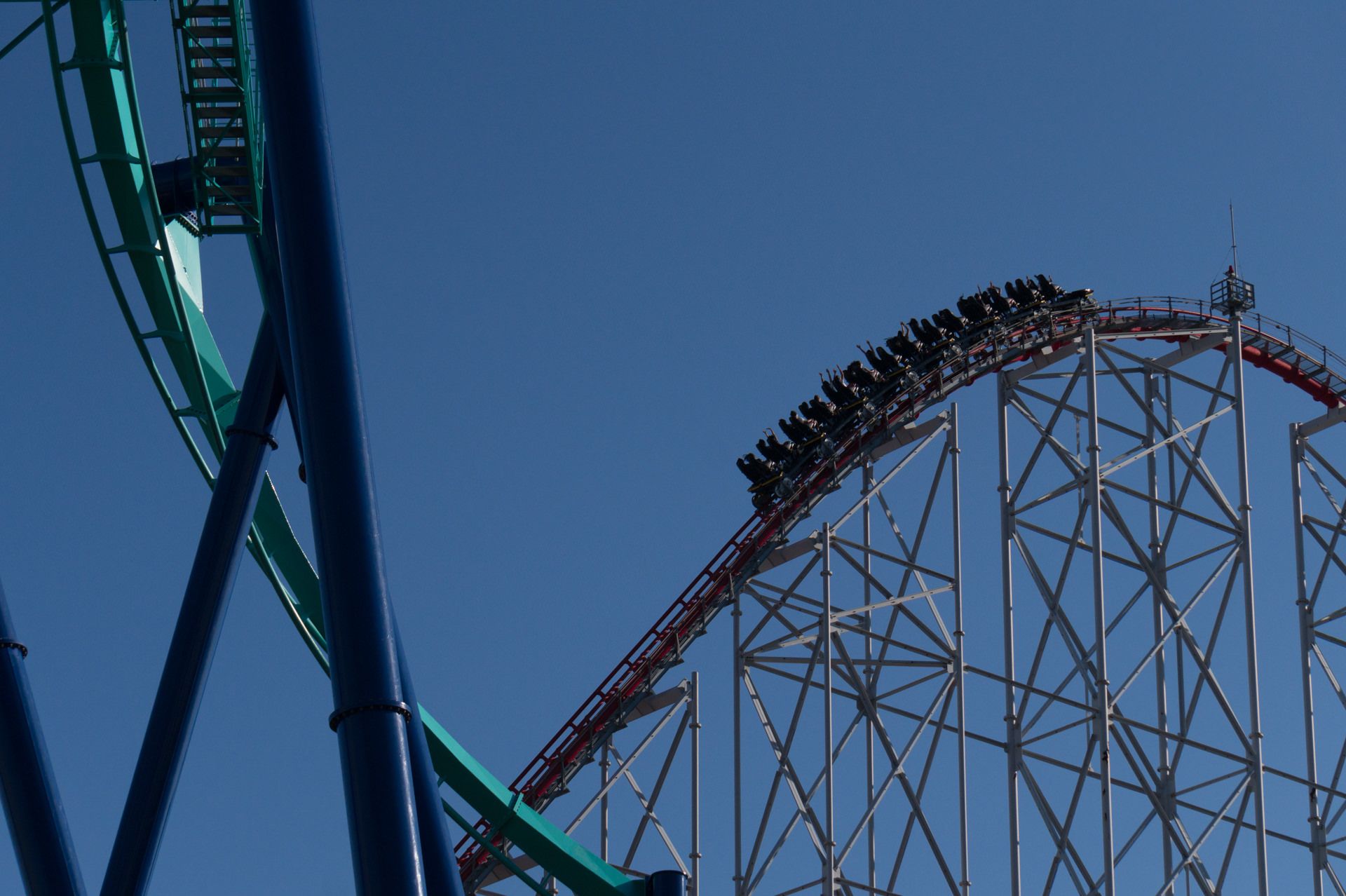
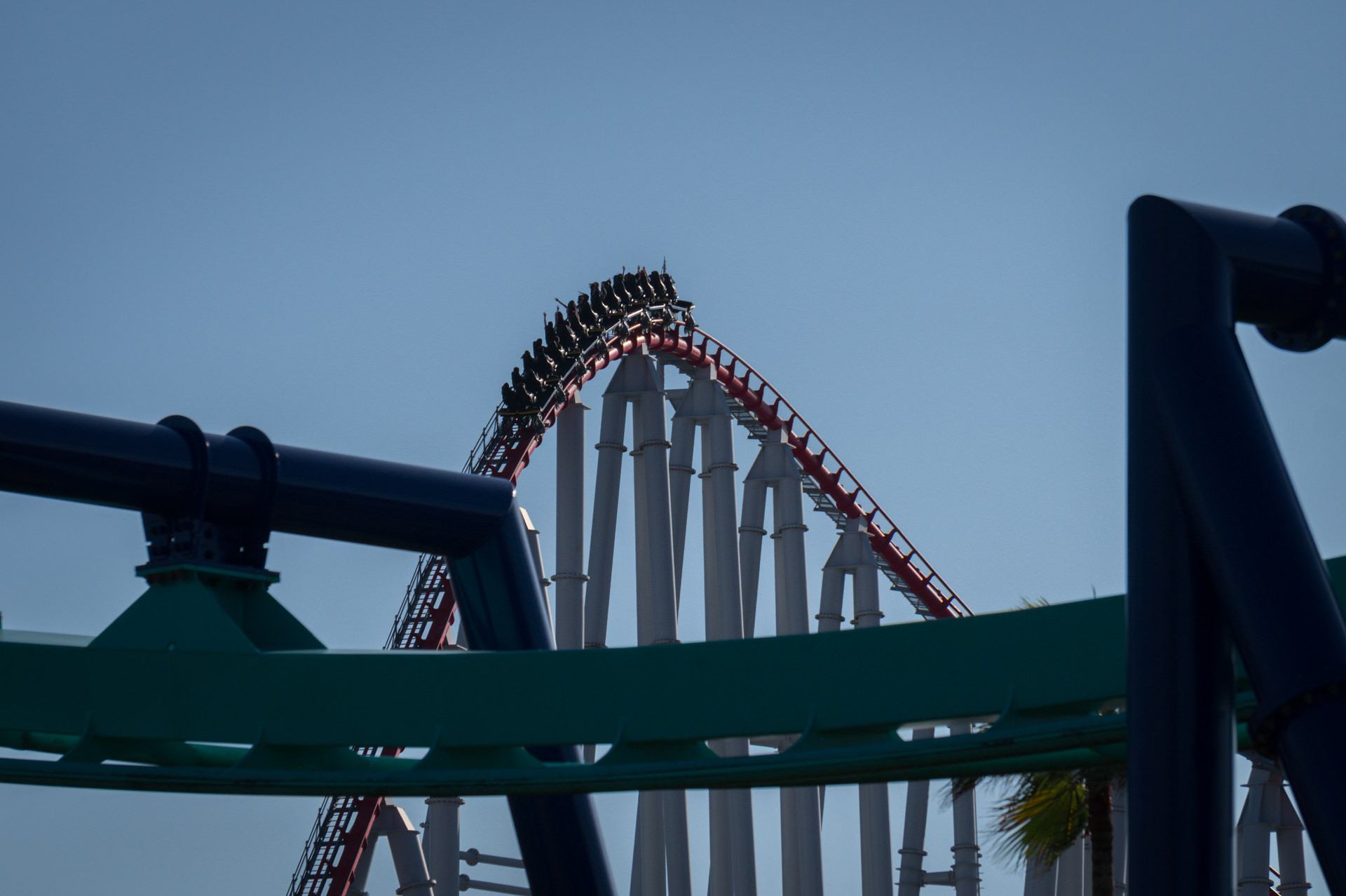
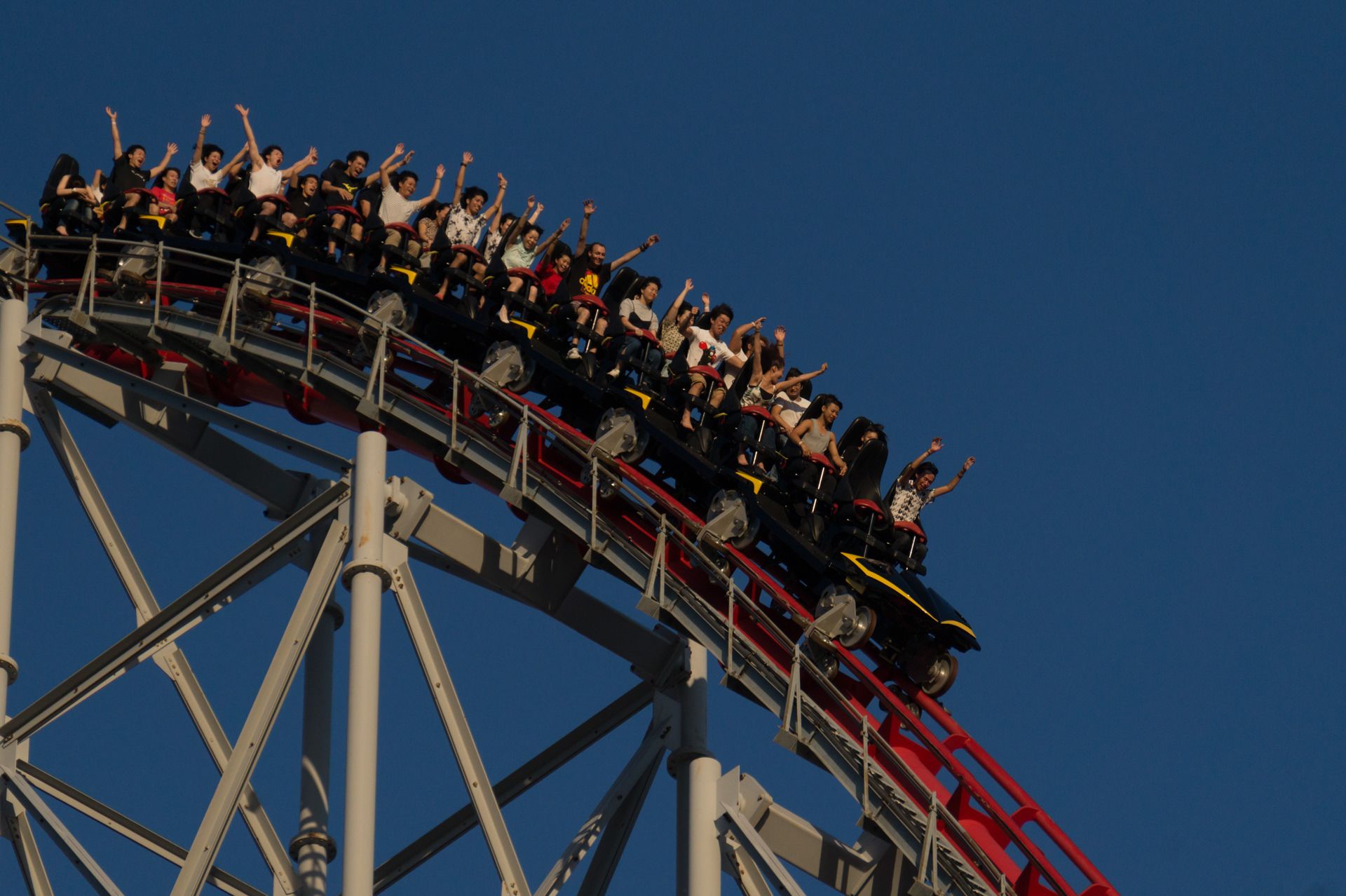
Equally appealing is Steel Dragon 2000. Built at the turn of the millennium, Steel Dragon 2000 is Japan’s largest roller coaster, with a height of 97 m. Even more impressive, however, is its length of about 2.5 km, which still makes it the longest roller coaster in the world. There are rumours that the roller coaster The Ultimate from the English amusement park Lightwater Valley will be extended, but until then there will probably not be a longer roller coaster.
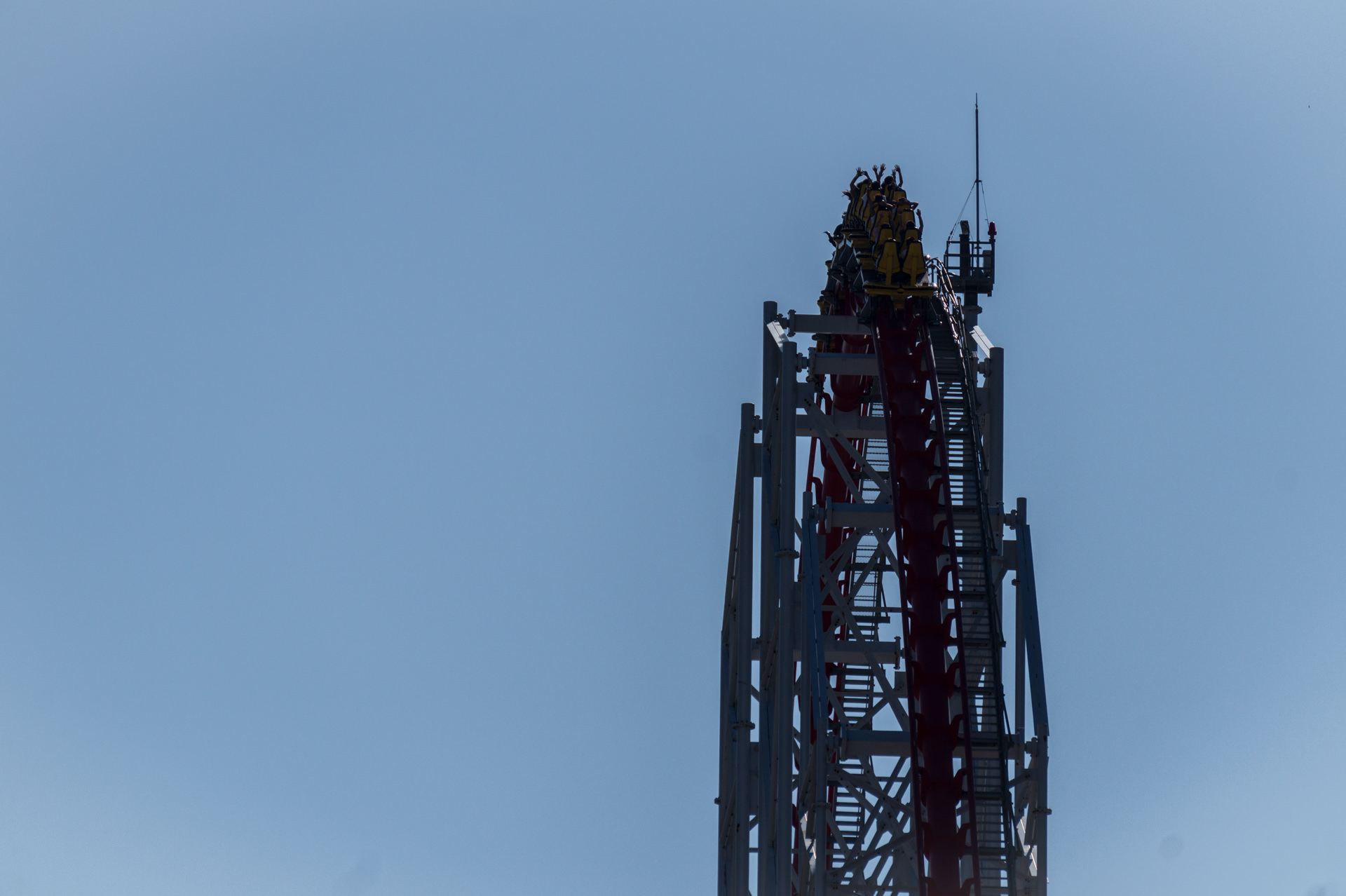
The ride on the Steel Dragon begins with a small dip out of the station, followed by a short right turn. The first lift chain is then waiting to take us up to a height of about 50 m, where we change to the second lift chain, which in turn takes us up to an impressive 97 m. Once there, we descend very quickly. We pass through the first valley at 152.9 km/h, and the train starts to vibrate. Unfortunately, this vibration is transmitted to the passenger, which is why you can only be happy to shoot up a 76.8 m high hill shortly afterwards. After a moment of shallow airtime, another valley of terror awaits you.
The ride through the second valley is also no fun at all and so I was happy to find myself on the third hill of the ride. This hill is only 64 m high and leads the train into a special combination of curves. In a wide steep curve, one approaches the bottom and immediately shoots up an inclined clockwise helix. On the way into the following valley, a change of direction takes place and a second, now counterclockwise, huge helix follows. With steady pressure, the smile on your face slowly comes back and you may slowly forget the crappy start of the ride. In the process, you race through a ground-hugging and bloody long left turn along the large shopping centre. However, you don’t notice much of that, after all, you’re still going at a breakneck pace. It’s just a shame that after a long bend and two small curve swings, the ascent into the block brake awaits.
On the block brake, which is placed very low in relation to the overall height of the ride, the speed of the train is reduced considerably before it descends into a series of continuous camelbacks. Here the train passes two tunnels and six crests, each with valleys at different heights. On each hill you take off in a wonderful floating airtime. Shortly afterwards, however, the braking section is reached and the ride comes to an end.
The Steel Dragon 2000 is not a bad roller coaster, but it doesn’t meet my personal taste. I really enjoy the ride from the entry into the long curves, but the vibrations in the first two valleys are so nasty to my stomach that I only did one more repeat ride during the two days of my visit. I’m interested to know what the ride would have been like in the original trains, as the trains built by Morgan were much more solidly built and therefore shouldn’t have started vibrating so quickly. The trains built by B&M, which were added in the tenth year of operation of the ride, are by no means bad and allow a much freer ride, but they do not correspond to the original.
They must have had their reasons – I don’t have a comparison with the previous state of the ride anyway – so it’s not that bad. It doesn’t stop anyone from doing a marathon on the ride, and if the start of the ride wasn’t so messed up, I would do it too.
Arashi
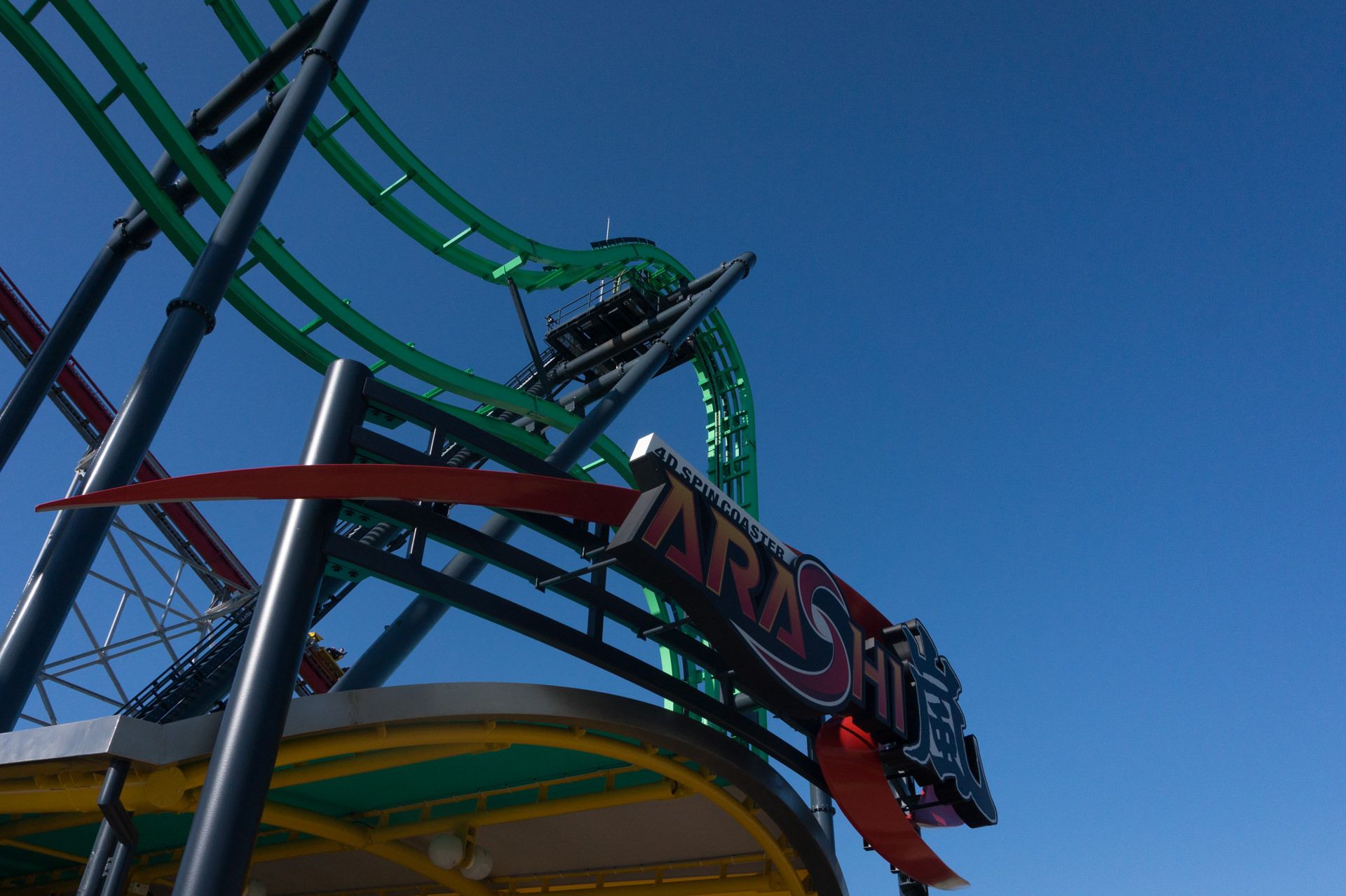
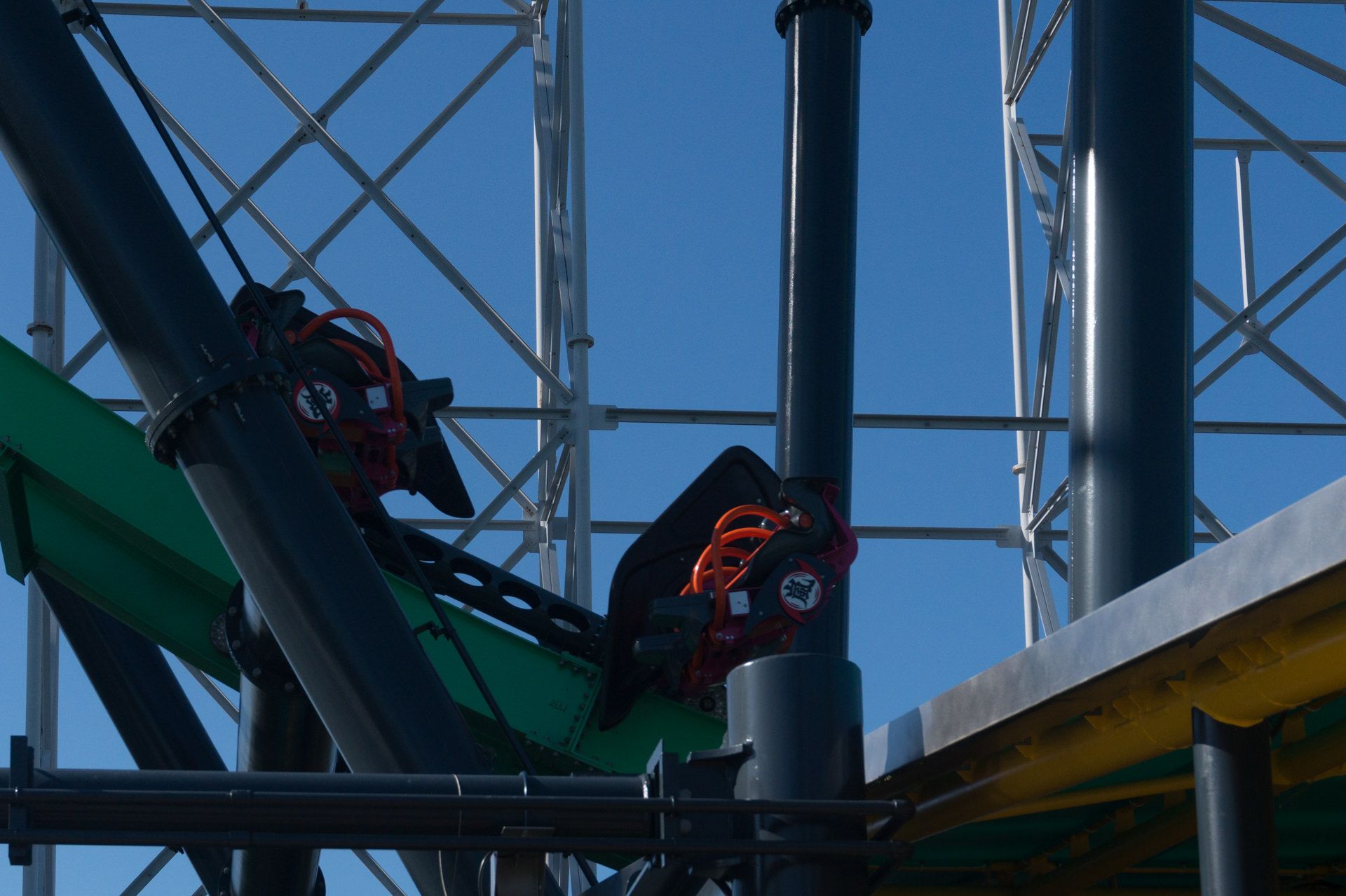
The Free Spin coaster Arashi on the other hand is simply no fun. The ride is inharmonious and absolutely hard. The rollovers are all generated only by the forced rotation of the gondola carrier, otherwise the ride here would be a leisurely scenic ride very similar to the new concept by the Swiss engineering firm Ride Engineers Switzerland, which will soon be realised at Schwaben Park. Unfortunately, the whole thing is no comparison to the competing product from Intamin, which is less squeamish even in the smallest version and fortunately dispenses entirely with technical aids for rollover – interestingly, although the ride on a Zac Spin is hard on the edge, the harmoniously superimposed movements make it much more pleasant and interesting.
Rock ‘n’ Roll
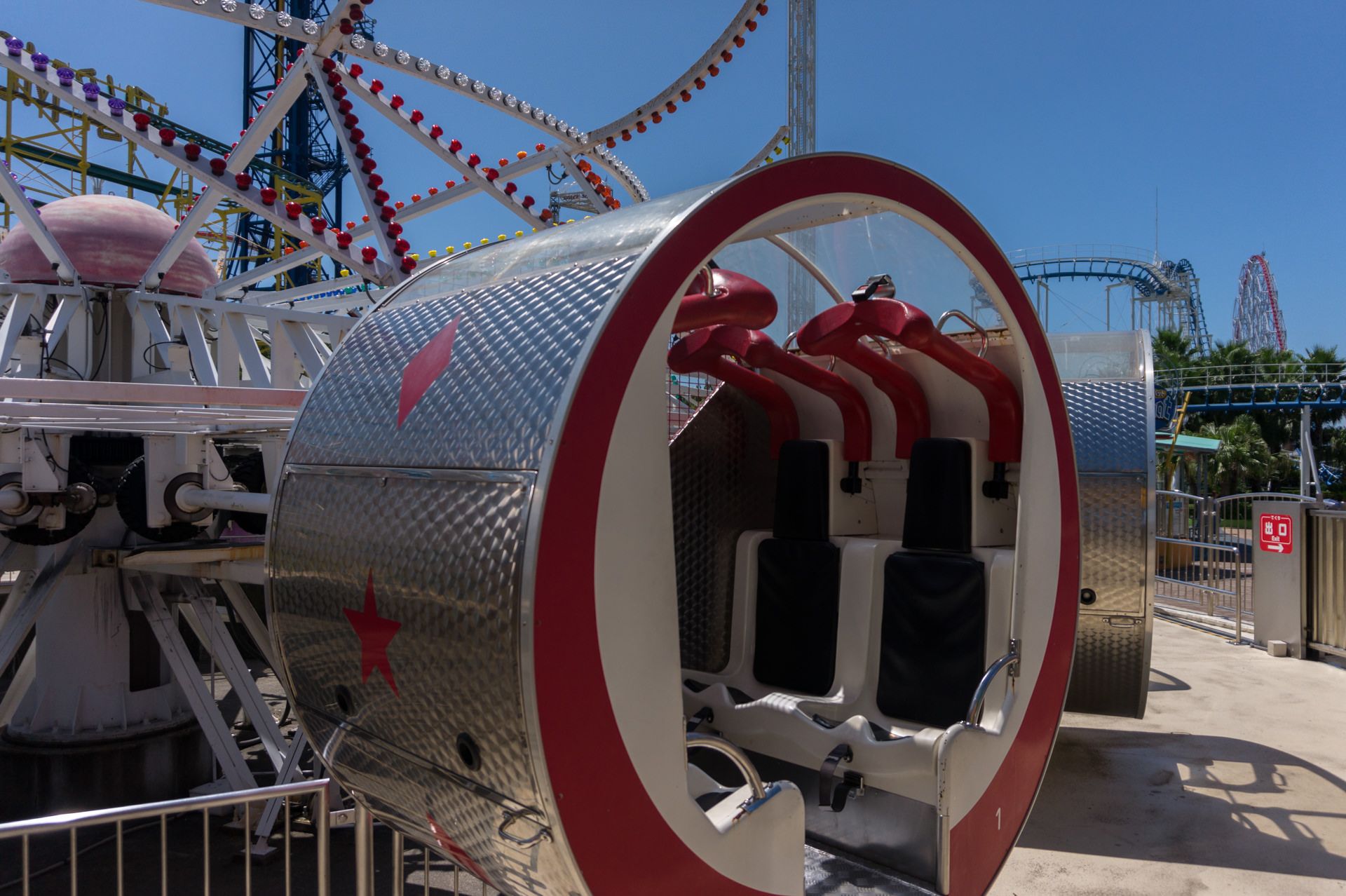
In fact, the Rock ‘n’ Roll ride shows that even forced somersaults can be ridden in a reasonably harmonious way. A friction wheel causes the individual gondolas to rotate, whereupon the passengers (depending on the load of the gondola) do one somersault after another.
Paratrooper and Telecombat
The Paratrooper next to it is similarly interesting, with its wheel rim tilting horizontally during the ride. Otherwise, the ride is typical for a Twister-like round ride, so it goes up and down in free-swinging gondolas, over and over again. This one was built by Technical Park, as was the Telecombat next door.
Wild Mouse
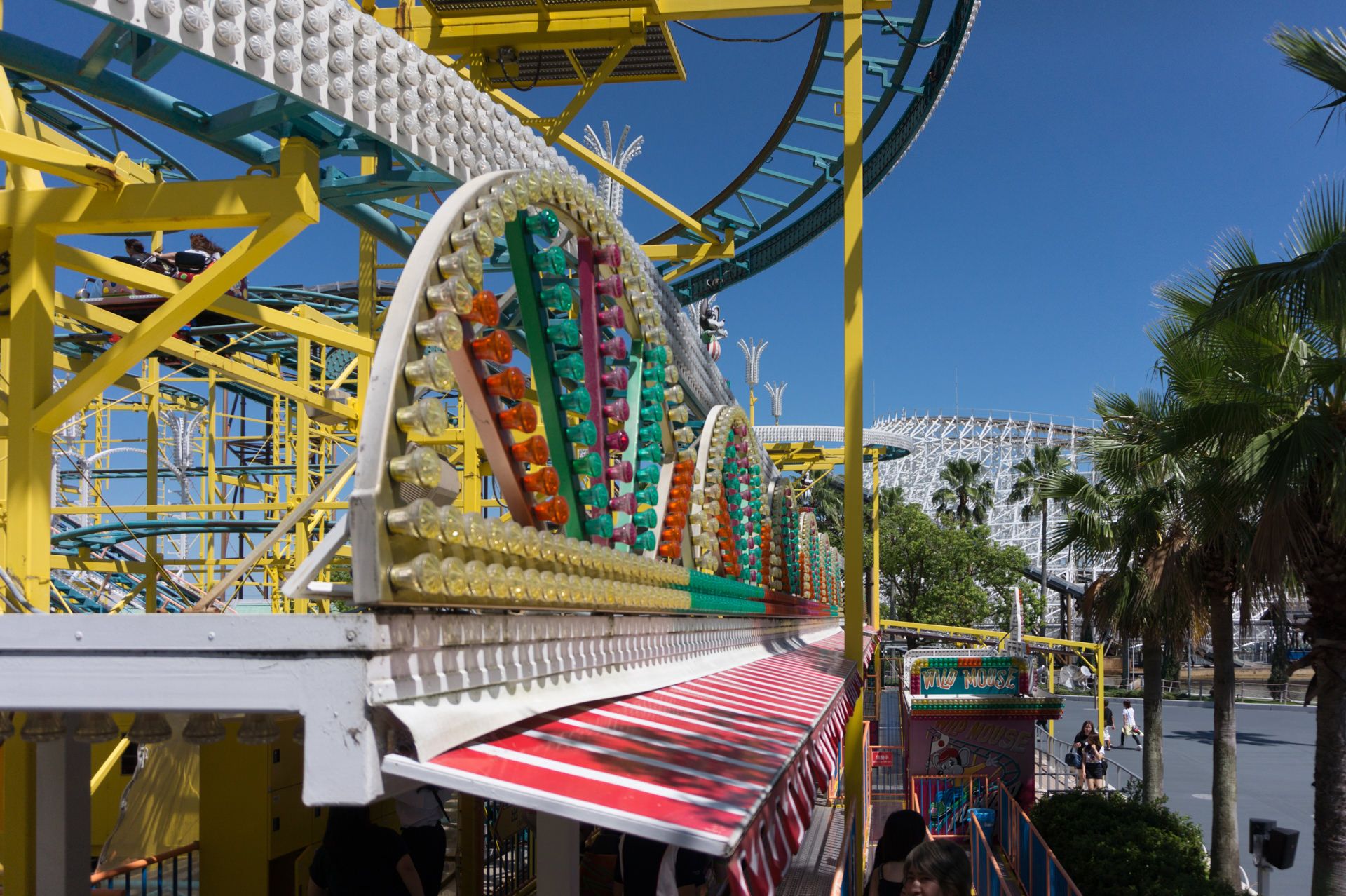
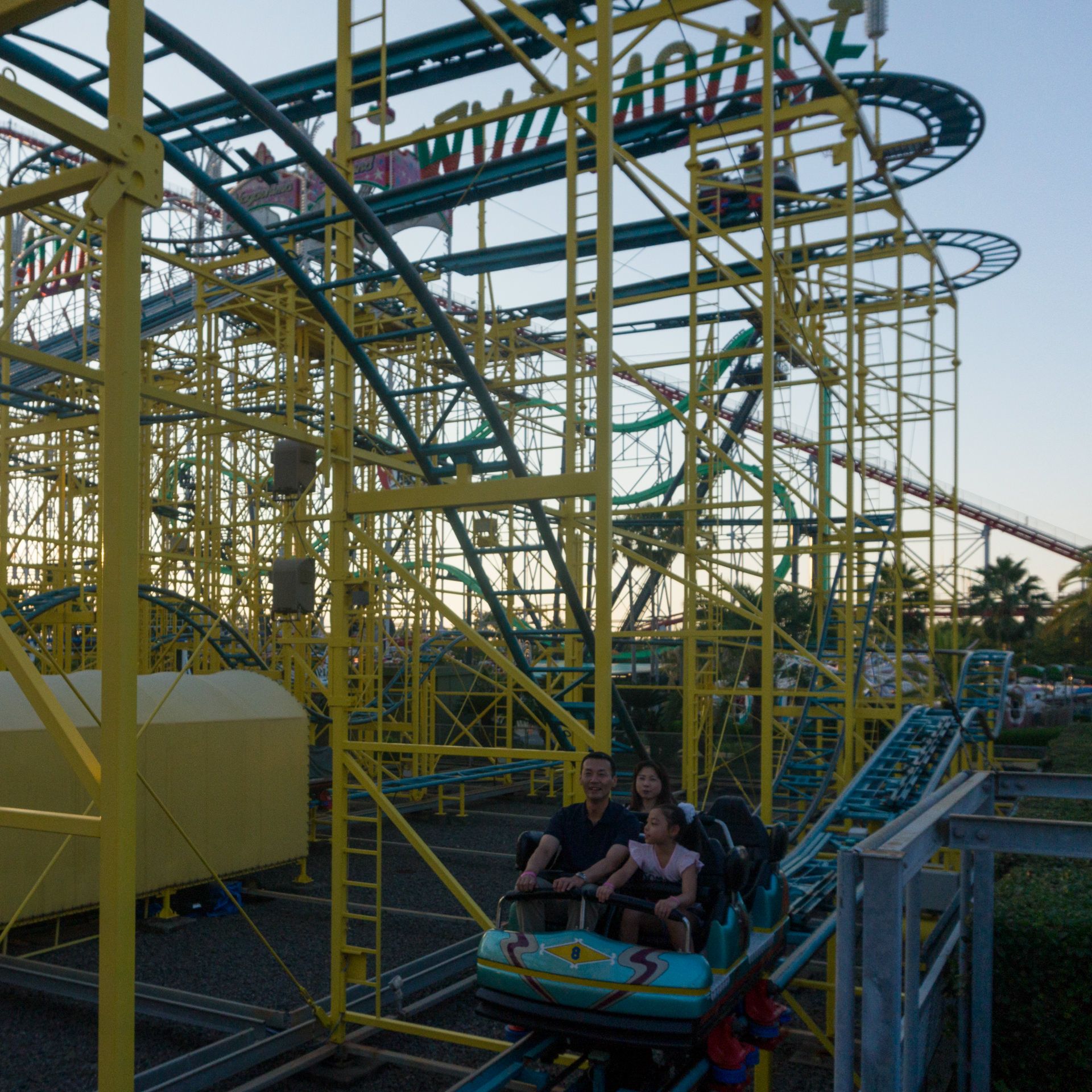
The ride portfolio in this corner is then complemented by the water ride Jet Rescue of German production. This is fitting, as the Wild Mouse is located right next to it in a double version, just as it could have been at a German funfair. Of course, it’s only real with the matching ticket booth and Schuko sockets. The attraction resembles one of the many Wild Mice from Mack Rides and therefore invites you to take a ride or two; after all, you can ride the ride in a mirror image – at least if both rides are running on the same day. We were lucky and were able to ride one of the two tracks on each of the two days we visited.
Free Fall and Frisbee
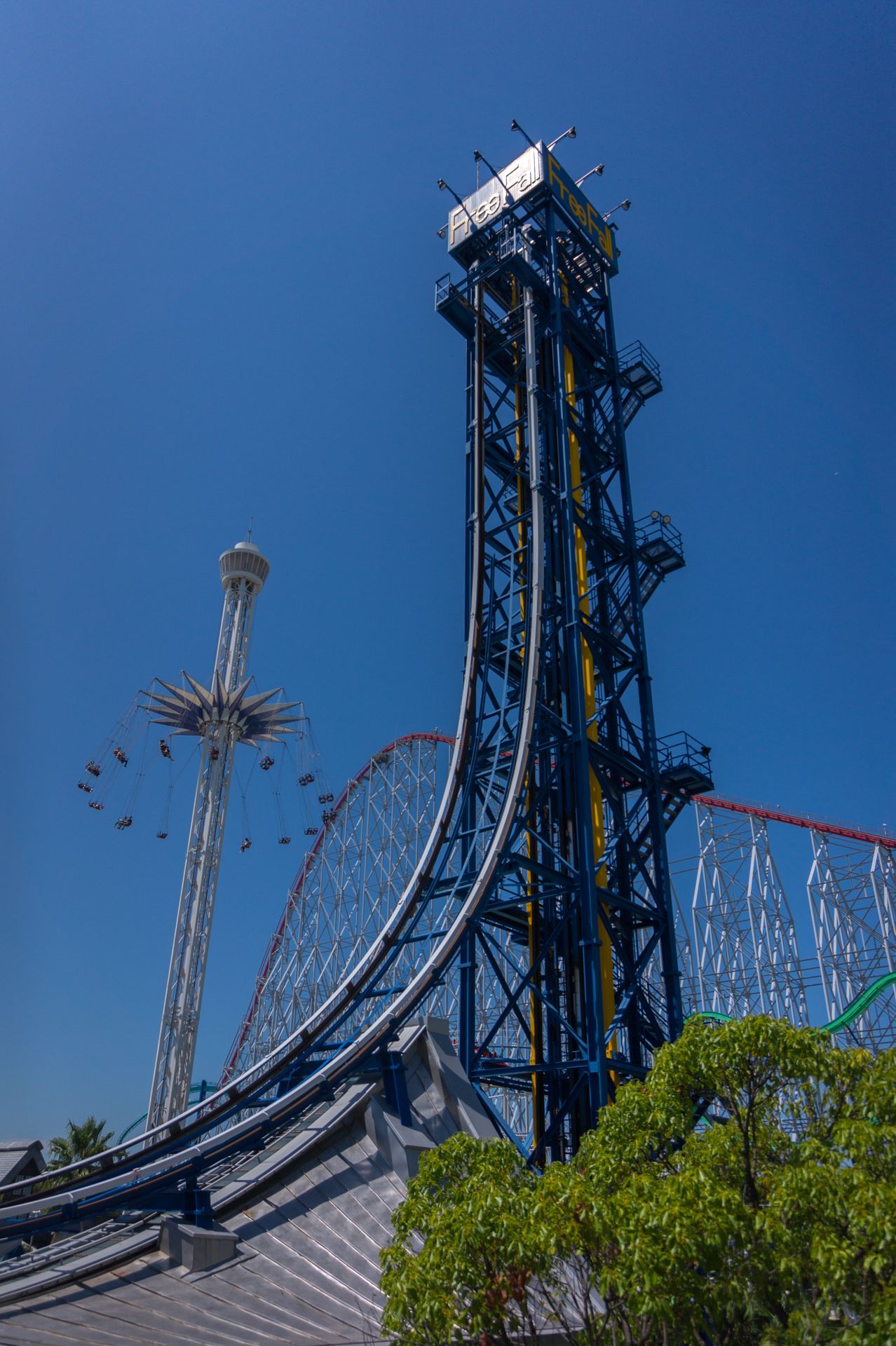
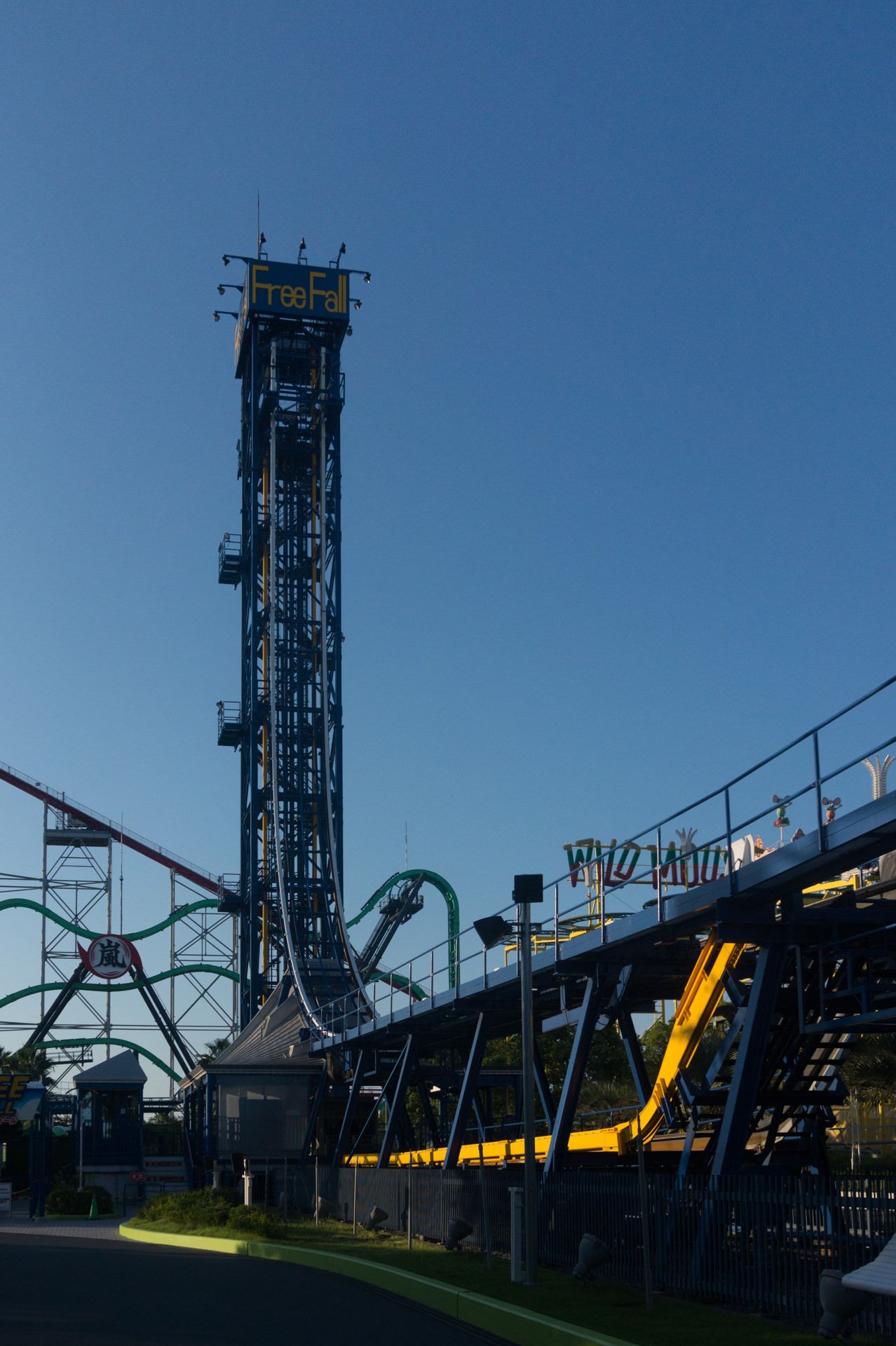
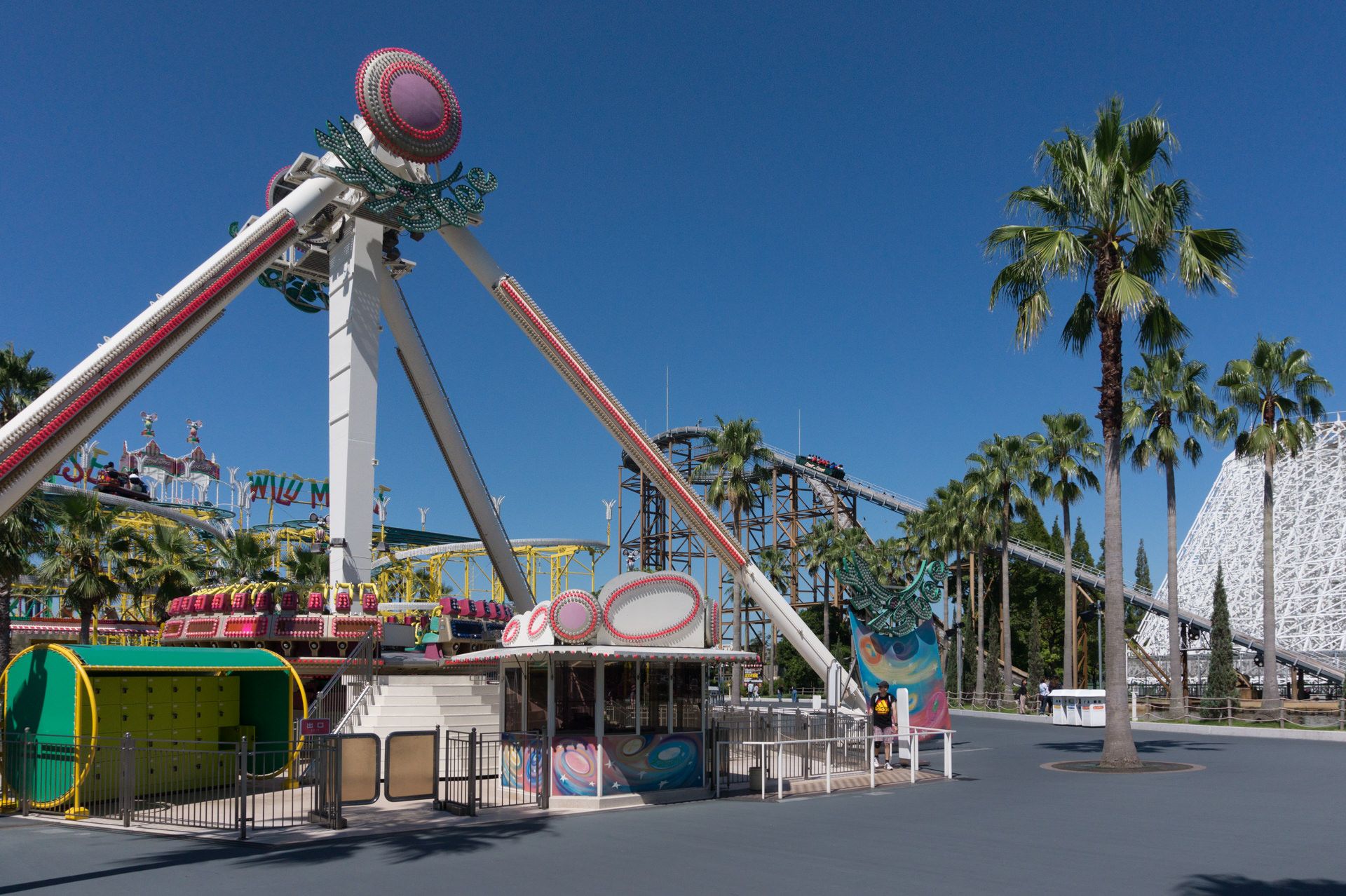
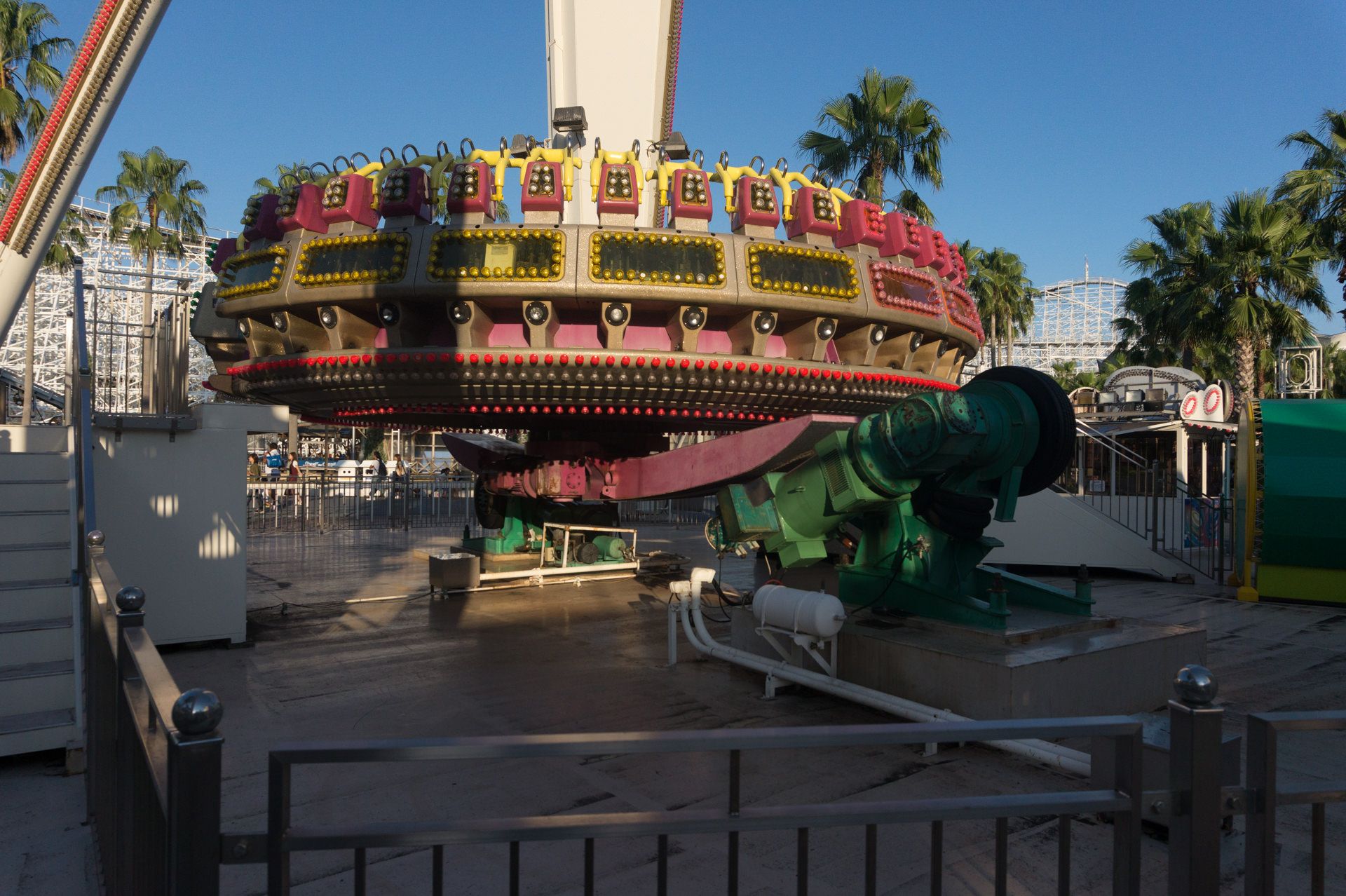
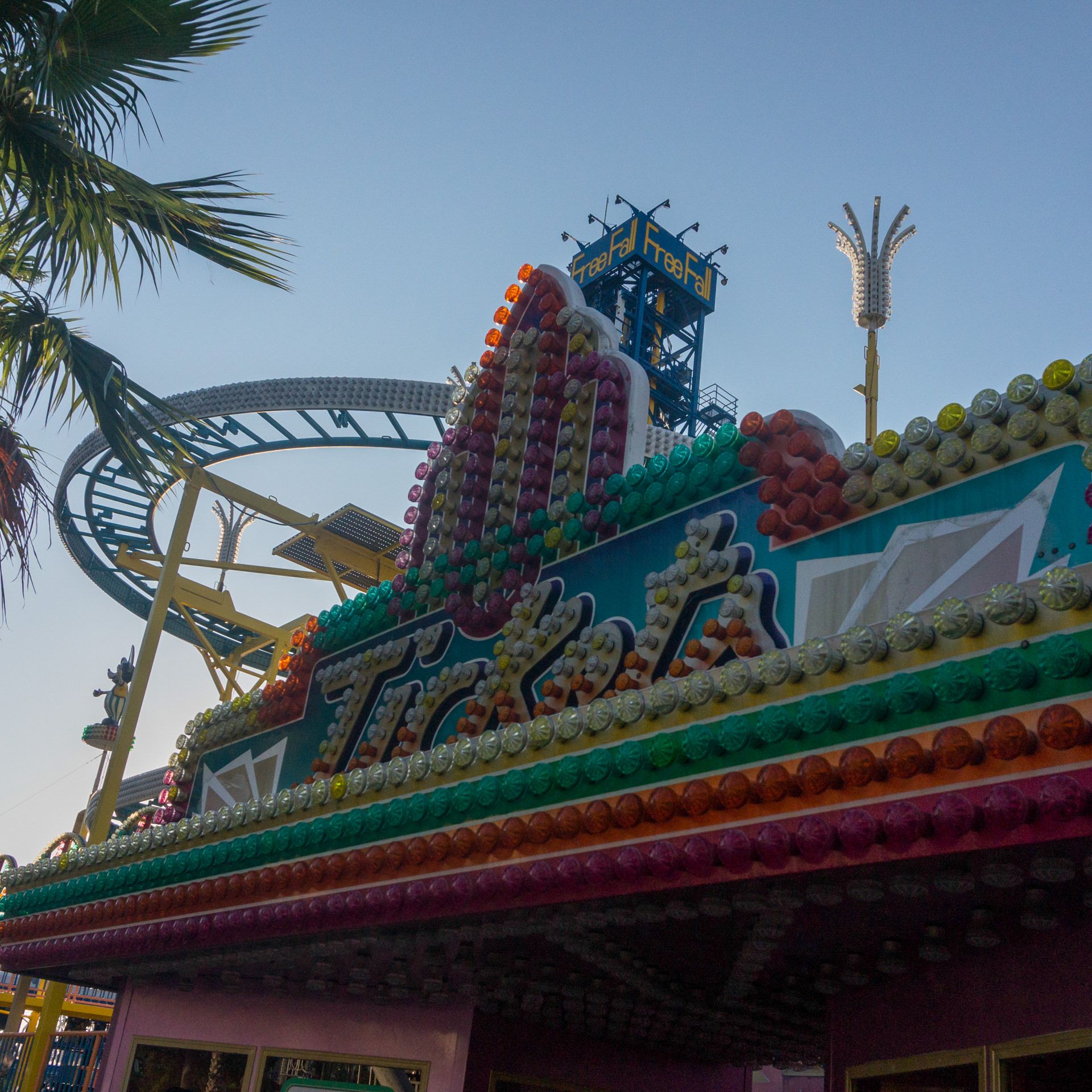
Unfortunately, we had no luck with the Free Fall, a first-generation free-fall tower, and therefore had to forego a ride. Fortunately, there is a park version of the HUSS Frisbee directly opposite, which is always a guarantee for a successful ride. In Nagashima, however, things were a bit different – the fast spins were missing – and so the ride was a trivial swing, which not even the showman Robrahn from Bremen could undercut. A pity, because the little Frisbees are usually always a big deal.
Shoot the Chute
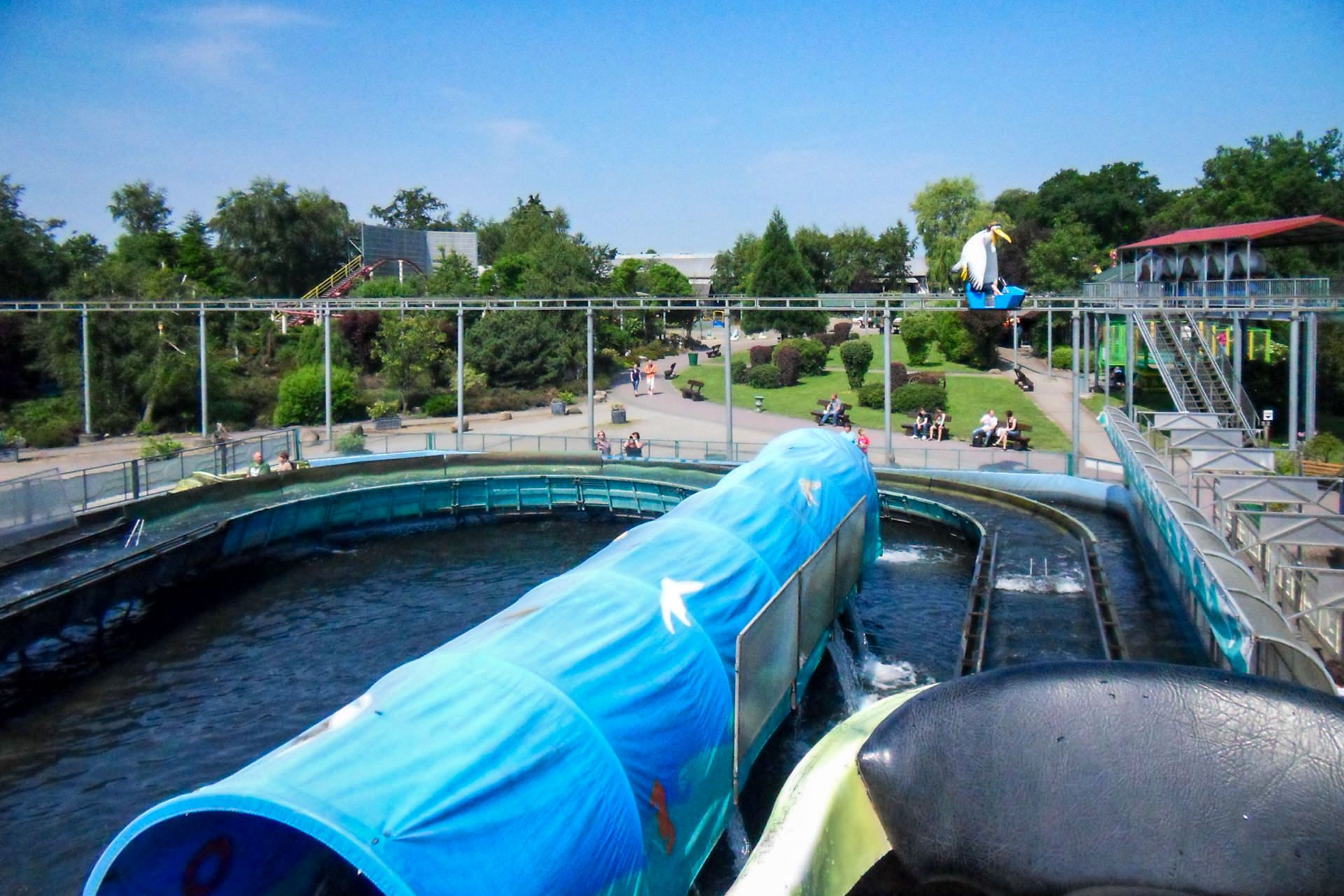
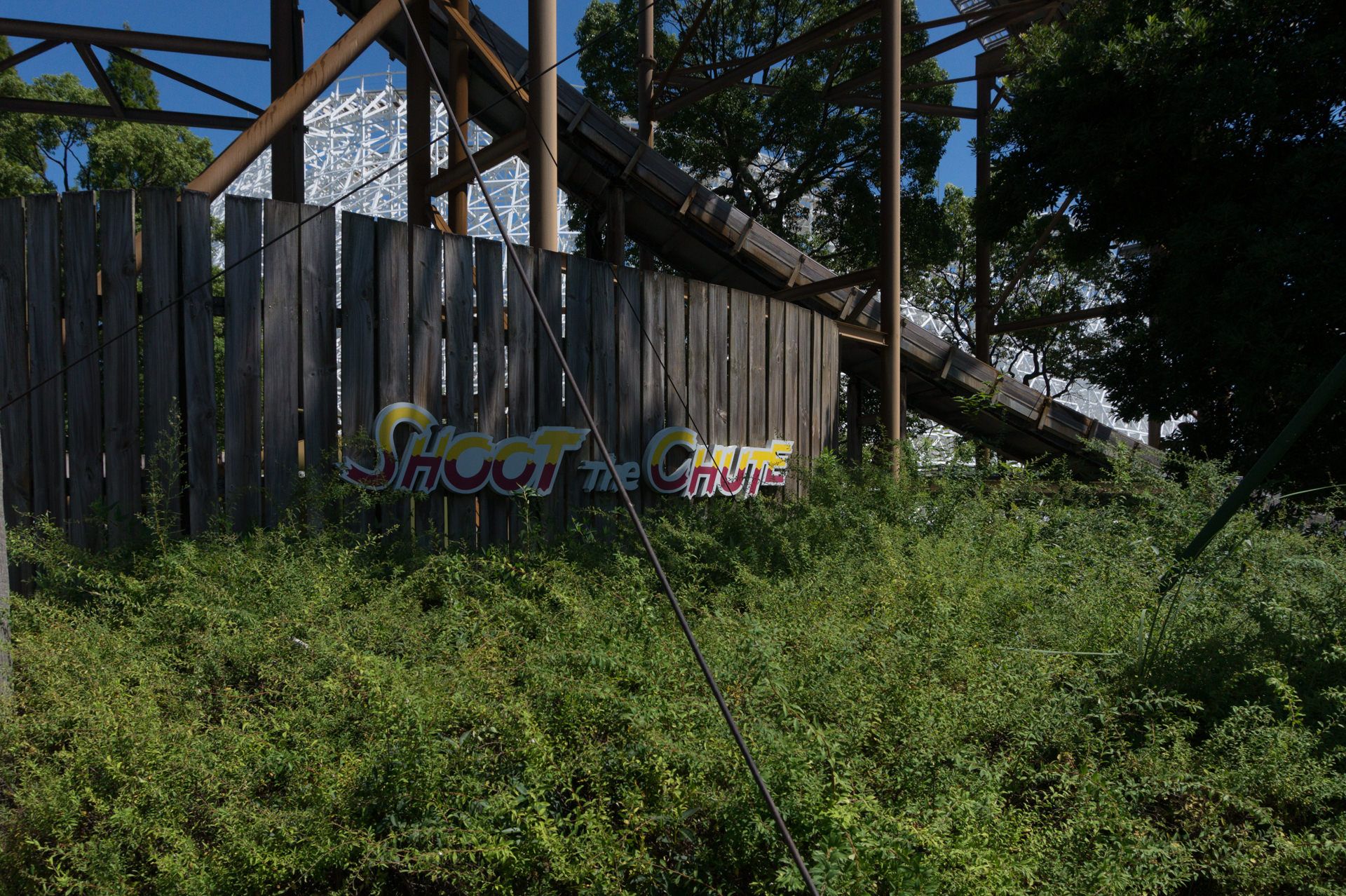
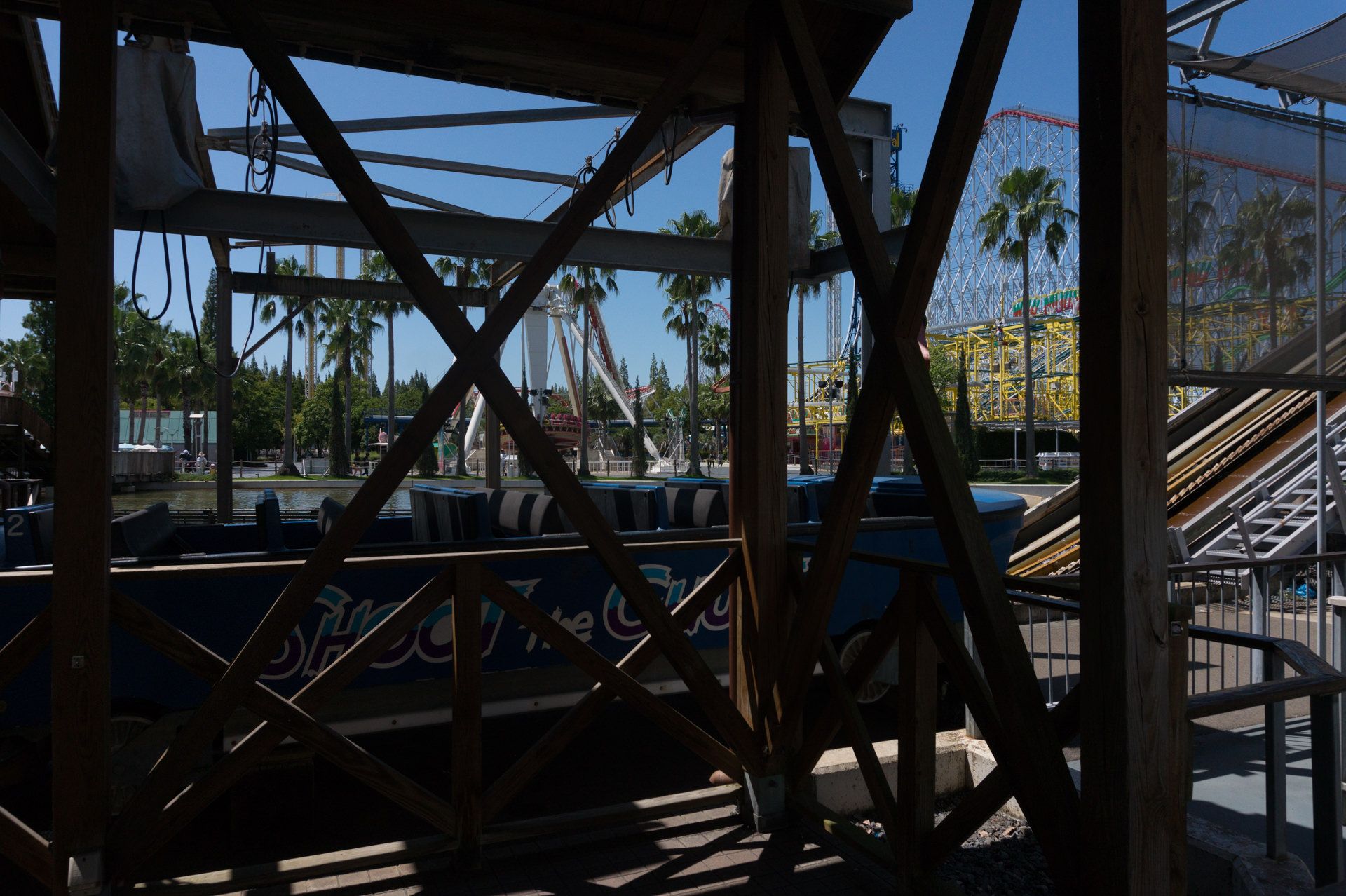
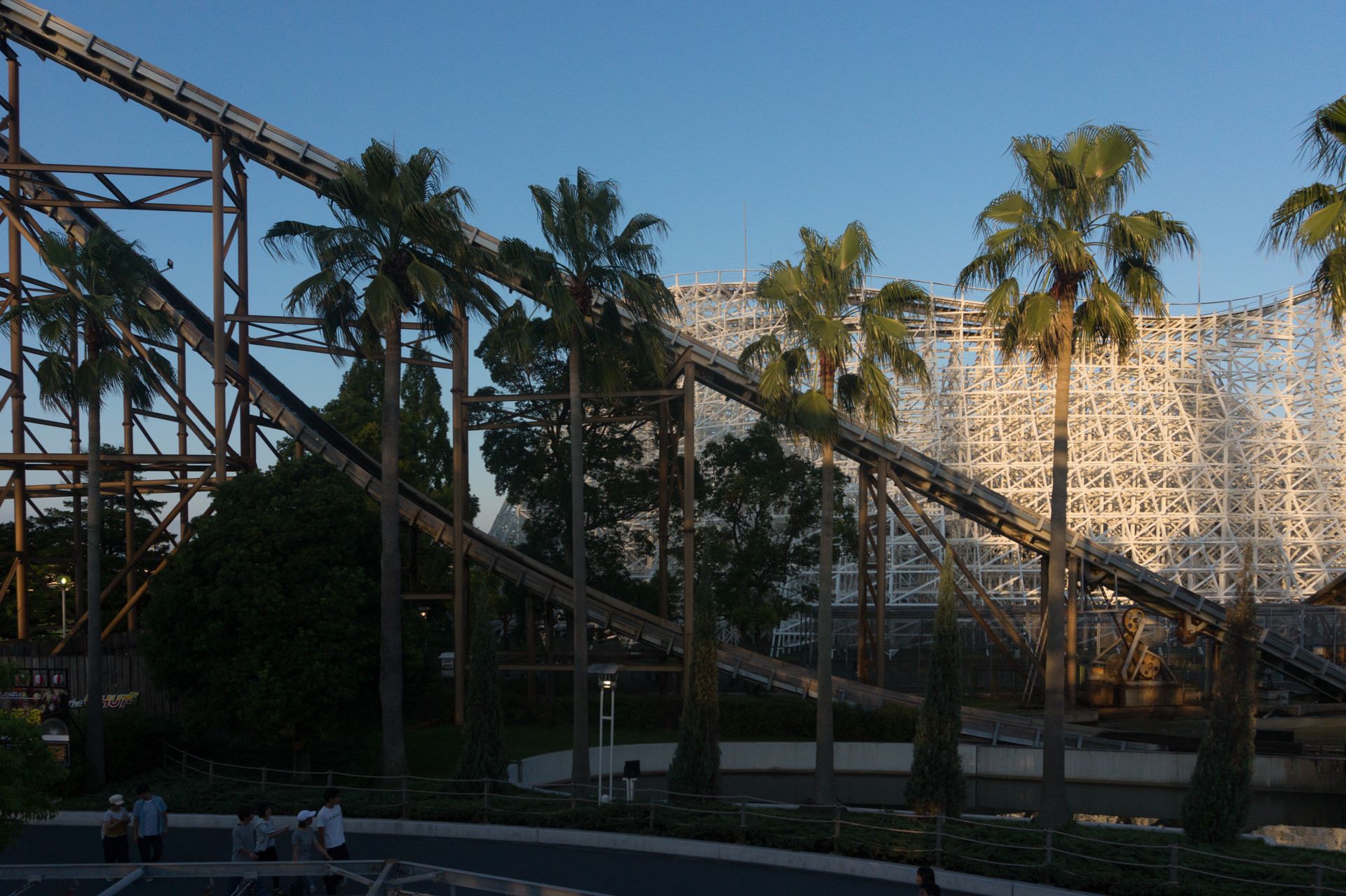
When one of your favourite rides bitterly disappoints you, it takes another favourite ride to put you back in a good mood. It’s a good thing that the Shoot the Chute of the Nagashima Spa Land amusement park, designed by O.D. Hopkins, is next door. As one of the first rides in the manufacturer’s Figure-8 design, the 30-metre-high ride is impressive, especially with its merciless wetness. Normally, in a spillwater, you are usually wet, but not soaked, by the time you reach the bridge over the run-out section, but this changes abruptly when you pass under the bridge. Here, however, it is the case that the boat creates such a high wave when it dives into the pool that it absorbs all the energy of the boat and thus decelerates the boat considerably so that the water has enough time to splash down on the passengers. You don’t get out this wet even from Valhalla of the English amusement park Blackpool Pleasure Beach and even there the degree of wetness is known to be like jumping into the Irish Sea. So everything is just right here and the name of the ride really lives up to its type – only why the first rows have to wear life jackets is beyond me, but luckily we were sitting a bit further back.
Something that has never been clear to me personally is the success of the Looping Starships from Intamin. In the looping fever at the beginning of the 1980s, the Bremen company HUSS developed an overhead boat swing in which the axle of the ride was driven, making a large number of rollovers and other rides possible. Only a short time later, the Weber company, also based in Bremen, followed suit with a similar ride. Intamin, on the other hand, planned an overhead boat swing that lives up to its name and uses a classic friction wheel drive to keep the ship moving until at some point it manages to roll over very narrowly.
Space Shuttle
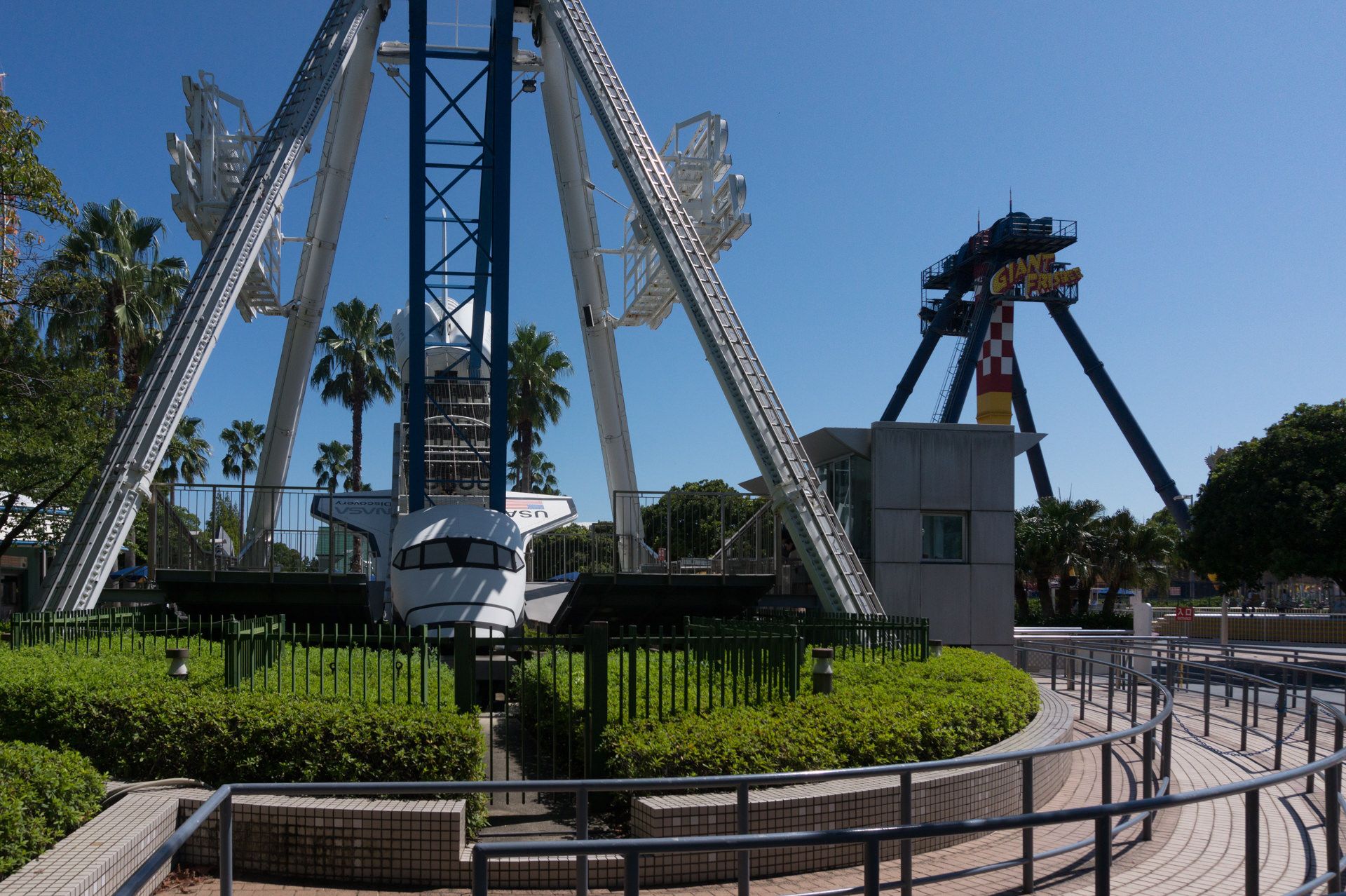
It’s interesting when you realise on your own body during the ride that this is exactly what makes the Looping Starship the best representative of its kind. It’s as if a normal boat swing just keeps accelerating, so you suddenly find yourself at angles you wouldn’t otherwise experience. At some point you manage to do a headstand and are afraid of getting stuck upside down. Shortly afterwards, the next, somewhat quicker somersault follows. A moment later, the long deceleration phase begins and you change direction again in all possible angles of inclination. Wonderful! I am absolutely thrilled with the ride. The design of the Space Shuttle also speaks for itself. It’s just a shame that none of them have survived the test of time in Europe; at least not in their original version. So dear Movieland Park team, please buy a suitable counterweight and the corresponding shoulder restraints. It’s worth it, I promise!
Giant Frisbee
The rest of the ride portfolio consists of a wave swinger, an Italian-made swing up with far too narrow gondolas, and a giant frisbee from HUSS. The latter just does its thing – like every other Giant Frisbee from the same manufacturer. It’s okay.
White Cyclone
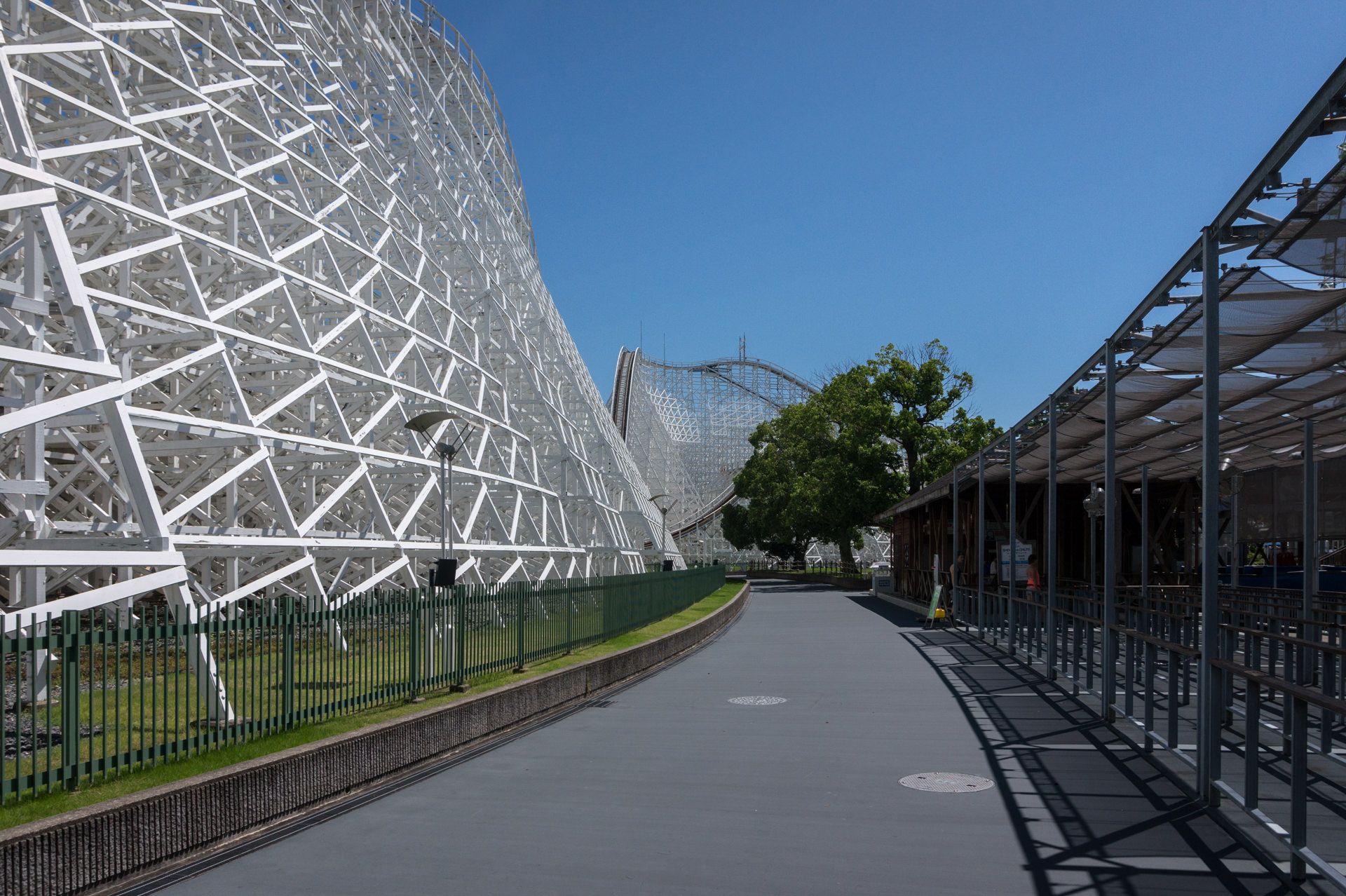
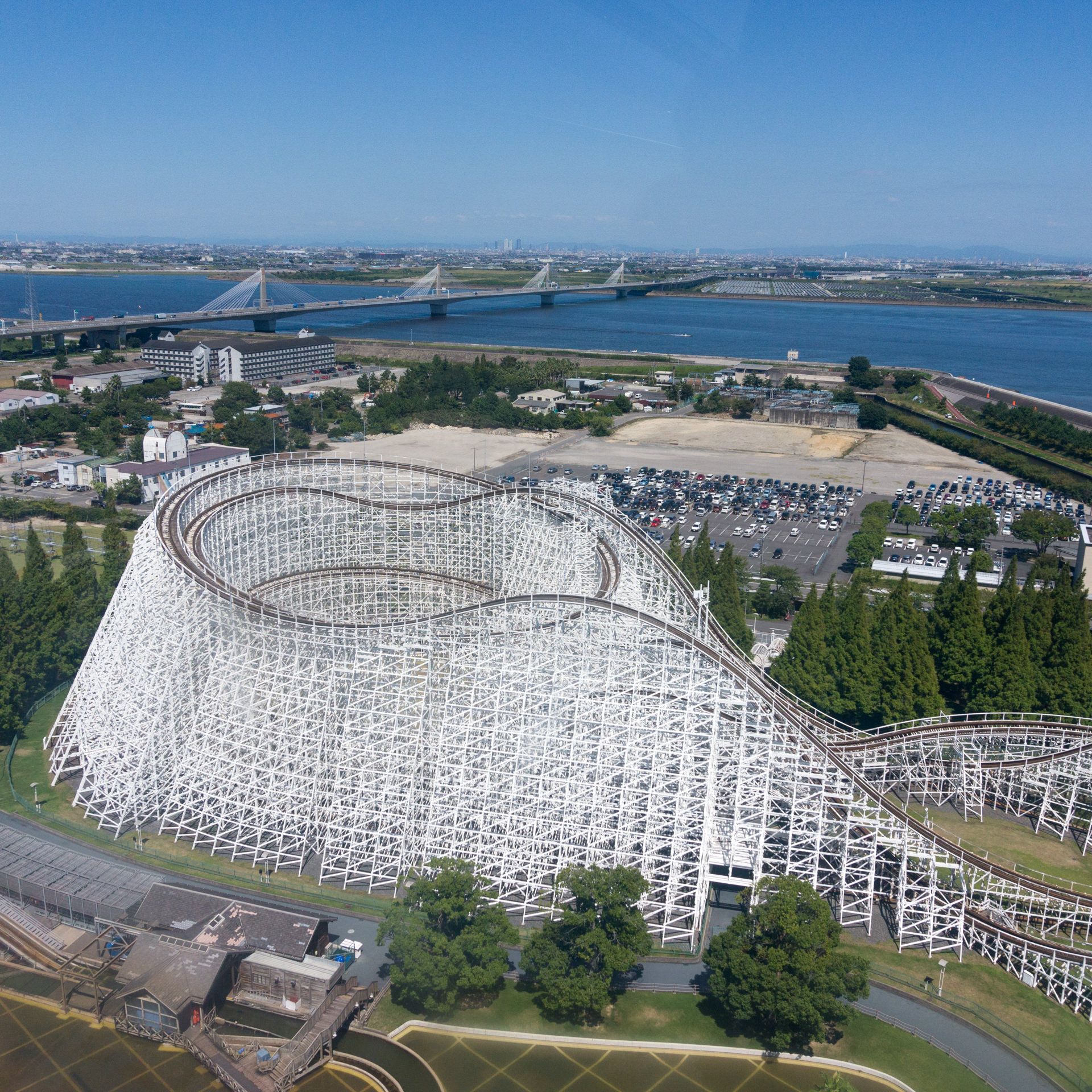
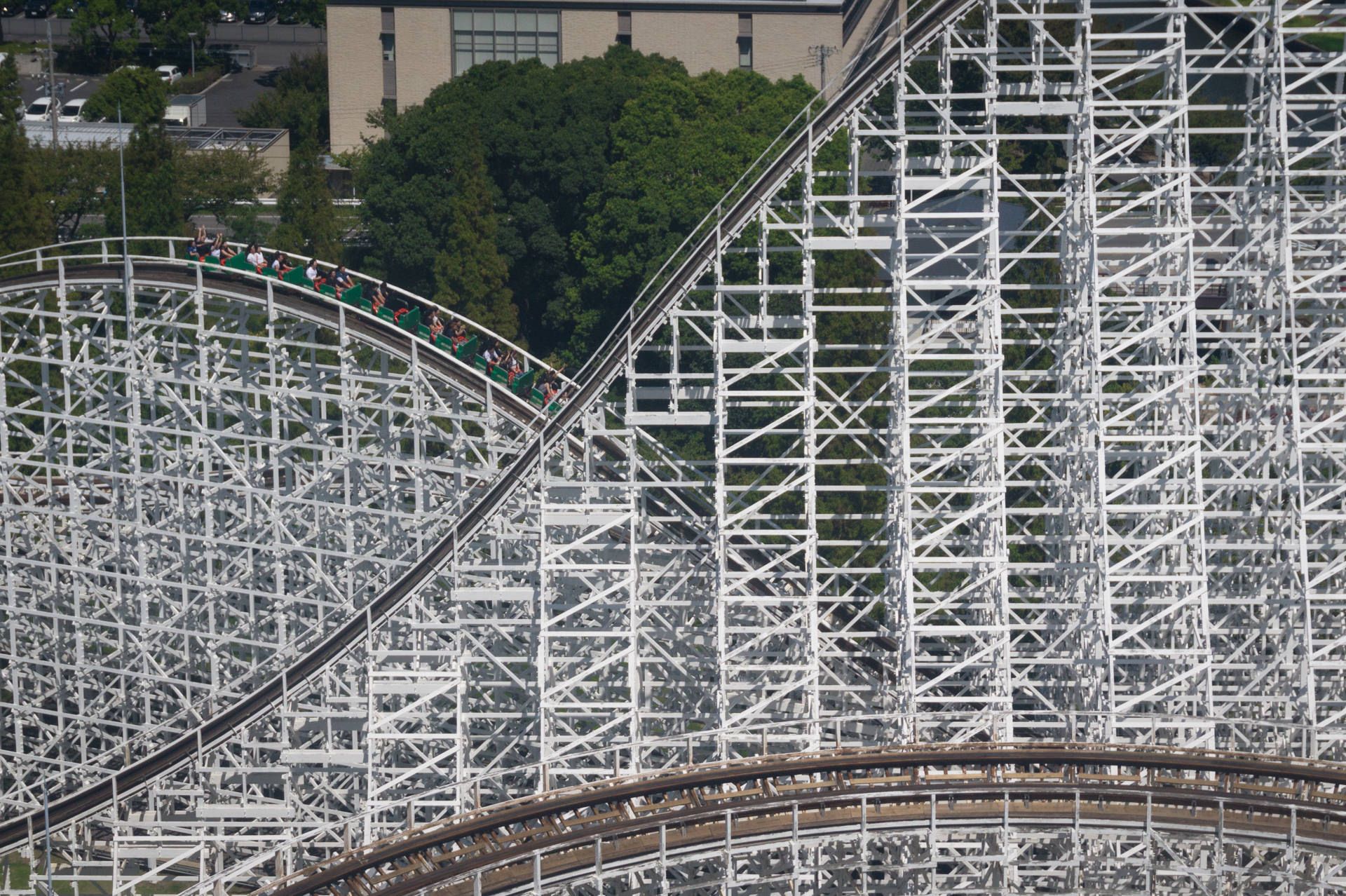
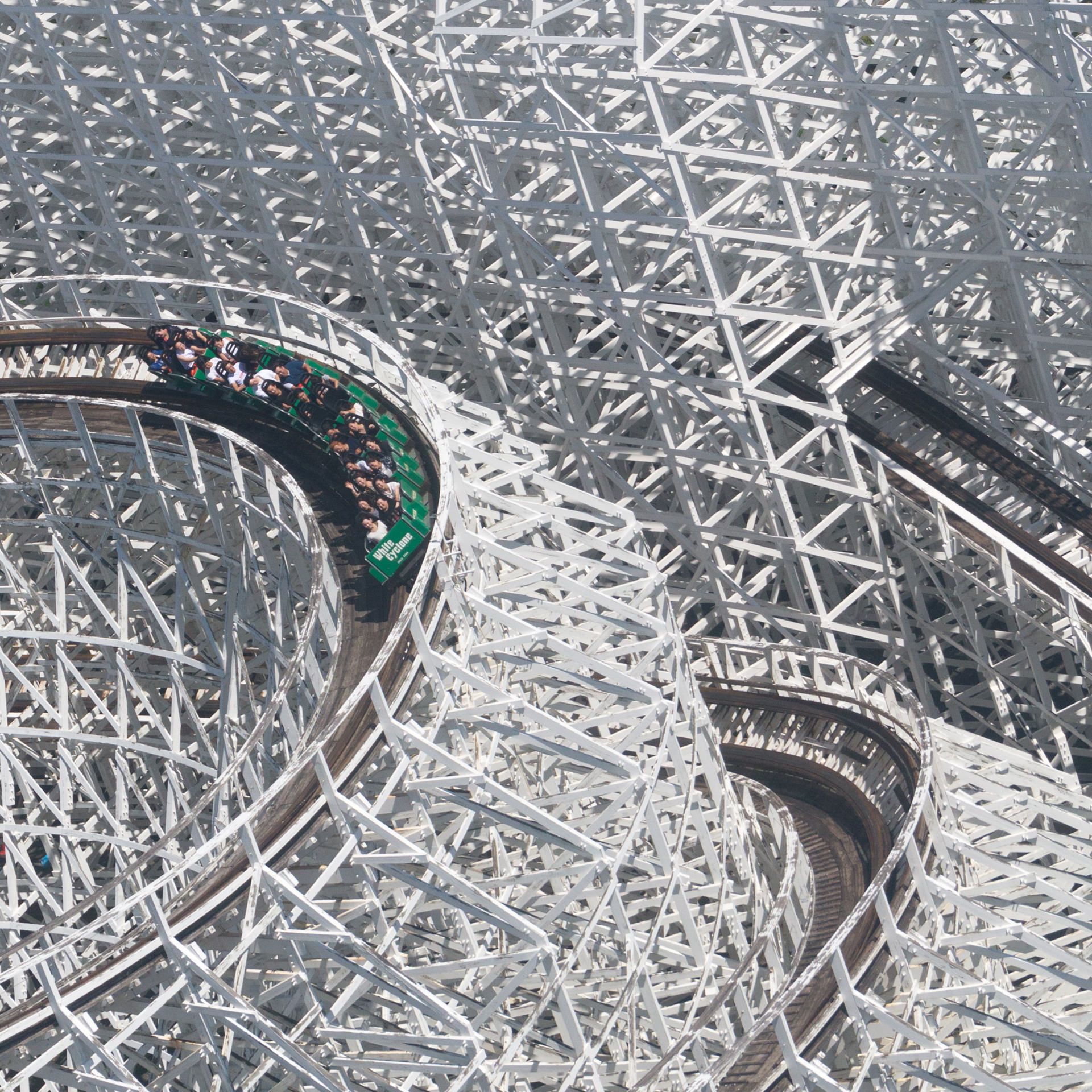
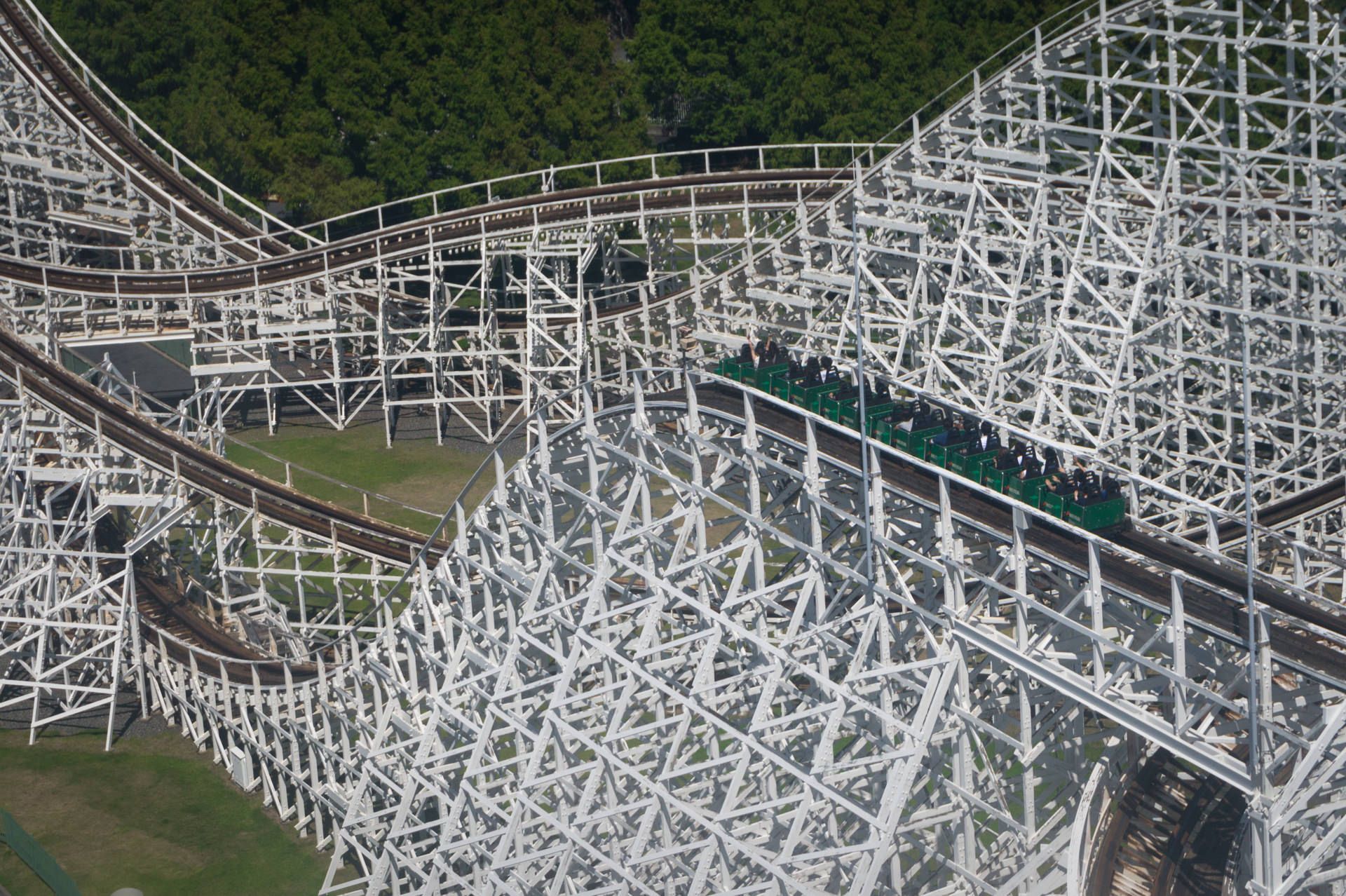
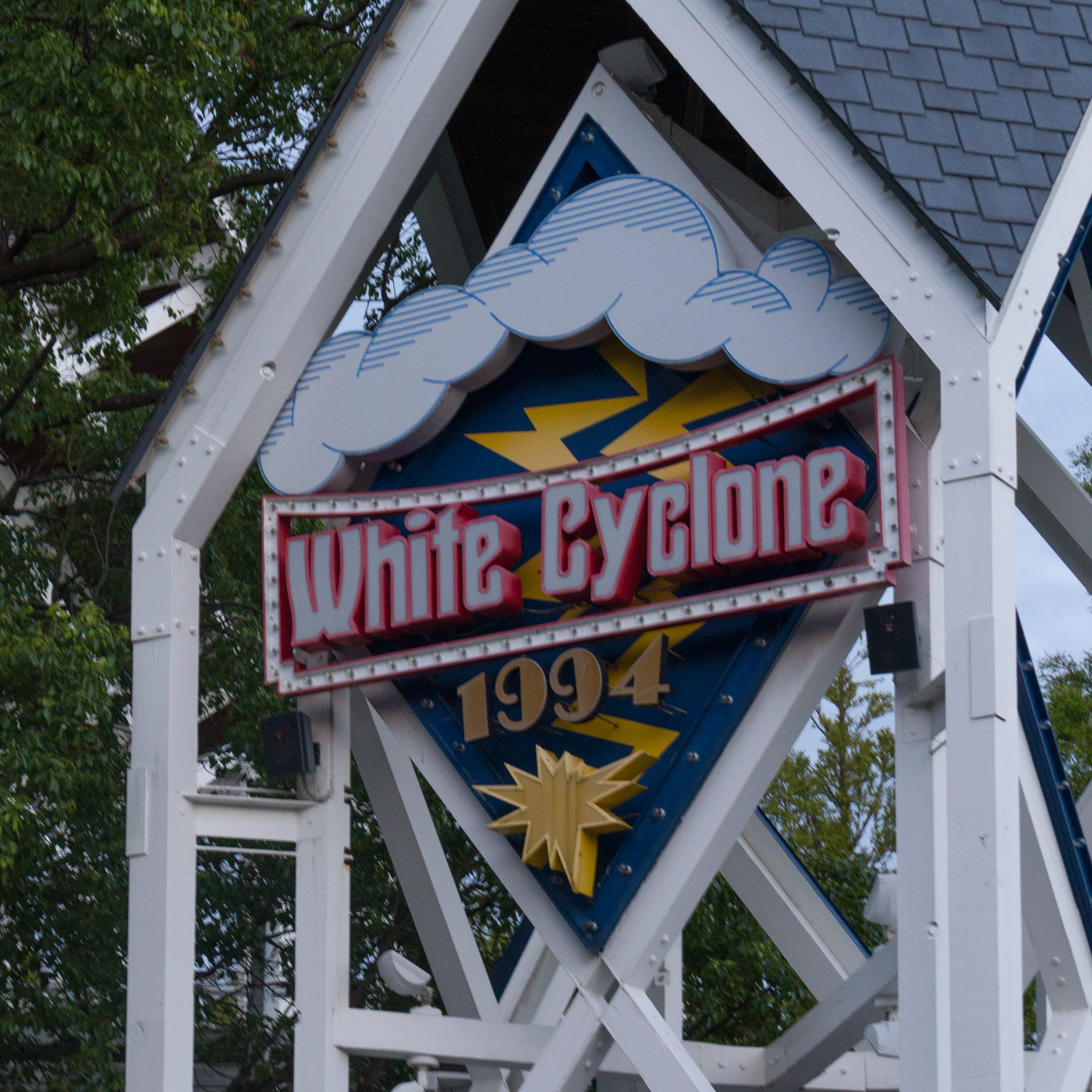
A glance at the clock on the 90-metre-high Aurora Wheel tells us: it’s time for wood. We are happy to comply and accordingly head for the entrance to the large white-painted wooden wall with the charismatic name White Cyclone.
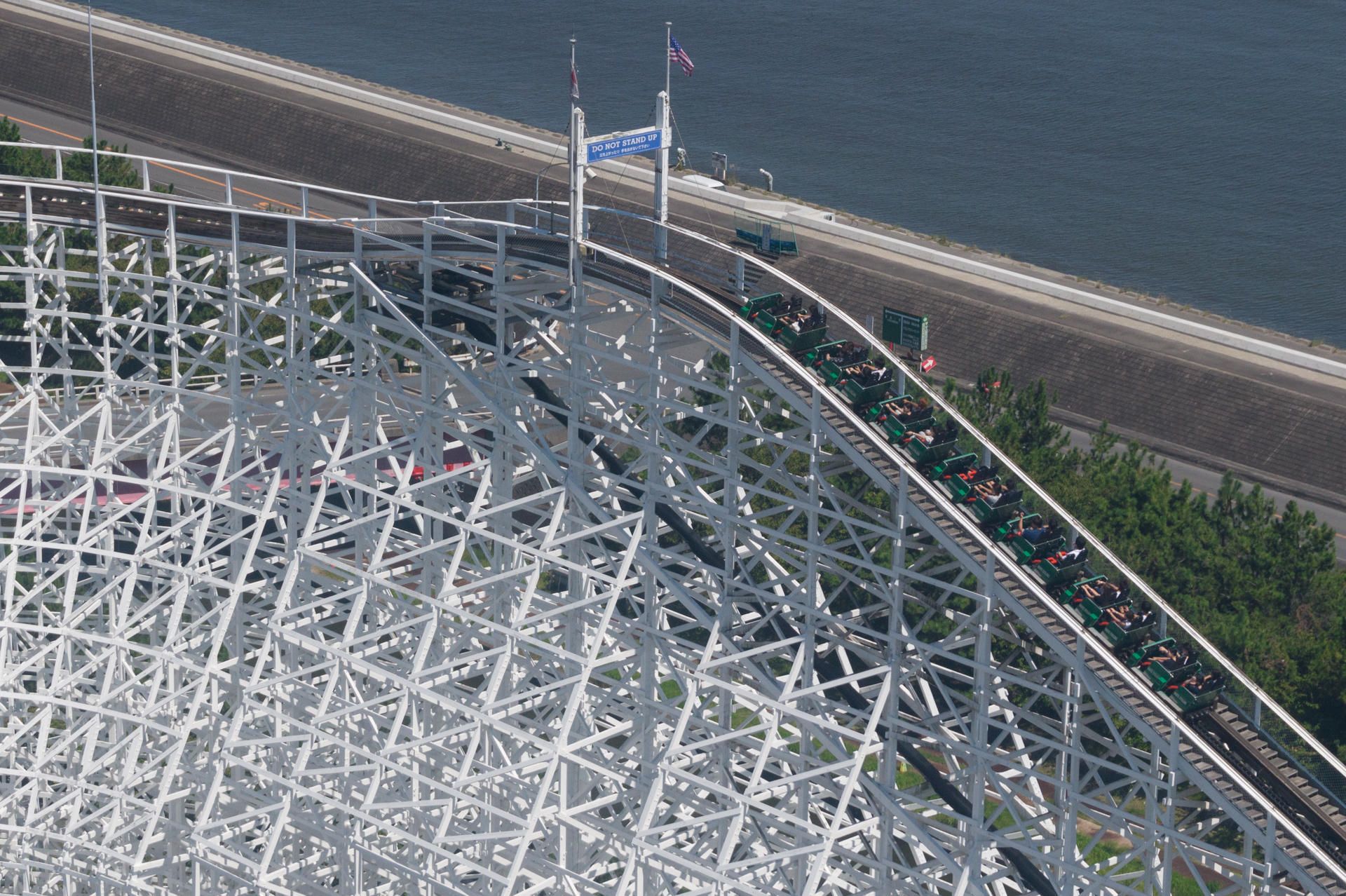
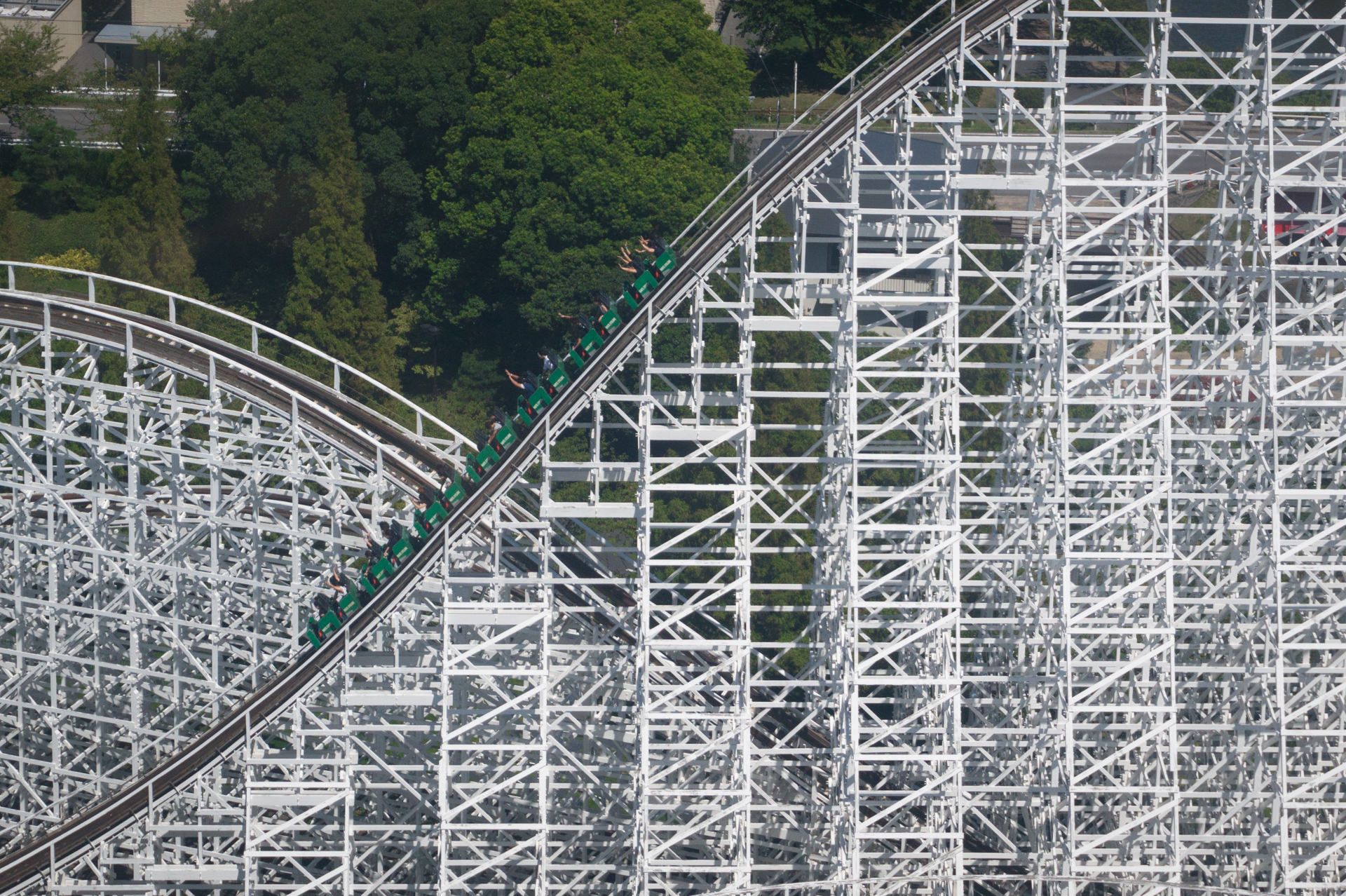
The ride in the PTC trains begins with a wide left turn around the waiting area of the ride. We constantly lose height to gain enough momentum to enter the lift hill. This then takes us to a height of 42 m, where we then have a moment to enjoy the magnificent view of Nagashima Spa Land and Ise Bay. After a left turn, however, we rapidly descend to the ground. With the finest shake, rattle and roll we cross the first valley and then climb a high airtime hill. The exit then leads into a gigantic, constantly tapering helix far above ground level. Here you ride a little over hill and dale until you leave it at some point after a rapid dip over a hill.
The hill in question seems to be almost as high as the entrance to the helix, but based on the existing speed, it shouldn’t actually be the case. Visually an interesting trick in any case and so we plunge down again in a wonderful play of forces. Another airtime hill follows, as it is written in the book, before we disappear in the forest of pillars. In a very wide upward spiral, we now steadily increase in altitude metres before we reach the same kind of helix we already experienced a few moments ago. But instead of diving down briefly and then gaining height, we climb metre by metre up the wooden structure before then reaching the block brake of the ride.
After the fast-paced first part of the ride, the train plunges to the ground again. With gusto we pass under the valley of the first descent, conquer another airtime hill and dive into the wooden structure one more time. Inside the first helix we now go through a wide left turn before we are surrounded by wooden beams again. We then cross the ride over two hills and make our way along the outer edge of the roller coaster. Below the lift hill, the train disappears under the wooden construction for the last time in a wide left turn. Shortly afterwards, we reach the braking section of the ride and soon the station.
White Cyclone was a great wooden roller coaster with great pacing, lots of airtime moments and a well-tuned acceleration curve. In addition, the roller coaster lived on the shake, rattle and roll like hardly any other wooden roller coaster in the country, let alone any other wooden roller coaster I have already ridden. While I can understand that the roller coaster is now undergoing a makeover by the company RMC – because the layout offers many possibilities that have not yet been exhausted – on the other hand it is a pity that one of only four wooden roller coasters in Japan will disappear as a result. At least the basic structure of what was once the best roller coaster in Nagashima Spa Land remains and will be used in the future best roller coaster in the park. So we can be curious!
Pictures Nagashima Spa Land
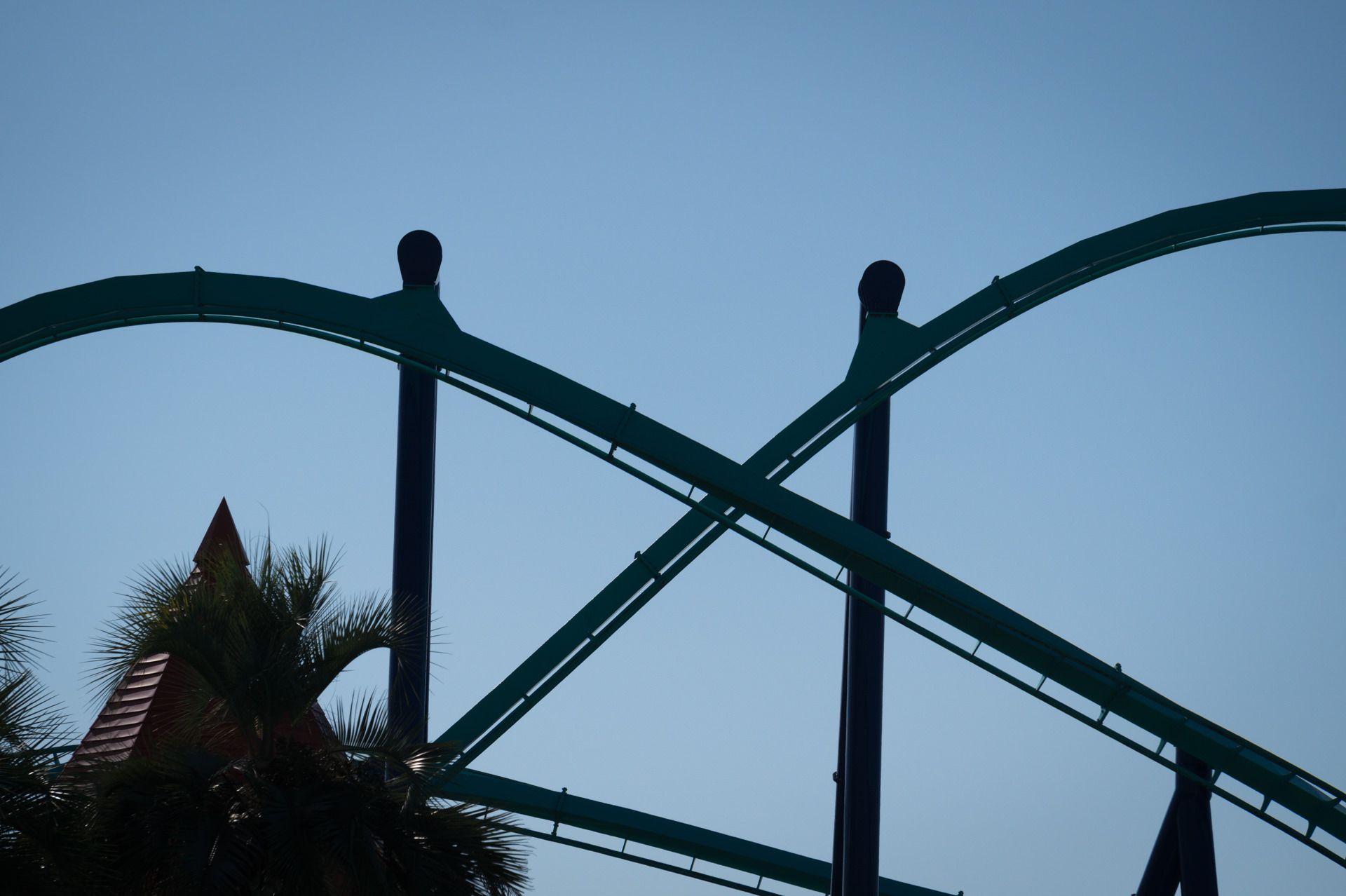
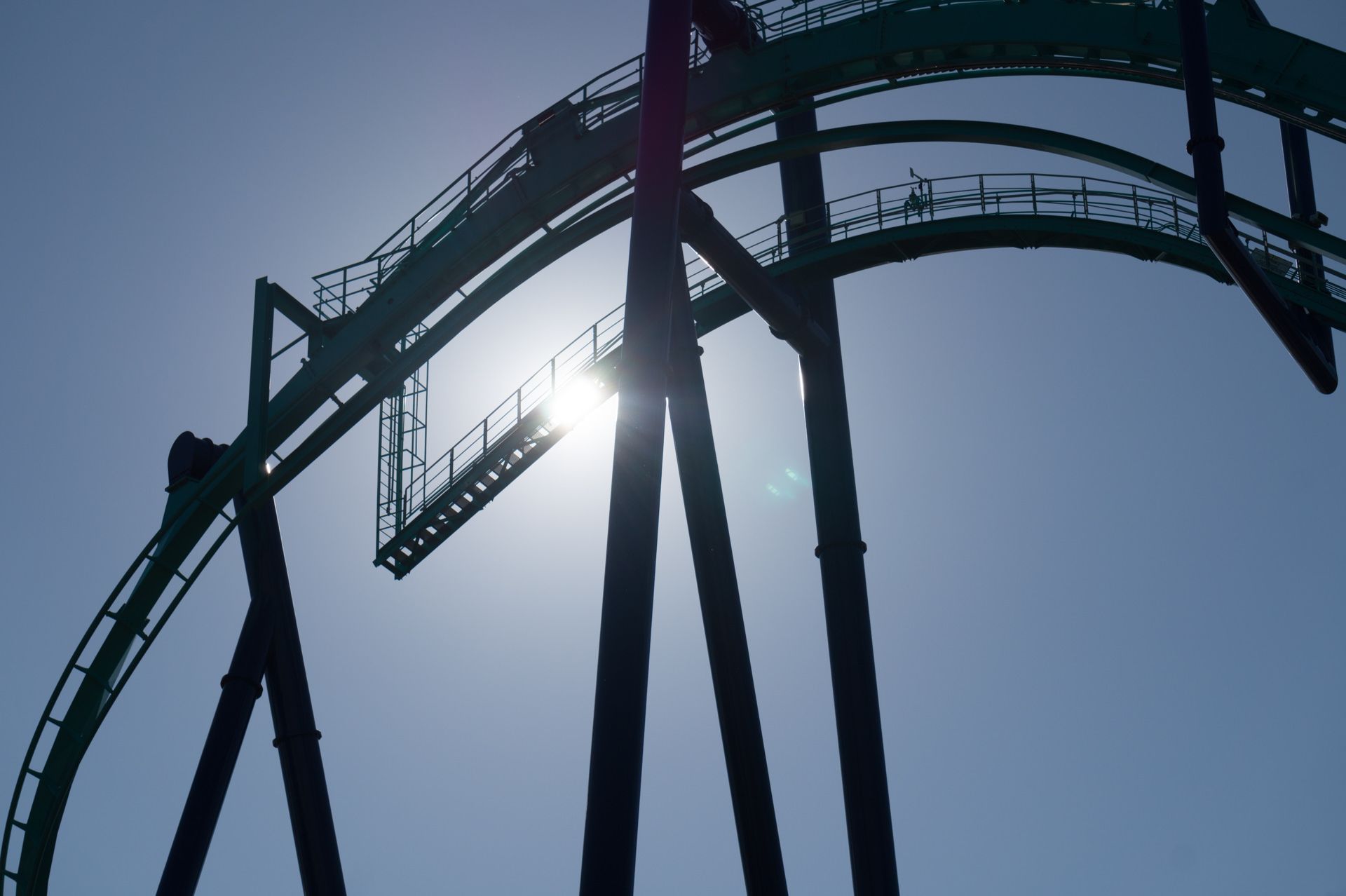
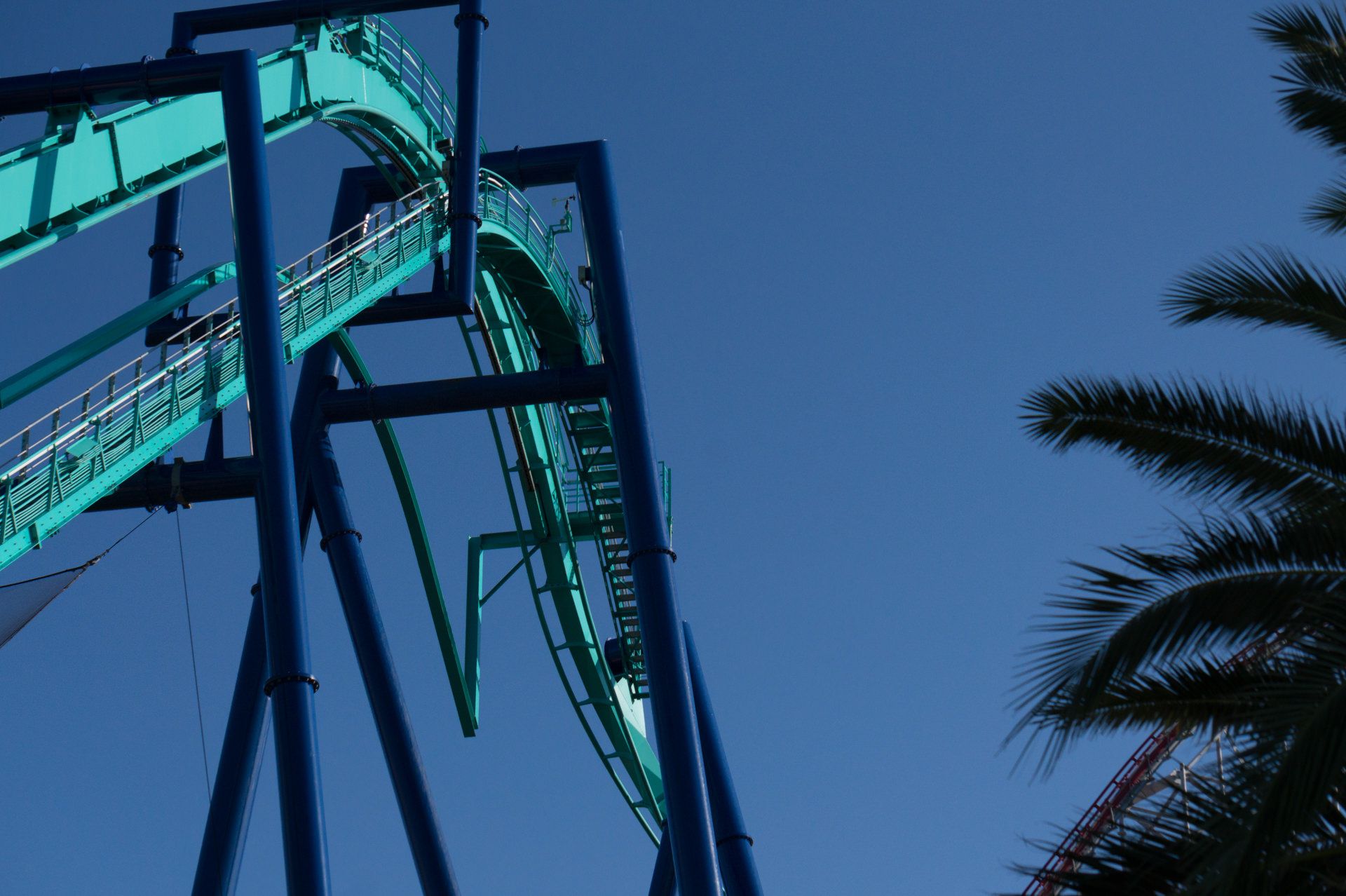


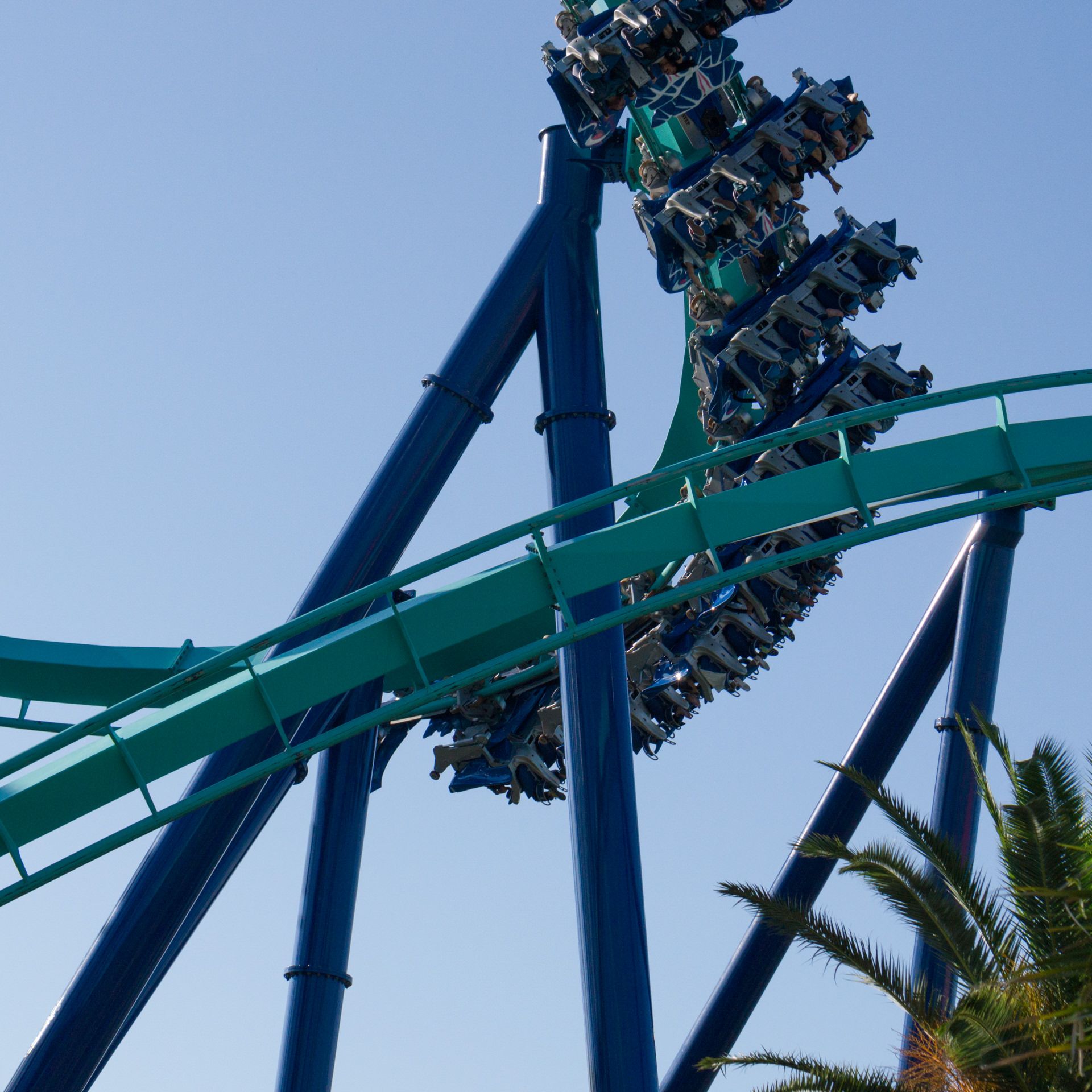















Conclusion Nagashima Spa Land
Nagashima Spa Land is a great amusement park that offers so much in such a large area that you can’t help but be happy. This park simply offers everything possible, which means that every target group is covered – with the exception of dark ride fetishists, of course, because there are simply none of those in the park (outside of the scary walkthrough and a Pokémon attraction). I, at least, was completely thrilled by Nagashima Spa Land, which is why I would gladly return. There are many reasons for this, and the renovation of White Cyclone is yet another. So we’ll see you again sometime, but then with the full programme of onsen, water park, hotel visit and a detour to the nearby gardens.
What is your opinion about the Nagashima Spa Land theme park? Just write it in the comment box below the review or visit our social media channels:
Click here for the next report of the Titanic Max Tour